 Ming Ye
You spent months perfecting your pad thai. You dialed in the sauce ratio, sourced the right noodles, trained your kitchen to plate it in under six minutes. A customer orders it on DoorDash. It arrives in a plain white container, inside a generic brown bag, with a receipt stapled to the outside.
The customer opens the bag. The food is great. But when somebody at the office asks "Where did you get that?" — they cannot remember your name. They check the app. They might reorder. Or they might try the next restaurant that shows up.
Here's the thing: according to restaurant industry data, roughly two-thirds of delivery customers say the packaging influences their perception of food quality. Your container is the only physical touchpoint between your brand and a delivery customer. And right now, most restaurants treat it like an afterthought.
But it gets worse. Every unbranded delivery order is a missed marketing opportunity that you already paid for. You paid for the ingredients. You paid for the labor. You paid the 15-30% commission to the delivery app. And then you sent it out in a box that could belong to any restaurant in town.
This guide shows you how to turn every takeout container, every bag, and every receipt into a brand touchpoint — without spending more than $0.25 per order.
The Hidden Cost of Unbranded Packaging
Let us start with the math that most restaurant owners never run.
Say you do 80 delivery and pickup orders per day. That is 2,400 orders per month. Each one leaves your restaurant and enters a home, an office, a break room — spaces where other potential customers see it.
If your packaging carries your brand, your website, and a reason to order directly next time, each container becomes a tiny billboard with a captive audience. If your packaging is plain, that exposure is worth exactly zero.
And that's not all: the customer retention gap between branded and unbranded packaging is dramatic. Industry research suggests that restaurants with branded delivery packaging see repeat order rates roughly 20-25% higher than those using generic containers. On 2,400 monthly orders, even a 10% improvement in repeat business means 240 additional orders per month. At a $30 average ticket, that is $7,200 in monthly revenue — from packaging.
Compare that to the cost. Branded stickers: $0.03 each. Custom-printed bags: $0.12 each. A bag insert card with a QR code to your own ordering site: $0.05 each. Total per order: about $0.20.
The monthly investment: $480. The monthly return: $7,200. That is a 15:1 ROI — and it compounds, because every new repeat customer becomes a source of future orders.
The 5 Packaging Touchpoints That Matter
Not every element of your packaging carries equal weight. Here are the five touchpoints ranked by impact, with the exact specifications that work.
1. The Bag (Your Billboard)
The bag is the first thing a customer sees and the last thing they throw away. It sits on a desk, a counter, a kitchen table — visible to everyone in the room.
What works: a one-color or two-color logo print on a kraft paper bag. The logo should be large enough to read from three feet away. Include your website URL beneath the logo — not your social media handles, not your phone number. The website. That is where orders happen.
Cost: custom-printed kraft bags run $0.10-$0.18 per bag at quantities of 1,000+. Compare that to the $0.06-$0.08 you are already paying for generic bags. The incremental cost is $0.04-$0.10 per order.
Here's what nobody tells you about delivery app orders: when the customer receives food in a branded bag with your own ordering URL, roughly 30% will bookmark or save that URL for next time. That means their next order comes direct — at zero commission instead of 25-30%. On a $30 order, that is $7.50-$9.00 in savings per converted customer.
2. The Container (Quality Signal)
Generic white foam containers tell customers one thing: this restaurant does not care about the details. The container is the frame around your food. It sets expectations before the first bite.
You do not need custom-molded containers. That is a $10,000+ minimum order that only chains can justify. Instead, choose high-quality stock containers in a distinctive color or material — black containers with clear lids, kraft paper bowls, bamboo fiber boxes — and add a branded sticker or stamp.
The Crafty Crab Seafood approach is instructive. With 19 locations pushing high volumes of takeout seafood, they standardized on black containers with a branded tamper-evident sticker across the lid. The sticker serves triple duty: it signals quality, prevents tampering during delivery, and carries a QR code linking to their direct ordering page. One sticker, three functions.
3. The Bag Insert (Your Secret Weapon)
This is the highest-ROI packaging element, and most restaurants skip it entirely. A bag insert is a card — business card size to postcard size — that rides inside the bag. The customer finds it when they unpack their food.
Now here is where it gets interesting. The bag insert is your chance to do what the delivery apps actively prevent: build a direct relationship with your customer.
An effective insert includes:
- A QR code linking to your own online ordering site — not DoorDash, not UberEats, your own website where you keep 100% of the revenue
- A first-order promo code for direct ordering (e.g., "DIRECT10" for 10% off your first direct order)
- A gift card offer — "Buy a $50 e-gift card, get $10 free" drives both immediate revenue and future visits
- Loyalty program enrollment — "Scan to join rewards: earn 1 point per dollar, redeem at 100 points for $10 off"
- Your social media handle (one, not five)
With KwickOS CRM, you can create unique promo codes for each campaign and track exactly how many bag insert codes get redeemed. You will know the precise ROI of every batch of inserts you print.
Cost: $0.04-$0.08 per card at quantities of 5,000+. That is less than the napkin you are already putting in the bag.
4. The Receipt (Often Overlooked)
Most POS systems print a receipt that lists items and a total. That is a waste of paper and a wasted touchpoint.
Your receipt should include a footer with your loyalty program enrollment link, an e-gift card purchase URL, and a short message: "Order direct at [yoursite.com] and save — no app fees, faster delivery." KwickOS lets you customize receipt footers per order type, so delivery receipts can carry different messaging than dine-in receipts.
5. The Seal (Trust and Tamper Evidence)
Tamper-evident seals became a customer expectation during the pandemic and they are not going away. A branded sticker that seals the bag serves two purposes: it proves the food was not opened during transit, and it puts your logo in the customer's hand one more time.
Round stickers with your logo: $0.02-$0.04 each. Custom die-cut stickers with a branded shape: $0.05-$0.08 each. Either way, it is the cheapest branding investment you will ever make.
The Eco-Friendly Angle: Branding That Pays Twice
Sustainable packaging is not just a feel-good choice — it is a brand differentiator that drives real purchasing behavior.
Industry research consistently shows that a majority of consumers prefer restaurants that use eco-friendly packaging, with a significant portion willing to pay a small premium for it. Among customers under 35, those numbers are even higher.
But here is the pattern interrupt most restaurant owners miss: eco-friendly packaging often costs less per use than you think. Compostable containers run about 15-30% more than standard plastic — but they eliminate waste hauling fees in cities with composting programs, and they qualify for sustainability certifications that unlock catering contracts with corporate offices and universities.
The branding play: print "100% Compostable" on your containers. It costs nothing extra and it gives environmentally conscious customers a reason to choose you over the restaurant down the street that is still using styrofoam.
Tiger Sugar, the bubble tea chain with 2 locations using KwickOS self-ordering kiosks, prints their brand and a "Plant-Based Cup" message on every container. Their customers photograph the cups and post them — free social media marketing driven entirely by packaging. Each Instagram story reaches an average of 200 viewers. That is advertising you could never buy at the price of a cup.
How to Brand Packaging on a Tight Budget
You do not need a $5,000 packaging overhaul. Here is the 3-tier approach, ranked by budget:
Tier 1: Under $200/month (The Starter)
- Branded stickers for bags and containers: $0.03 each x 2,400 orders = $72/month
- Bag insert cards with QR code + loyalty enrollment: $0.05 each x 2,400 = $120/month
- Total: $192/month
This is the minimum viable branding package. The stickers carry your logo and the inserts drive direct orders and loyalty sign-ups. You keep using your existing generic bags and containers — the stickers transform them.
Tier 2: $200-$500/month (The Standard)
- Everything from Tier 1
- Custom-printed kraft bags: $0.14 each x 2,400 = $336/month
- Branded tamper-evident seals: $0.03 each x 2,400 = $72/month
- Total: ~$480/month
This is where most successful delivery-heavy restaurants land. The branded bag is the biggest visual upgrade — it is the difference between "some food arrived" and "Sakura Sushi arrived."
Tier 3: $500+/month (The Premium)
- Everything from Tier 2
- Custom containers in brand colors: $0.08-$0.15 premium per container
- Eco-friendly materials with sustainability messaging
- Seasonal or limited-edition packaging for holidays and promotions
Seasonal packaging — think holiday-themed containers or Valentine's Day gift card inserts — drives social sharing. And when gift card sales spike during holidays, your packaging is the vehicle that delivers the message. An insert reading "Give the gift of [Restaurant Name] — e-gift cards available at [your site]" during November and December can drive thousands in gift card revenue.
Connecting Packaging to Your POS and Loyalty System
Branded packaging without tracking is just decoration. The real power comes when you connect your packaging to your POS system, your loyalty program, and your e-gift card platform.
Here's the thing: every bag insert should carry a trackable element. A unique promo code. A QR code with UTM parameters. A loyalty enrollment link with a source tag. When the customer uses that code to place a direct order, your POS system captures the conversion — and you know exactly which packaging campaign drove it.
With KwickOS, this closed loop works automatically:
- At checkout, the POS prints a receipt with a customized footer based on order type (delivery gets a "direct ordering" message, pickup gets a loyalty enrollment prompt)
- The bag insert carries a QR code linked to your KwickMenu online ordering page with a tracked promo code
- When the customer scans and orders direct, KwickOS captures the source, applies the promo, and enrolls them in your loyalty program automatically
- Future orders earn points toward rewards — creating a repeat cycle that started with a $0.05 card in a bag
T. Jin China Diner uses this exact approach across 15 locations and 75 terminals. Every delivery bag contains an insert with a location-specific QR code. The centralized KwickOS dashboard shows which locations generate the most direct order conversions from packaging inserts — and they double down on what works.
And that's not all. The e-gift card angle is massive for packaging. An insert reading "Send an e-gift card instantly — perfect for birthdays, holidays, or just because" costs $0.05 to print and can generate hundreds in gift card sales. Gift cards carry a built-in return visit: the recipient has to come back to use it. Industry data shows that gift card holders spend an average of 20-40% more than the card value when they redeem.
The Delivery App Problem — And How Packaging Solves It
Let us talk about the elephant in the room. If you are doing delivery through DoorDash or UberEats, you are paying 15-30% commission on every order. On a $30 order, that is $4.50-$9.00 going to the app — not to your restaurant.
Your packaging is the single most effective tool for converting third-party customers into direct customers. But it gets worse for restaurants that do nothing: the delivery apps own the customer relationship. The customer ordered through DoorDash, received food in a generic bag, and their loyalty is to DoorDash — not to you.
Branded packaging with a direct ordering QR code breaks that cycle. The customer sees your brand, scans the code, bookmarks your ordering page, and next time orders direct. You keep the full margin.
Consider the numbers for a restaurant doing 60 delivery orders per day through third-party apps at a $32 average ticket:
| Scenario | Monthly Orders | Commission | Monthly Cost |
|---|---|---|---|
| 100% third-party | 1,800 | 25% | $14,400 |
| Convert 20% to direct | 1,440 app + 360 direct | 25% / 0% | $11,520 |
| Convert 40% to direct | 1,080 app + 720 direct | 25% / 0% | $8,640 |
Converting just 20% of third-party orders to direct saves $2,880/month — $34,560/year. And the primary driver of that conversion? A $0.05 bag insert with a QR code.
With KwickDriver, you can offer your own delivery at $2 flat + $6.99 per 5 miles — a fraction of the 25% commission model. Your bag insert becomes the bridge: "Order direct at [site]. Free delivery on orders over $35."
Real-World Packaging Strategies That Work
Let us look at what actual KwickOS merchants are doing with their packaging.
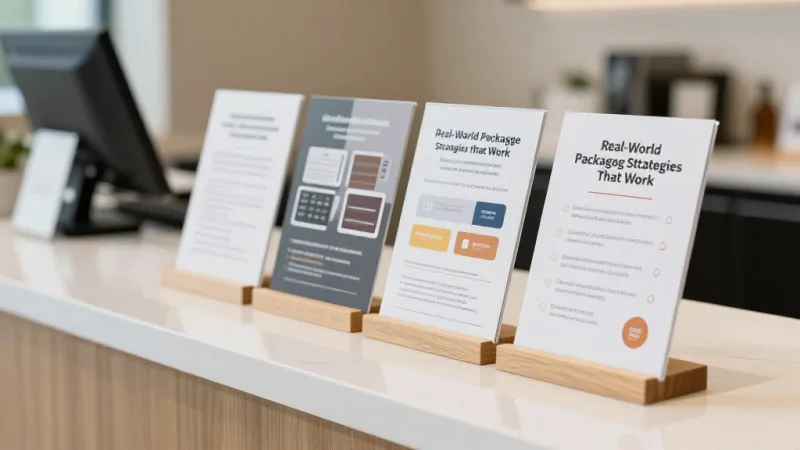
Rockin' Rolls Sushi Express (3 stores, 49 iPad self-ordering stations) uses a two-pronged approach: in-store orders get a branded napkin band with their Instagram handle, while delivery orders get a full bag insert with a direct ordering QR code and a "Join Rockin' Rewards" loyalty prompt. Their direct ordering percentage has grown steadily since implementing the inserts.
Baked Cravings, operating a self-serve kiosk at Lego Land, packages every item in a custom-printed sleeve that doubles as a collectible. Families photograph the packaging with their Lego Land photos and post on social media — turning every $8 cupcake into organic social media reach.
The lesson: packaging branding is not one-size-fits-all. Match your packaging strategy to your customer's behavior. Delivery customers need a reason to order direct. Dine-in customers need a reason to come back. Event and attraction customers need something shareable.
Implementation Checklist: Week-by-Week
Week 1: Audit your current packaging. Count how many touchpoints carry your brand (likely zero or one). Calculate your monthly delivery order volume and average ticket.
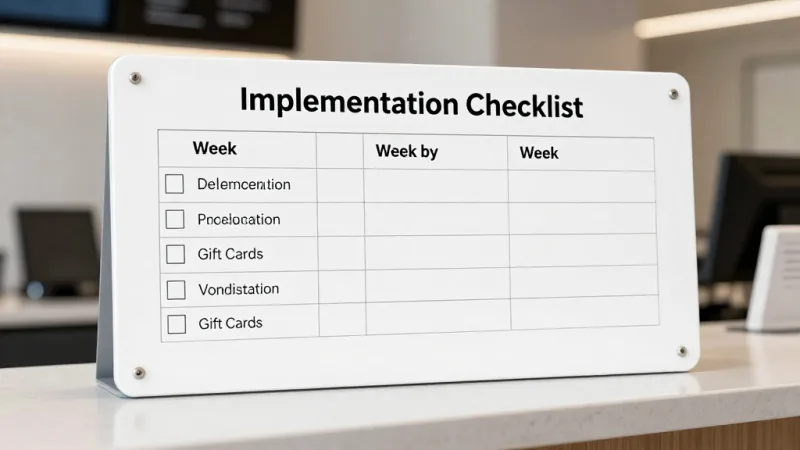
Week 2: Design your bag insert. Include a QR code to your online ordering page, a first-order promo code, loyalty enrollment, and e-gift card offer. Order a test batch of 500 — most online printers deliver in 5-7 days.
Week 3: Order branded stickers and tamper-evident seals. Set up promo code tracking in your POS. If you are using KwickOS, create a specific promo code for the campaign and configure receipt footers for delivery orders.
Week 4: Deploy. Train staff to include an insert in every delivery and pickup bag. Monitor promo code redemptions daily for the first two weeks.
Month 2: Review redemption data. If inserts are converting, order custom-printed bags as the next upgrade. If not, A/B test a different offer — a stronger discount, a gift card bonus, or a loyalty point multiplier.
Use our delivery profit calculator to see exactly how much you would save by converting third-party orders to direct. And check our comparison pages to see how KwickOS stacks up against locked POS systems that charge you commission on every order.
Turn Every Box Into a Billboard
KwickOS connects your packaging to your POS, loyalty program, and direct ordering — so every bag insert, every sticker, and every receipt drives trackable revenue.
Get Your Free Demo