 Tom Jin
A stranger is deciding whether to eat at your restaurant tonight. They have never met you. They will never taste your food before they decide.
Instead, they pull out their phone, type your name into Google, and look at one thing: a number between 1 and 5, followed by a stack of reviews written by people you may not even remember serving.
Here's the thing: that number is doing your selling for you, whether you manage it or not. And right now, for most independent restaurants, nobody is managing it. Reviews pile up. The owner reads them, gets angry at the unfair ones, feels good about the kind ones, and does nothing systematic. Meanwhile, the number quietly sets the ceiling on how many people ever walk through the door.
Let me show you exactly what that number is costing you — and then how to take control of it.
The $47,000 Number Hiding in Your Star Rating
Industry research suggests that a single star of improvement in a restaurant's average rating drives somewhere between 5% and 9% more revenue. That's not a soft branding metric. That's cash.
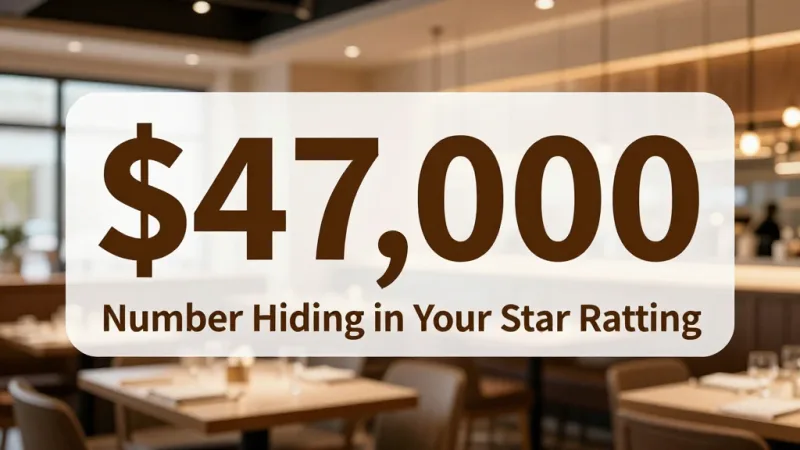
Run the math on a restaurant doing $520,000 a year — a fairly ordinary independent operation. A move from 3.6 stars to 4.6 stars, at the middle of that range, is worth roughly $47,000 in additional annual revenue. Same kitchen. Same menu. Same rent. The only thing that changed was the number strangers see before they decide.
But it gets worse. The damage from a low rating compounds in a way most owners never see, because the customers it costs you never show up to complain. They just quietly pick the place down the street with 4.5 stars instead of your 3.7. You never meet them. You never know they existed. You just feel it as a dining room that's a little emptier than it should be, month after month.
And most diners now read reviews before choosing a restaurant. Your rating isn't a vanity score sitting on a page nobody visits. It is the storefront. It is the host at the door. For a huge share of your would-be customers, it is the entire first impression — formed before they ever see your logo, your patio, or your menu.
So the real question isn't "should I care about reviews?" It's "do I have a system, or am I leaving $47,000 on the table and hoping?"
Step 1: Monitor Everything (You Can't Fix What You Can't See)
You cannot manage a reputation you aren't watching. The first job is simple visibility: know what's being said, where, and how fast.
Here are the platforms that actually move the needle, in order of priority:
- Google Business Profile — The most important, full stop. Google reviews feed directly into Search and Maps, which is where the overwhelming majority of "restaurants near me" decisions happen. If you fix one platform, fix this one first.
- Yelp — Still powerful, especially in dense metros and among diners who plan ahead. Yelp's filtering algorithm can hide your legitimate reviews, so it needs active attention.
- Facebook — Recommendations and star ratings that show up when locals share your page.
- TripAdvisor — Critical if you get tourists or destination diners.
- Delivery apps — DoorDash and Uber Eats ratings quietly determine how high you rank in the app and whether hungry customers ever scroll to your listing.
Set up free Google alerts for your business name, claim every listing, and check them on a fixed schedule — not "when you remember." The multi-location operators we work with, like Crafty Crab Seafood (19 stores, 152 terminals) and T. Jin China Diner (15 stores, 75 terminals), treat review monitoring as a daily operational metric, the same way they watch food cost or labor. One weak location can drag down an entire brand's perception, so they catch problems at the store level before the average moves.
Quick gut check: when was the last time you looked at your Google rating? If the answer is "a few weeks ago," you already have your first assignment.
Step 2: Respond to Negative Reviews Like a Professional
This is where most owners lose money — not by getting a bad review, but by handling it badly.
Remember who you're actually writing for. You are not writing to the angry customer. That ship has sailed. You are writing to the hundreds of future customers who will read that exchange while deciding whether to trust you. A calm, specific, generous response to a harsh review can win you more business than the review ever cost you.
Here's the framework I give every operator. Respond within 24 to 48 hours, and follow four steps:
- Thank them. "Thank you for taking the time to share this." It disarms, and it signals maturity to every reader.
- Acknowledge the specific issue. Name the actual problem — the cold soup, the 40-minute wait, the rushed server. Generic apologies read as scripted. Specific ones read as sincere.
- Apologize without excuses. "That is not the experience we want anyone to have, and I'm sorry it happened to you." No "but we were slammed that night." Excuses tell future readers you'll blame them too.
- Move it offline. "I'd genuinely like to make this right — please reach out to me directly at [email/phone]." This shows accountability and gets the emotional back-and-forth off the public page.
Here's a response template you can adapt today:
"Hi [Name], thank you for letting us know about your visit on Saturday. You're right that a 45-minute wait on a slow night is not acceptable, and I'm sorry we let you down. That's on us, not on you. I'd like to understand what happened and make it right — please email me directly at owner@yourrestaurant.com. — Tom, Owner"
Notice what that response does for the next reader: it makes the owner look human, accountable, and fair. A prospective diner who sees that thinks, "If something goes wrong, this place will take care of me." That's worth more than the one star you lost.
And here's the part that turns reputation management into revenue: when you win a wronged guest back, close the loop with a tangible gesture. An e-gift card for their next visit, sent straight to their phone, does two things at once — it apologizes with something real, and it books a future visit. A guest who returns and has a great second experience frequently updates their review. You didn't just neutralize a negative; you manufactured a positive.
Step 3: Turn Negative Reviews Into Operational Fixes
Now let's talk about the thing almost nobody does: treating reviews as free consulting.
Every complaint is a data point. One angry review is an opinion. Five reviews mentioning slow service on weekends is a staffing problem with a dollar sign attached. Ten reviews mentioning the same overpriced dish is a menu-pricing signal. Your reviews are the most honest customer survey you will ever get, and it's free.
This is where your POS data becomes a superpower. When you can cross-reference the complaint against what actually happened, patterns snap into focus:
- "The wait was insane" → Pull ticket times from your POS for that daypart. Is your kitchen consistently slow after 7 p.m.? That's a prep or staffing fix, not a personality flaw.
- "They got my order wrong" → Are order errors clustered on certain shifts or terminals? A POS with clear, routed checkout tickets and fingerprint employee login tells you exactly who rang what, so you can coach the right person instead of guessing.
- "Cold food" → A kitchen display system that timestamps every ticket shows whether food is sitting under the pass too long before it's run.
KwickOS runs POS, kitchen display, and CRM as one connected system, which means the story behind a bad review is usually sitting in your own data — you just have to look. Shogun Japanese Hibachi used customized station displays to get new operators up to speed in under five minutes; the same visibility that speeds up training is what surfaces the operational cracks reviews are complaining about.
Fix the root cause, and the reviews change on their own. That's the whole game: reputation isn't spin, it's operations made visible.
Step 4: Handle Fake and Malicious Reviews Without Losing Your Mind
Not every one-star review is honest. Some are competitors. Some are people who were never customers. Some are extortion — "give me a free meal or I'll trash you online." And some are just cruel.
But here's the trap: the natural human response — firing back an angry public reply — is the single worst thing you can do. It makes you look unhinged to every future reader, regardless of who was right.
Do this instead:
- Flag it through the platform. Google, Yelp, and Facebook all have official tools to report reviews that violate policy — reviews from non-customers, hate speech, profanity, obvious competitor sabotage, or extortion. Use the tool, not the reply box.
- Document everything. Screenshot the review, note dates, and check your POS records — if the "customer" describes an order you have no record of, that's evidence the review is fake.
- Respond calmly and factually, once. "We have no record of this visit and take feedback seriously. If you were a guest, please contact us directly so we can look into it." That single measured line tells every future reader the review is suspect, without you throwing a punch.
- Escalate only if it's defamatory. For genuinely damaging false claims, consult an attorney — but 95% of cases resolve through the platform's process. Don't nuke a fly.
Removal isn't guaranteed and can take days or weeks. The discipline is patience: a fake review buried under twenty recent genuine five-star reviews does almost no damage. Which brings us to the most important step of all.
Step 5: Go on Offense — Build a Review-Generating Machine
Everything so far has been defense. Defense keeps you from bleeding. Offense is how you win.
The single most powerful move in reputation management isn't responding to bad reviews — it's drowning them in genuine positive ones. A restaurant that collects fifteen honest five-star reviews a month never has to fear the occasional one-star, because it's mathematically invisible against the tide. And volume plus freshness is exactly what Google's algorithm rewards.
Here's the secret most owners miss: your happiest customers would leave a review — they just forget the moment they walk out the door. Your job is to ask them at the peak of their happiness and make it take five seconds.
This is where your POS stops being a cash register and becomes a marketing engine. With a system like KwickOS, where checkout, CRM, and messaging live together, you can automate the entire loop:
- Trigger at checkout. When a guest pays and the ticket closes clean, the system can automatically text or email a one-tap Google review link a few hours later — while the meal is still a warm memory.
- Trigger on loyalty and gift cards. A customer who just enrolled in your loyalty program, earned points, or redeemed an e-gift card is, by definition, engaged and happy. Those are your best review candidates — ask them.
- Route the unhappy ones privately first. The smartest setups ask "How was everything?" first. Happy guests get pointed to Google; unhappy guests get pointed to a private feedback form that reaches the owner — so you fix the problem before it becomes a public one-star.
One caution: never buy reviews or pay for them. It violates every platform's policy and can get your listing penalized or wiped. The goal is to remove friction for genuinely happy customers, not to fabricate praise.
Diva Nail Beauty (4 locations) leaned on automated, POS-triggered follow-ups after service, tied into their membership and points program, and turned a steady stream of quiet, satisfied clients into a steady stream of public five-star reviews — the same efficiency mindset that gave them a 90% jump in back-office productivity. The reviews were always available; they just needed a system to ask.
Want to see what a rating change is worth for your specific volume? Run your numbers through our free restaurant calculators, and if you're weighing platforms, our comparison guides break down which systems actually connect checkout to customer follow-up.
Where Gift Cards and Loyalty Fit Into Reputation
Reputation isn't only about damage control — it's about building a base of customers so loyal they defend you.
A well-run loyalty and membership program creates repeat guests, and repeat guests write dramatically warmer reviews than one-time visitors. They know your name, they forgive an off night, and they mention specific dishes and staff by name — the kind of detailed, credible review that convinces strangers. Gift cards and e-gift cards pull in fresh customers (someone else vouched for you by buying the card) while giving you a natural, non-awkward moment to ask for a review once the card is redeemed at checkout.
Tie it together and the flywheel spins: great experience → loyalty enrollment or gift-card redemption at the POS → automated review request → more five-star reviews → higher rating → more new customers → more loyalty members. That's not five disconnected tactics. On a unified platform, it's one machine — and it's the machine your competitors on locked, single-purpose systems can't easily build.
The Bottom Line
Your online reputation is not a soft, fuzzy branding concern you can get to "someday." It is a hard number, visible to every future customer, worth as much as $47,000 a year in real revenue — and it's either being managed or being neglected. There is no middle.
The good news: managing it doesn't require a full-time marketing hire. It requires a system. Monitor the platforms that matter, respond to criticism like a professional, mine complaints for operational fixes, handle fakes with patience instead of fury, and — above all — put your POS to work quietly generating a steady flow of genuine positive reviews from the happy customers you already have.
Defense keeps the number from falling. Offense makes it climb. Do both, and you'll never again let a stranger's phone talk them out of a table you worked so hard to fill.
Turn Every Happy Customer Into a 5-Star Review
KwickOS connects checkout, loyalty, gift cards, and automated review requests in one platform — so your best moments turn into your best marketing. See how it works.
Explore KwickOS for Restaurants
Frequently Asked Questions
How much is a restaurant's online reputation actually worth?
Industry research suggests a one-star improvement in a restaurant's average rating can lift revenue by 5% to 9%. For a restaurant doing $520,000 a year, moving from 3.6 to 4.6 stars can be worth roughly $47,000 in additional annual revenue. Because most diners read reviews before choosing where to eat, your rating functions like a price tag that every potential customer sees before they walk in.
How quickly should I respond to a negative restaurant review?
Aim to respond within 24 to 48 hours. A fast, calm, specific response signals to every future reader that you take service seriously. Speed matters more than perfect wording: the review is public, and prospective customers are reading your response as much as the complaint. Thank the guest, acknowledge the specific issue, apologize without excuses, and move the detailed resolution offline with a direct contact.
Can I get a fake or defamatory review removed?
Sometimes. Google, Yelp, and Facebook all allow you to flag reviews that violate their policies — reviews from people who were never customers, reviews with hate speech or profanity, obvious competitor sabotage, or extortion attempts. Removal is not guaranteed and can take days to weeks. Report the review through the platform's official flagging tool, document everything, and never respond emotionally in public. If a review is truly defamatory, consult an attorney, but most disputes are resolved through the platform's process.
What is the best way to get more positive reviews?
Ask happy customers at the moment of peak satisfaction, and make it effortless. The most reliable method is to trigger a review request automatically at checkout or right after a great experience — a POS with built-in CRM can text or email a one-tap review link to guests who paid, enrolled in loyalty, or redeemed a gift card. Never buy reviews or offer payment for them, which violates platform policies and can get your listing penalized.
Which review platforms matter most for restaurants?
Google is the single most important platform because it feeds Search and Maps, where most local discovery happens. Yelp still carries weight, especially in larger metros. Facebook, TripAdvisor, and delivery-app ratings (DoorDash, Uber Eats) matter depending on your customer base. Focus your energy on Google first, then Yelp, then the platforms your specific customers actually use.