 Tom Jin
You opened your second location because the first one was working. Then a third. Then somewhere between the fifth and the eighth, it stopped feeling like growth and started feeling like chaos.
You've got twelve managers each ordering from their own vendors. Twelve versions of the menu, none of them quite matching. Twelve payroll runs, twelve inventory counts, twelve sets of numbers that don't arrive until the 15th of the following month — by which point the money is already gone.
Here's the thing: you can feel the leak, but you can't see it. Somewhere in that sprawl, one location is paying 40% more for the same case of chicken than the store six miles away. Somebody's comping meals off the books. A price increase from your produce supplier hit eight stores three weeks ago and nobody noticed.
And it gets worse. The obvious solution — hire a corporate team, roll out one rigid system, make every store do it exactly the same way — is how good restaurant groups turn into soulless chains. The neighborhood spot that people loved becomes "location #7," the local specials disappear, the regulars stop coming, and the numbers you were trying to fix get worse instead of better.
So here's the real question, and it's the one this entire article answers: How do you get the cost control, visibility, and standardization of a centralized operation — without stripping away what makes each restaurant feel local?
The answer isn't more control. It's the right kind of control. Let me show you exactly where the line goes.
The Rule That Makes Everything Else Work: Centralize the Invisible, Localize the Visible
Before we get into purchasing, HR, or reporting, you need one principle to guide every decision. Get this wrong and you'll either stay chaotic or become a chain. Get it right and you scale cleanly.
The rule is simple: centralize everything your customer never sees, and localize everything they experience.
Your customer doesn't see your vendor contracts, your payroll processor, your loyalty program's back-end, or your reporting standards. Those should be identical and centrally controlled across all locations — that's where scale creates savings and consistency.
Your customer absolutely sees the menu, the prices, the specials, the staff, and the vibe. Those should stay flexible, adjustable by each location within guardrails corporate sets. That's where local identity lives.
A restaurant group operating on this rule looks like this: corporate negotiates a national chicken contract every store buys from (invisible → centralized), but the Houston location keeps its Cajun seasoning blend while the Dallas location runs a lemon-pepper special (visible → localized). One master loyalty program spans all twelve stores so a customer earns points anywhere (invisible back-end → centralized), but each store designs its own community events and neighborhood promos (visible → localized).
Every section below is just an application of this one idea. Keep it in your head.
Centralized Purchasing: Where the Biggest Money Hides
Let's start with the single largest opportunity, because it's usually the one bleeding the most.
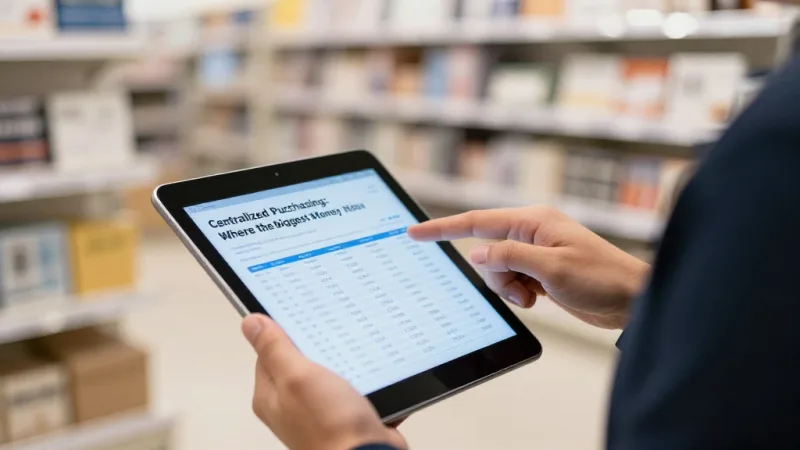
When each location orders independently, you lose on three fronts at once. First, you lose volume pricing — twelve stores buying separately never negotiate like one buyer purchasing twelve times the volume. Second, you get price drift, where one manager's "trusted vendor" is quietly charging 15–40% more than another store pays for the identical product. Third, you get rogue ordering, the off-contract purchases nobody approved that never show up until you're reconciling invoices.
Consolidate purchasing onto one platform and the math changes fast. Groups that centralize vendor contracts and buy on combined volume typically cut food and supply costs by 3 to 8 percent. That range sounds modest until you run it against real numbers:
| Group Size | Annual Food/Supply Spend | 4% Savings | 7% Savings |
|---|---|---|---|
| 5 locations | $2,500,000 | $100,000 | $175,000 |
| 12 locations | $6,000,000 | $240,000 | $420,000 |
| 19 locations | $9,500,000 | $380,000 | $665,000 |
That's $240,000 a year on a 12-store group — for a change that requires no new customers, no new menu items, and no additional labor. It's pure margin you were already leaking.
But — and this is the localize-the-visible part — centralized purchasing doesn't mean every store cooks the identical menu. It means every store buys approved products from approved vendors at negotiated prices. The Cajun location still orders its specialty spices; it just orders them through the system, on contract, with the price visible to corporate. You get the savings and the control without dictating the recipe.
This is exactly how T. Jin China Diner runs 15 stores across 75 terminals — real-time remote monitoring of what every location is ordering and selling, from one screen, without a corporate buyer having to phone each store. And it's how Crafty Crab Seafood coordinates purchasing and one-click menu sync across 19 stores and 152 terminals while each location still customizes its kitchen display for special requests.
Unified Reporting: The 2 AM Number Check That Ends the Guessing
Here's a pattern I've watched destroy otherwise-healthy groups: decisions made on data that's three weeks old.
When your P&L for each store lands on the 15th of the following month, you're not managing — you're doing an autopsy. The overpour that started in week one ran for six weeks before you saw it. The location whose labor cost crept from 28% to 34% did it in the dark. By the time the report confirms the problem, you've already eaten two months of it.
Unified reporting flips this. One dashboard, every location, updated as the day happens. You check sales, labor percentage, void counts, and food cost from your phone at 2 AM if you want to — because the data is live, not archived.
And that's not all. The real power of unified reporting isn't seeing each store; it's comparing them. When all twelve locations report to the same standard, outliers scream at you:
- The labor outlier. Eleven stores run 29% labor; one runs 36%. Now you know exactly where to look — and it took ten seconds, not a month.
- The void abuser. One location's void rate is triple the group average. That's either a training problem or a theft problem, and you found it this week instead of at tax time.
- The hidden star. One store's dessert attach rate is double everyone else's. What are they doing at the register? Bottle that and roll it out to the other eleven.
This is only possible because the data comes from one system. When each store runs different software — or worse, different POS vendors from different acquisitions — you spend more time reconciling formats than actually managing. A single platform across all locations is what turns twelve piles of data into one decision engine. Want to model what tighter labor and food targets do to your bottom line? Our restaurant profit margin calculator lets you run the scenarios before you roll them out.
Shared HR, Payroll, and Compliance: One System, Many Stores
People are your second-largest cost after food, and across a group they're also your largest compliance risk. Twelve locations means twelve chances for a wage-and-hour mistake, a mispunched clock, or an unauthorized manager comp.
Centralizing HR doesn't mean corporate hires every dishwasher. It means the systems around your people are shared: one payroll integration, one time-and-attendance standard, one set of scheduling rules, one identity check.
This is where KwickOS does something most platforms simply can't. Employee verification runs on fingerprint authentication — 1:N and 1:1 — not a four-digit PIN that gets shared, texted, and abused. When a clock-in requires an actual fingerprint, buddy punching stops. Across a twelve-store group where even a few minutes of padded time per shift compounds into real money, closing that gap centrally protects the whole organization at once. (Toast, for the record, doesn't support fingerprint at all.)
Cross-location scheduling matters here too. When a server calls out in one store and a qualified employee two locations over has open availability, a unified system can surface that in seconds. Managing 152 employees across 19 stores from one dashboard — the way multi-location operators do on KwickOS — is only possible when HR, attendance, and scheduling live on the same platform your registers do.
For a deeper dive on the staffing side of this, we wrote a full guide on managing staff across multiple locations.
Local Menu Flexibility: The Part That Keeps the Soul
Now for the half of the equation most centralization projects get catastrophically wrong.
The temptation, once you've built a beautiful central dashboard, is to standardize the menu too. One master menu, one price, every store identical. It feels clean. It feels controlled. And it's often exactly how a beloved local group becomes a forgettable chain.
The right architecture gives you a master menu with local override. Corporate maintains the core catalog and can push a brand-wide change — a new item, a recipe update, a seasonal LTO — to all twelve stores with a single click. But each location can:
- Carry local-only items the neighborhood loves (the dish that would never sell in another market but packs the house here).
- Adjust prices to its actual market — a downtown store and a suburban store shouldn't charge the same, and forcing them to leaves money on one table and customers walking away from the other.
- Run its own specials and community promotions without waiting for corporate sign-off on every $2 discount.
Crafty Crab's 19 stores share a synced menu backbone yet each customizes the kitchen experience for local demand. That's the model: consistency where it creates trust, flexibility where it creates connection. Menu design itself is worth getting right — our guide on multi-location menu management walks through the one-click sync workflow in detail.
The checkout experience deserves the same treatment. Your POS checkout flow should be consistent enough that an employee trained at one store can work a register at any store on day one — Shogun Japanese Hibachi gets new operators proficient in under five minutes precisely because the flow is standardized. But the payment side stays flexible: because KwickOS is processor-agnostic, each location can even keep its own merchant account and negotiated processing rate while still reporting into the same central dashboard. You standardize the experience without locking every store into one payment vendor's rates.
Gift Cards and Loyalty: The Program That Should Span Every Store
If there's one thing that should be aggressively centralized — invisible back-end, remember — it's your gift card and loyalty program. And it's the one groups most often fumble by letting each store run its own.
Think about what a customer expects from a group: buy a gift card at the downtown location, redeem it at the suburban one. Earn loyalty points on Tuesday's lunch, burn them on Friday's dinner across town. When gift cards and points are trapped in per-store silos, you break that expectation and you look small — the opposite of the point of being a group.
A unified program turns your whole footprint into one ecosystem:
- Group-wide gift cards and e-gift cards. One balance, redeemable anywhere. Digital gift cards sell especially well online and travel between locations effortlessly — a customer buys one as a present, the recipient redeems it at whichever store is closest to them.
- A single loyalty and points wallet. Members accumulate and redeem across every location, so the more stores you have, the more valuable membership becomes. That's a network effect working in your favor.
- Centralized promotions with local targeting. Corporate runs a brand-wide double-points weekend; an individual store layers a neighborhood-only offer on top. Centralized engine, localized reach.
The financial upside is real: a shared loyalty program measurably lifts repeat-visit frequency, and gift cards bring in prepaid revenue plus breakage on top. Running that program from one platform — rather than stitching together twelve store-level punch cards — is the difference between a loyalty program that grows with you and one that fragments as you scale.
The Architecture That Makes This Possible: Hybrid Local + Cloud
Everything above depends on one technical foundation, and it's worth being explicit about it because it's where a lot of platforms quietly fail.
Centralization implies "cloud" — one central brain. But a pure-cloud restaurant system has a fatal flaw for a multi-location group: when the internet drops at a store, that store goes dark. No orders, no checkout, no register. Multiply that risk across twelve locations and you're guaranteeing outages somewhere every month.
KwickOS runs a hybrid local-plus-cloud architecture. Each location operates on local hardware with roughly 1ms latency — so registers are fast and, critically, keep working even if the connection to headquarters drops. The store keeps taking orders, checking out customers, running gift cards, and printing kitchen tickets. When the internet returns, that location's sales, labor, and inventory data sync back to the central dashboard automatically.
That's the quiet magic of doing centralization right: corporate gets one live view of all twelve stores, and each store keeps running no matter what happens to its connection. You get the visibility of the cloud and the reliability of local — instead of choosing one and paying for it in the other.
If you're weighing this against the platform you have now, our KwickOS vs Toast comparison breaks down the processor freedom, offline reliability, and fingerprint verification differences that matter most at scale.
A 90-Day Playbook to Centralize Without the Chaos
You don't flip a switch and centralize twelve stores overnight. Here's the sequence that works:
- Days 1–15: Instrument, don't change. Get every location reporting into one dashboard first. Change nothing operationally. Just start seeing — because you can't fix what you can't measure, and the outliers will reveal themselves in the first two weeks.
- Days 15–45: Centralize purchasing. This is your biggest, fastest win. Consolidate vendor contracts, move all ordering onto the platform, kill rogue purchasing. Bank the 4–8% before you touch anything customer-facing.
- Days 45–75: Unify people systems. Standardize time-and-attendance (fingerprint verification), payroll integration, and cross-location scheduling. Roll out your group-wide gift card and loyalty program here.
- Days 75–90: Set menu guardrails, then let go. Establish the master menu and the rules for local overrides — then explicitly hand local menu, pricing, and promo authority back to your operators. This last step is what protects the soul. Do it deliberately.
Notice the order: you centralize the invisible first (reporting, purchasing, HR), and the very last thing you do is guarantee local flexibility on the visible stuff. That sequence is the whole strategy in miniature.
The Bottom Line
The groups that scale well aren't the ones with the most corporate control. They're the ones that drew the line in the right place — ruthless standardization on the back office, genuine freedom on the storefront.
Centralize purchasing and you claw back hundreds of thousands a year. Unify reporting and your outliers surface in seconds instead of months. Share HR and you close the compliance and time-theft gaps that multiply with every location. Run one gift card and loyalty program and your footprint becomes a network instead of a scattering of silos. And through all of it, keep the menu, the prices, and the promotions local — because that's the part your customers actually fell in love with.
Haidilao runs 600+ locations worldwide on exactly this balance of central consistency and local responsiveness. The tools that make it possible aren't reserved for giants anymore. A 5-store group can run the same architecture a 600-store group does — one dashboard, real-time visibility, local flexibility, and a system that keeps every register running even when the internet doesn't.
That's not centralization at the expense of identity. That's centralization in service of it.
Run Your Whole Group From One Dashboard
KwickOS gives multi-location operators real-time visibility across every store — centralized purchasing, unified reporting, fingerprint HR, and group-wide loyalty — while each location keeps its own menu, prices, and soul. See it on your own numbers.
Get My Free DemoFrequently Asked Questions
What does centralized restaurant group management actually mean?
Centralized management means running purchasing, HR, pricing rules, and reporting from one dashboard that sees every location in real time, while still letting each store keep its own menu, local specials, and staffing. The goal is to standardize the back office — contracts, payroll, food cost, compliance — without forcing every location to look and feel identical. A hybrid POS platform makes this possible by syncing data centrally while running each store locally, so it keeps working even when the internet drops.
How do restaurant groups centralize without losing each location's identity?
The rule of thumb is: centralize the invisible, localize the visible. Purchasing contracts, payroll, gift card and loyalty programs, and reporting standards are centralized because customers never see them. The menu, pricing, specials, and local promotions stay flexible per location because that is what customers experience. On KwickOS, corporate sets guardrails — approved vendors, base recipes, brand-wide loyalty — while each store adjusts its own menu and price tier within those guardrails.
How much can a restaurant group save by centralizing purchasing?
Groups that consolidate vendor contracts and negotiate on combined volume typically cut food and supply costs by 3 to 8 percent. For a 12-location group buying $6 million a year in food, even a 4 percent reduction is roughly $240,000 back to the bottom line annually. The savings come from volume pricing, eliminating rogue local ordering, and catching price creep through unified reporting instead of 12 separate spreadsheets.
Can each location keep its own menu and prices on a centralized system?
Yes. On a well-designed platform, corporate maintains a master menu and pushes brand-wide changes with one click, but individual locations can carry local items, adjust prices to their market, and run their own specials. Crafty Crab Seafood runs 19 stores on KwickOS with one-click menu sync while still customizing per location. The point of centralization is control and visibility, not forced uniformity.
Does centralized management work if the internet goes down at one store?
On a cloud-only system, an internet outage can stop a location from taking orders. KwickOS uses a hybrid local-plus-cloud architecture: each store runs on local hardware with about 1ms latency and keeps taking orders, checking out customers, and printing tickets even when the connection drops. Once the internet returns, that location syncs its sales, labor, and inventory data back to the central dashboard automatically.