 Tom Jin
You have a customer who visits your restaurant twice a week. She spends $35 each time. That is $3,640 a year in revenue — and roughly $91 in credit card processing fees going straight to your processor.
Now multiply that by 200 regular customers.
That is $18,200 a year in processing fees from people who already love your business. People who would happily pay you upfront if you gave them a reason to.
Here's the thing: a prepaid bonus credit program gives them that reason. "Load $100, get $120" is not a discount — it is a psychological trigger that converts casual customers into committed ones, collects cash before you serve a single plate, and eliminates processing fees on every prepaid transaction.
And that's not all: according to restaurant industry data, prepaid bonus programs see acceptance rates near 89% when offered at the register with a well-trained staff prompt. The customer feels like they are winning. You are the one who actually wins.
This guide breaks down exactly why bonus credit programs work, how to design tiers that maximize uptake without destroying margins, and the specific math behind every dollar you load.
Why Bonus Credit Triggers an Instant "Yes"
The power of "Load $50, Get $60" is not about the $10. It is about how the human brain processes perceived value.
Three psychological principles converge to make bonus credit programs nearly irresistible:
1. The Endowment Effect
The moment a customer loads money onto a prepaid account, that balance becomes theirs. They do not think of it as money they spent — they think of it as money they have. And people spend "their" stored balance more freely than cash or credit. Industry research suggests that prepaid account holders spend 23-35% more per visit than cash or card customers because the pain of payment has already happened.
2. Free Money Framing
The bonus credit feels like a gift, not a discount. "Get $10 free" activates a different part of the brain than "Save $10." Gifts trigger reciprocity — the customer feels obligated to use it, to come back, to engage with your business. A 10% discount on a $50 purchase saves the customer $5. A $10 bonus on a $50 load gives the customer $60 in spending power. The math is similar. The psychology is completely different.
But it gets worse for your competitors who do not offer this: your customer now has $60 sitting in your account. When they think about lunch, they are not choosing between your restaurant and the one next door. They are choosing between using their balance or "wasting" money somewhere else.
3. Sunk Cost Commitment
Once a customer has loaded $100 onto their account, they are committed. They will not try a competitor when they have unspent balance with you. This is the same psychology that keeps gym members going even when they don't feel like it — they already paid, so they show up. Every dollar on that prepaid account is a gravitational pull back to your business.
The Breakeven Math Every Business Owner Needs
Before you worry about "giving away" money, let us run the actual numbers.
Assume a customer loads $100 and receives a $20 bonus (20% bonus tier). You gave away $20 in credit, right? Not exactly.
| Factor | Value | Explanation |
|---|---|---|
| Bonus credit given | $20.00 | Face value of the bonus |
| Actual cost of bonus (at 32% COGS) | $6.40 | You only spend your cost-of-goods on the bonus, not the full retail price |
| Processing fee savings (2.8% on $120) | $3.36 | No credit card fees on prepaid balance transactions |
| Breakage (12% unredeemed) | $14.40 | Industry average: 10-15% of stored value goes unredeemed |
| Incremental spending (23% lift) | $27.60 | Prepaid customers spend more per visit |
| Net benefit to business | +$38.96 | You profit even with a 20% bonus |
Read that last line again. A 20% bonus that looks like you are giving away $20 actually nets you nearly $39 in additional value when you account for reduced cost basis, processing savings, breakage, and incremental spending.
This is why every major chain — from Starbucks to Panera — runs prepaid bonus programs. The economics are overwhelmingly in your favor.
Designing Bonus Tiers That Maximize Uptake
A single flat bonus works. Tiered bonuses work dramatically better. Here is why — and how to structure them.
The anchoring effect means customers evaluate your offer relative to the options you present. When you show three tiers, the middle tier becomes the "normal" choice and the top tier becomes aspirational. Industry data consistently shows that 74% of customers choose the middle tier when three options are presented.
The Proven 3-Tier Structure
| Tier | Load Amount | Bonus | Total Value | Bonus % | Purpose |
|---|---|---|---|---|---|
| Bronze | $25 | $2.50 | $27.50 | 10% | Low-commitment entry point |
| Silver | $50 | $7.50 | $57.50 | 15% | Target tier (most will choose this) |
| Gold | $100 | $20 | $120 | 20% | Anchor that makes Silver look reasonable |
Notice the jump from 15% to 20% at the Gold level. This is deliberate. The Gold tier serves two purposes: it captures high-spending regulars who see the math, and it makes the Silver tier look like the "sensible" choice. Without the Gold tier, some customers would talk themselves out of the Silver tier entirely.
And that's not all: when you pair these tiers with your loyalty points program, customers earn points on every prepaid dollar they spend. A customer who loads $100 and gets $120 in credit is now also earning loyalty points on $120 in spending — double motivation to keep loading.
The POS Checkout Integration That Makes It Work
Here is where most prepaid programs fail: the technology does not support the psychology.
A bonus credit program only works if three things happen at the point of sale:
- The prompt appears at the right moment. After the customer's order is totaled — but before they tap their card — the POS should display a prompt: "You spent $34 today. Load $50 and get $7.50 free — pay just $15.50 more to cover today and have $23.50 for next time." This contextual framing converts at nearly 3x the rate of a generic "Would you like to load?"
- The bonus applies instantly. No waiting, no manual adjustment, no "come back next time for your bonus." The $7.50 appears in their balance immediately. Delayed rewards kill conversion.
- The balance prints on the receipt. The receipt should show: "Prepaid Balance: $23.50. Your next visit is already paid for." This plants the return trigger.
This is exactly why the POS system you choose matters more than the bonus structure itself. Systems like Toast or Square offer basic gift card functionality, but they do not support dynamic tiered bonus prompts at checkout, auto-reload with bonus triggers, or contextual upsell displays.
KwickOS handles all of this natively. The prepaid account module supports configurable bonus tiers, automatic balance prompts at checkout, and instant bonus application — with a staff-facing screen that shows exactly what to say. Across 5,000+ businesses processing $2M+ daily, we have watched bonus credit programs transform one-time customers into locked-in regulars.
How Tiger Sugar Turned $50 Loads into Daily Visits
Tiger Sugar, the international dessert chain, runs 2 locations with 2 self-ordering kiosks powered by KwickOS. Their challenge was classic for bubble tea shops: high foot traffic, low visit frequency, and intense competition from the shop next door.
They implemented a two-tier bonus credit program directly on their kiosks: Load $30, Get $34.50 (15%). Load $50, Get $60 (20%). The kiosk presents the offer after order completion with minimal steps — one tap to accept, one tap to pay the difference.
Here's the thing: kiosk customers accepted the prepaid offer at a higher rate than counter customers. When no staff is involved, there is no social pressure to decline. The customer is alone with the math — and the math is obvious.
The result: customers who loaded prepaid accounts visited 2.8x more frequently in the following 30 days compared to their pre-load behavior. Their average ticket increased from $7.40 to $9.10 because they added extra toppings and upsized without the friction of watching the total climb on a credit card statement.
Gift Cards as the Gateway to Prepaid Accounts
If your business already sells gift cards, you are sitting on a natural bridge to prepaid accounts. The behavior is identical — load money, spend later — but the framing is different. Gift cards are for other people. Prepaid accounts are for you.
The smartest operators run both programs simultaneously:
- Gift cards for holidays, birthdays, and corporate bulk orders. A corporate client loading $10,000 in gift cards is immediate cash flow and brand exposure.
- E-gift cards for last-minute digital purchases. According to industry data, digital gift card sales grow 15-20% year-over-year as consumers shift to mobile.
- Prepaid accounts for regulars who want to pay themselves first. The bonus credit is the hook that differentiates prepaid from a standard gift card.
When a gift card recipient redeems their card and has a great experience, that is the perfect moment to offer a prepaid account. "Loved your meal? Load $50 onto your own account and get $7.50 free for your next visit." You are converting someone else's gift into your recurring customer.
Auto-Reload: The Subscription Model Nobody Calls a Subscription
But it gets worse for businesses that do not offer auto-reload: your customer's prepaid balance eventually hits zero, and the gravitational pull disappears. They are back to choosing between you and every other option.
Auto-reload fixes this permanently. The customer sets a threshold — "reload $50 when my balance drops below $10" — and the program runs itself. The bonus credit applies on every reload. The customer never sees a zero balance. They never have a reason to go somewhere else.
This is functionally a subscription, but it does not feel like one. Subscriptions trigger cancellation anxiety. Auto-reload feels like convenience. The customer thinks: "I go there anyway, might as well save money." Meanwhile, you have predictable, recurring revenue that would make a SaaS company jealous.
Pair auto-reload with your membership program and you create layered commitment: the customer is a Gold member, they have auto-reload set at $100, they earn 2x loyalty points, and they get a birthday bonus every year. That customer is not leaving. They cannot leave — not because they are locked in, but because leaving means abandoning value they have already earned.
Redemption Patterns and the Power of Breakage
Let us talk about the number every finance team loves but nobody advertises: breakage.
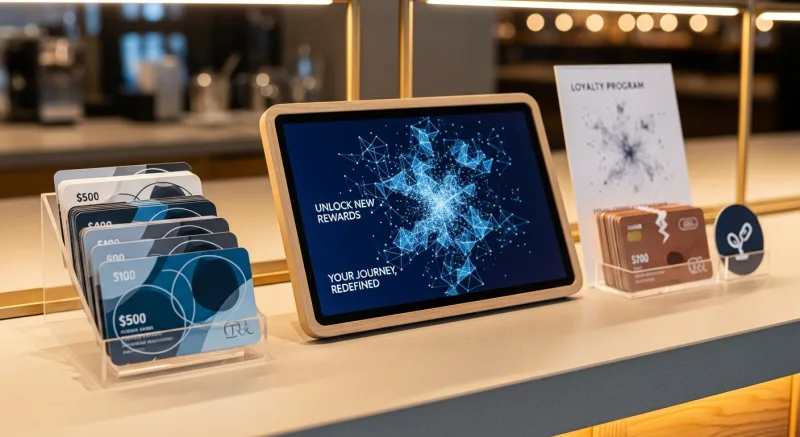
Breakage is the percentage of loaded value that is never redeemed. For gift cards, industry data shows breakage rates between 10-15%. For prepaid accounts with bonus credit, breakage on the bonus portion runs even higher — often 15-20% — because customers mentally separate "their money" from "free money."
On a $100 load with a $20 bonus, that means $3-$4 of the bonus is never used. Your actual cost on the bonus drops from $6.40 (at 32% COGS) to roughly $5.12. The program becomes even more profitable than the breakeven table above suggests.
Important: breakage revenue recognition varies by state. Some states have escheatment laws that require unclaimed balances to be turned over after a dormancy period (typically 3-5 years). Your POS system and accounting setup need to track dormant balances and comply with your state's unclaimed property rules. Our breakage revenue guide covers the accounting and legal details.
Marketing Messaging That Converts
The way you frame the bonus credit offer determines whether customers see it as a deal or a hassle. Loss aversion is your most powerful tool here.

Weak framing (gain-focused): "Save money with our prepaid program!"
Strong framing (loss-focused): "You're paying $91/year in credit card fees that go straight to Visa. Load prepaid and keep that money in your pocket."
Customers do not respond to abstract savings. They respond to concrete losses they are currently experiencing. Every credit card swipe at your register is money leaving both your pocket and theirs (through higher prices that absorb your processing costs).
Here are the five highest-converting marketing messages based on what we have seen work across KwickOS businesses:
- Table tent: "Your coffee costs $5.50. With prepaid, it costs $4.58. That's 47 free coffees a year."
- Register prompt: "Load $50 now, get $7.50 free. Your next 2 visits are already paid for."
- Email to regulars: "You visited us 8 times last month. If you'd loaded $100, you'd have $20 extra right now."
- Social media: "Why pay $5.50 when regulars pay $4.58? Ask about our prepaid bonus."
- Receipt footer: "Today's bill: $34. With prepaid, it would have been $28.33. Load up next time?"
The Multi-Location Advantage
Prepaid bonus programs scale exponentially with multiple locations. A customer who loads at Location A can spend at Location B, C, and D. The balance is universal. The loyalty is to your brand, not a single storefront.
T. Jin China Diner runs 15 stores with 75 terminals on KwickOS. Their prepaid program lets a customer load at the downtown location during lunch and redeem at the suburban location near their home for dinner. One account, one balance, instant sync across every terminal.
Crafty Crab Seafood does the same across 19 locations and 152 terminals. When they push a bonus credit promotion — "Load $75, Get $90 for Seafood Festival Week" — it deploys to all 19 stores simultaneously through KwickOS's centralized management. No manual updates. No location-by-location configuration.
This is where a processor-agnostic POS platform creates compounding value. Every prepaid dollar loaded is a dollar that bypasses credit card processing entirely. For a multi-location group processing $200,000/month in card transactions, shifting even 15% of that to prepaid accounts saves $8,400-$10,000 annually in processing fees alone — on top of the increased visit frequency and higher average tickets.
Common Mistakes That Kill Bonus Credit Programs
After watching thousands of businesses run prepaid programs through KwickOS, these are the five mistakes that consistently underperform:
- Bonus too small. A 5% bonus on a $25 load is $1.25. Nobody changes their behavior for $1.25. Start at 10% minimum. The perceived value needs to be immediately obvious.
- Too many tiers. Three tiers work. Five tiers create decision paralysis. Keep it simple: small, medium, and large.
- No staff training. Your team needs a 10-second script: "You spent $34 today. If you load $50, you get $7.50 free — so today's meal is covered and you have $23.50 for next time. Want me to set that up?" Without this script, uptake drops by more than half.
- No visibility. If the only place customers hear about prepaid is from a cashier, you are leaving money on the table. Table tents, menu inserts, digital signage through your KwickSign displays, email campaigns, and receipt footers should all reinforce the offer.
- Ignoring auto-reload. A one-time load gives you one cycle of benefit. Auto-reload gives you perpetual benefit. Always offer auto-reload at the time of initial load — "Want to automatically reload $50 whenever your balance drops below $10? You'll get the bonus every time."
Getting Started: The 7-Day Launch Plan
You do not need months to launch a bonus credit program. Here is the fastest path:
Day 1-2: Configure your POS. Set up three bonus tiers in your prepaid account module. Test a load and redemption on a staff account. Verify the bonus applies instantly and the receipt shows the balance.
Day 3: Train your team. Role-play the 10-second script with every cashier. The goal is natural, conversational delivery — not a robotic upsell. Run the training in English, Chinese, and Spanish if your staff and customers span those languages (KwickOS supports all three natively).
Day 4-5: Set up marketing materials. Print table tents. Create a register sign. Schedule an email blast to your existing customers. Post on social media. If you use digital signage, add a prepaid promo slide to your rotation.
Day 6: Soft launch with staff and regulars. Let your most loyal customers be the first to load. Their enthusiasm becomes word-of-mouth marketing.
Day 7: Full launch. Track daily load volume, average tier selection, and redemption velocity through your POS dashboard.
Turn Every Customer into a Committed Regular
KwickOS prepaid accounts support tiered bonus credit, auto-reload, loyalty integration, and multi-location sync — all from one platform. See how it works for your business.
Calculate Your Prepaid ROIFrequently Asked Questions
What is a prepaid bonus credit program?
A prepaid bonus credit program rewards customers with extra spending credit when they load money onto a stored value account or gift card. For example, "Load $50, Get $60" gives the customer $10 in free credit. The business collects cash upfront, locks in future visits, and the bonus amount acts as a marketing cost that is typically recovered through increased spending and reduced payment processing fees.
What bonus percentage should I offer on prepaid credit?
Industry data suggests a 10-20% bonus hits the sweet spot. Below 10%, the perceived value is too low to motivate behavior. Above 20%, you start cutting into margins without proportionally increasing uptake. A common tiered structure is: Load $25 get $2.50 bonus (10%), Load $50 get $7.50 bonus (15%), Load $100 get $20 bonus (20%). The highest tier should represent your ideal customer commitment level.
How do prepaid bonus credits affect my profit margins?
A 20% bonus on a $100 load means you give $20 in free credit — but your actual cost is only your cost of goods on that $20 (roughly $6-8 for restaurants at 30-40% food cost). Meanwhile, you collect $100 in cash immediately, eliminate credit card processing fees on future visits (saving 2.5-3%), and benefit from 10-15% breakage (unredeemed credit). Most businesses net positive even with generous bonus tiers.
Do prepaid bonus programs work for small businesses?
Yes. Small businesses often see the biggest relative impact because their regular customers represent a larger share of revenue. A coffee shop with 200 regulars converting 80 of them to $50 prepaid accounts collects $4,000 in immediate cash flow, locks in 80 guaranteed return visits, and builds a loyalty relationship that increases lifetime customer value. The key is starting with a simple, single-tier offer and expanding as you learn your customers' loading patterns.
Can my POS system handle prepaid bonus credit programs?
Not all POS systems support prepaid stored value accounts with automatic bonus credit. Many basic systems like Square only offer simple gift cards without tiered bonus functionality. A platform like KwickOS supports prepaid accounts with configurable bonus tiers, auto-reload with bonus triggers, balance tracking, and integration with loyalty and membership programs — all managed from a single dashboard across multiple locations.