 Tom Jin
You have gift cards. They sit on your counter. Customers buy one or two at a time — $25 here, $50 there. Maybe you sell $2,000 in gift cards during a good month.
Now picture this: an HR director from the office building next door walks in. She needs 200 gift cards for employee appreciation week. Each one loaded with $50. That's a single order worth $10,000.
Here's what makes it worse: she ordered those cards from Starbucks last year. Not because Starbucks has better food than you. Because Starbucks had a corporate sales page, bulk pricing, and an invoice she could expense. You didn't.
You're losing $10,000 orders to competitors who simply made it easy to buy in bulk.
And that's not all. That one corporate order isn't a one-time event. Employee appreciation happens every quarter. Client gifts go out every holiday season. New hire welcome packages happen monthly. One corporate relationship becomes $30,000 to $40,000 per year in guaranteed gift card revenue — plus the additional spend when those 200 card holders come in and spend 20-40% beyond the card value.
This guide shows you exactly how to find corporate buyers, structure bulk pricing that protects your margins, and build a B2B gift card program that turns single purchases into recurring quarterly revenue.
Why Corporate Gift Cards Are the Highest-ROI Revenue Channel You're Ignoring
Let's talk about the numbers that make corporate gift card sales irresistible.
A retail gift card customer buys one card, maybe twice a year. Average value: $35. Annual revenue per retail buyer: $70.
A corporate gift card client buys 50 to 500 cards, two to four times per year. Average card value: $50. Annual revenue per corporate buyer: $10,000 to $100,000.
But it gets worse — for the businesses not doing this.
Here's the math that makes corporate gift cards more profitable than you'd expect, even with bulk discounts:
| Revenue Factor | Retail Gift Cards | Corporate Bulk Gift Cards |
|---|---|---|
| Average purchase | $35 | $5,000 (100 × $50) |
| Bulk discount | None | 10% ($500) |
| Net gift card revenue | $35 | $4,500 |
| Overspend at redemption (avg 25%) | $8.75 | $1,250 |
| Breakage (12% unredeemed) | $4.20 | $600 |
| Total effective revenue | $47.95 | $6,350 |
| New customers acquired | 0-1 | 60-80 (first-time visitors) |
That $500 discount you gave on the bulk order? It bought you $1,250 in overspend, $600 in breakage revenue, and 60 to 80 new customers who had never walked through your door before. Every one of those new visitors is a potential loyalty member, a future regular, a five-star reviewer.
Here's the thing: corporate clients don't comparison shop on price. They comparison shop on convenience. The restaurant that makes it easiest to order, invoice, and receive bulk gift cards wins the account — every time.
7 Types of Corporate Clients Who Buy Gift Cards in Bulk
Before you start prospecting, you need to know who's buying. These are the seven corporate buyer categories with the highest gift card volume:
1. HR Departments (Employee Rewards & Recognition)
The biggest corporate gift card buyers by volume. Employee appreciation, performance bonuses, birthday gifts, work anniversaries, holiday gifts, wellness incentives. A 200-person company running a quarterly recognition program needs 50 to 100 gift cards every three months. Industry research suggests employee recognition spending averages $150 to $200 per employee per year across U.S. companies.
2. Real Estate Agencies (Closing Gifts)
Every agent needs a closing gift. The average agency closes 30 to 80 transactions per year. A $75 gift card to your restaurant beats a generic fruit basket every time — and you become the agent's default closing gift vendor. One real estate office can mean $2,000 to $6,000 in annual gift card revenue.
3. Insurance Companies & Financial Advisors (Client Appreciation)
Insurance agents send gifts to clients at renewal time. Financial advisors send holiday gifts to their top accounts. These are high-value professionals who buy premium denominations — $75 to $100 per card — and they buy consistently because client retention directly impacts their income.
4. Dental and Medical Offices (Referral Rewards)
"Refer a friend, get a $25 gift card." Dental practices are the #1 user of gift cards as referral incentives. A busy dental office generates 10 to 20 referrals per month. That's $250 to $500 in monthly gift card orders from a single practice — and they never stop ordering because referrals never stop coming.
5. Car Dealerships (Service Incentives & Sales Gifts)
Dealerships use gift cards to incentivize service visits, close sales ("free dinner on us when you buy today"), and reward referrals. A single dealership with 100+ monthly transactions can consume $1,000 to $3,000 in gift cards per quarter.
6. Property Management Companies (Tenant Appreciation)
Apartment complexes, HOAs, and commercial property managers send holiday gifts and renewal incentives to tenants. A 300-unit apartment complex buying $25 cards for holiday gifts is a $7,500 single order. And they do it every December.
7. Event Planners & Nonprofits (Raffle Prizes & Donor Gifts)
Charity auctions, golf tournaments, corporate retreats, trade shows. Event planners need gift cards in bulk for raffle prizes, swag bags, and speaker gifts. These orders spike in spring (galas) and fall (fundraisers).
Stop and think about a one-mile radius around your business. How many offices, agencies, clinics, and dealerships are within walking distance? Each one is a potential $5,000+ annual corporate gift card client that you've never approached.
How to Structure Bulk Pricing That Protects Your Margins
The number one fear business owners have about corporate gift card sales: "Won't the discount eat my margins?"
No. And here's why.
Gift card economics are fundamentally different from food or product economics. When someone redeems a $50 gift card and spends $63 (that 25% average overspend), your food cost on the additional $13 is roughly $4 — but that $13 is pure incremental revenue you wouldn't have had without the card. Add breakage, and the math tilts heavily in your favor even after the bulk discount.
Here's a tiered pricing structure that works for most businesses:
| Order Size | Discount | Example (100 × $50 cards) | Your Net Revenue |
|---|---|---|---|
| 1-24 cards | 0% (retail price) | — | Full face value |
| 25-49 cards | 5% | — | 95% face value |
| 50-99 cards | 10% | $4,500 | 90% + overspend + breakage |
| 100-249 cards | 12% | $4,400 | 88% + overspend + breakage |
| 250+ cards | 15% | $4,250 | 85% + overspend + breakage |
At the 15% discount tier, you're still collecting $4,250 in cash upfront for $5,000 in card value. When those cards are redeemed, breakage and overspend recover most of the discount. And the customer acquisition cost per new visitor? Under $5 — compared to $15 to $25 for Google Ads or $30+ for food delivery commissions.
But it gets better. You can offer an alternative to cash discounts: bonus value. Instead of "15% off 100 cards," offer "Buy 100 × $50 cards, get 15 bonus $50 cards free." The corporate client perceives more value (115 cards instead of 100), but your actual cost is lower because those 15 bonus cards carry breakage and overspend economics too.
The Corporate Sales Outreach System (Step by Step)
Knowing who to target is only half the battle. Here's the exact outreach system that turns cold prospects into bulk buyers.
Step 1: Build Your Prospect List (Week 1)
Walk a one-mile radius around your business. Write down every office, clinic, dealership, real estate agency, insurance office, and property management company you see. Then search Google Maps for the same categories within that radius. You should have 30 to 60 prospects within a mile of most commercial locations.
For each prospect, find the decision-maker. For HR departments, it's the HR manager or office manager. For small businesses, it's the owner. LinkedIn is your best tool here — search "[Company Name] HR manager" or "[Company Name] office manager."
Step 2: Create Your Corporate Gift Card Page (Week 1)
You need a landing page on your website — or at minimum, a one-page PDF — that corporate clients can review. This page should include your bulk pricing tiers, the ordering process (email, phone, or online form), delivery options (pickup, delivery, e-gift cards via email), custom branding options (co-branded cards for orders over $2,500), and invoicing terms (net-30 for approved accounts).
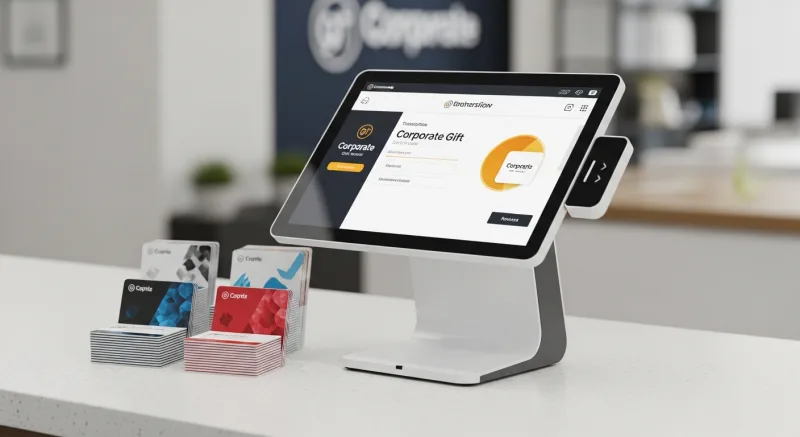
Don't have a website with this kind of flexibility? KwickOS merchants can generate e-gift cards in any quantity through the POS dashboard and email them directly to corporate clients for distribution. No separate e-commerce system needed — the same platform that runs your POS checkout handles gift card batch generation, tracking, and redemption across all locations.
Step 3: The Drop-In Visit (Week 2)
This is where most businesses fail. They send an email and wait. Don't wait. Walk in.
Bring a $25 gift card and a printed corporate pricing sheet. Ask for the office manager or HR contact. Hand them the gift card and say: "We're [Your Restaurant] right down the street. We just launched a corporate gift card program with bulk pricing. This one's on us — try us out. When you're ready for employee gifts or client appreciation, we can handle orders of any size with net-30 invoicing."
That $25 investment gets your food in front of the decision-maker. When they love the meal (and they will), the next employee appreciation order goes to you instead of Starbucks.
Step 4: Follow Up With Value (Week 3-4)
Three days after the drop-in, send an email. Don't ask for the sale — provide value. Share a one-page guide: "5 Employee Appreciation Ideas That Don't Feel Generic." Include your gift card program as one of the five ideas. This positions you as a partner, not a salesperson.
Two weeks later, follow up with a seasonal pitch: "Holiday gift card orders are already coming in — we're reserving custom card stock for corporate clients who order by [date]. Want me to hold some for you?"
Step 5: Close and Systematize (Ongoing)
Once a corporate client places their first order, the relationship practically runs itself. Set calendar reminders for their reorder cycles. Most corporate gift card purchasing follows a predictable pattern: Q1 (new year recognition), Q2 (summer events), Q3 (back-to-school for education clients), Q4 (holiday gifts). Reach out two weeks before each cycle with a simple: "Ready for your next batch? Same order as last time, or any changes?"
E-Gift Cards: The Secret Weapon for Corporate Sales
Physical cards have their place — they're tangible, they feel premium in a gift bag, they look great on a display. But for corporate sales volume, e-gift cards are the game-changer.
Here's why corporate buyers prefer e-gift cards for large orders:
- Instant delivery. No waiting for card stock to arrive. An HR manager can order 200 e-gift cards at 2 PM and have them in employees' inboxes by 3 PM.
- Zero inventory. You never run out. No card stock to order, no rack to maintain, no physical cards to store.
- Remote distribution. Remote and hybrid workforces can't receive physical cards easily. E-gift cards reach every employee regardless of location.
- Custom messaging. Each e-gift card can include a personalized message from the corporate buyer: "Thank you for 5 years of excellence, Sarah." That personal touch makes your gift cards the preferred choice over generic alternatives.
- Tracking and reporting. Corporate clients can see which cards have been redeemed and which haven't. This matters for HR departments tracking program participation.
With KwickOS, you can generate e-gift card batches directly from your POS system, email them individually or in bulk, track activation and redemption in real time, and pull reports that show your corporate client exactly how their program performed. This is the same system that handles your walk-in gift card sales, your e-gift card marketing campaigns, and your full gift card program — one integrated platform, zero additional software.
Custom Branding That Turns One Order Into a Recurring Partnership
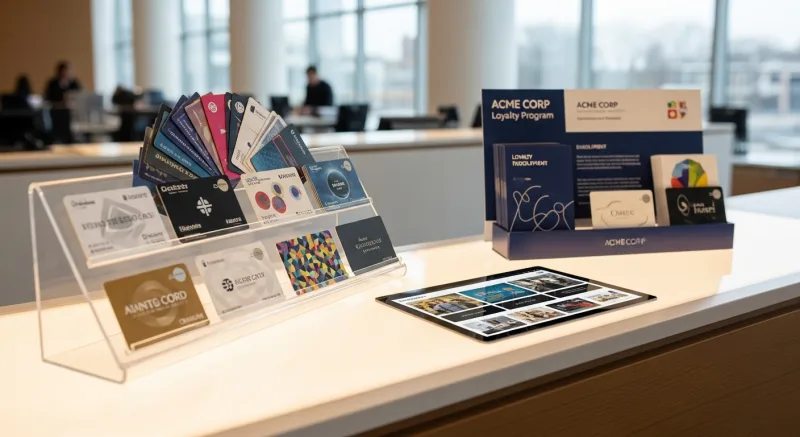
Here's the thing about corporate gift cards: the company buying them wants their employees and clients to associate the gift with them, not just with your restaurant.
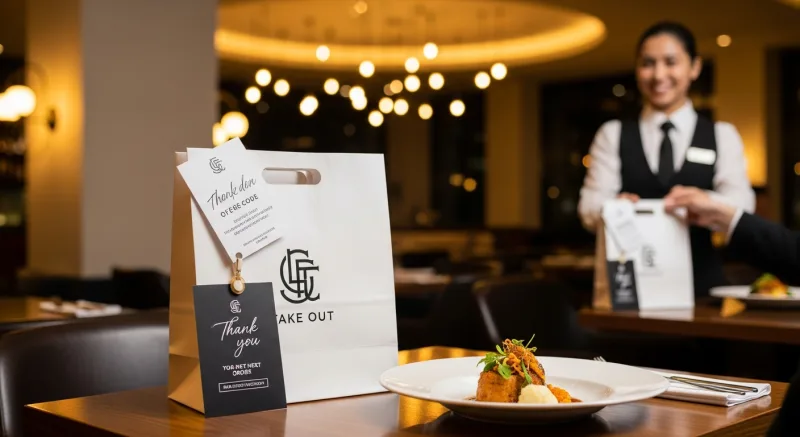
This is where co-branding transforms a transaction into a partnership.
For physical cards, offer co-branded designs for orders over $2,500. Your restaurant's logo on the front, the corporate client's logo on the back (or side by side). Card stock costs $1.50 to $3.00 per card for custom prints, but here's what happens: the corporate client now has "their" gift card. It's part of their brand identity. Switching to a different restaurant means redesigning the card, reprinting, and explaining to employees why the gift changed. Switching costs create retention.
For e-gift cards, custom branding is essentially free. Add the corporate client's logo, colors, and a custom message template. KwickOS supports custom e-gift card designs through the platform — no graphic designer required.
Crafty Crab Seafood, which operates 19 locations with 152 terminals on KwickOS, uses this exact strategy for corporate catering and gift card accounts across their markets. One centralized gift card system means a corporate client in Houston can order cards that work at any of their 19 locations — the same multi-location sync that handles menu updates handles gift card balance tracking.
Invoicing, Tax Benefits, and the Details That Close Deals
Corporate buyers don't pull out a credit card at the counter. They need invoices, purchase orders, and receipts that their accounting department can process. If you can't provide these, you lose the account to someone who can.
Invoicing Basics
Set up a simple invoice template with your business name and address, the client's company and billing contact, order details (quantity, denomination, discount, total), payment terms (net-30 is standard for corporate), and your payment methods (check, ACH, wire transfer). Don't activate the gift cards until payment clears — or set up a credit application for established corporate accounts.
The Tax Benefit Pitch
This is the close that most businesses don't know about. Corporate gift card purchases are often tax-deductible as business expenses. Employee achievement awards, client gifts (up to $25 per recipient per year under IRS guidelines), and promotional giveaways all qualify. When you pitch corporate gift cards, mention this: "Your accountant will love this — gift cards for employee recognition are a deductible business expense." That single sentence moves the conversation from "nice to have" to "smart business decision."
Year-End Planning
The biggest corporate gift card order of the year happens in Q4. Companies with remaining budget want to spend it before December 31 (use-it-or-lose-it budgets) and holiday gifting peaks in the first two weeks of December. Start reaching out to corporate prospects in early October. By November, most companies have already committed their gift card orders to someone. Don't be the business that starts prospecting in December.
Gift Cards as a Gateway to Your Loyalty Program
Here's the open loop most businesses miss: every corporate gift card you sell is a loyalty program acquisition tool.
Think about it. A corporate client buys 200 gift cards. Two hundred people — most of whom have never visited your business — walk through your door to redeem them. Each one is a first-time customer. And what do you do with first-time customers?
You enroll them in your loyalty program.
Train your staff to say this at redemption: "Would you like to join our rewards program? You'll earn points on everything you spend today, including anything over your gift card balance." With KwickOS, loyalty enrollment happens right at the POS during checkout — one tap, the customer enters their phone number, and they're in. No separate app to download, no card to carry.
Here's the conversion rate that matters: according to restaurant industry data, gift card redeemers who join a loyalty program at their first visit return 2.4 times more often than those who don't. On a 200-card corporate order, if you convert even 30% to loyalty members, that's 60 new regulars who come back an average of 4 to 6 times per year. At a $40 average check, those 60 members generate $9,600 to $14,400 in annual repeat revenue — from a single corporate gift card order.
That's not a gift card program. That's a customer acquisition engine.
The POS System Behind Scalable Corporate Gift Card Sales
Here's where most businesses hit a wall: their POS system can't handle bulk gift card operations.
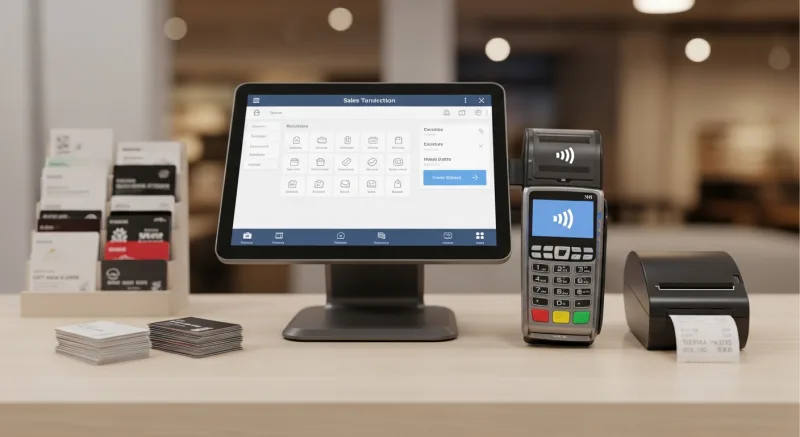
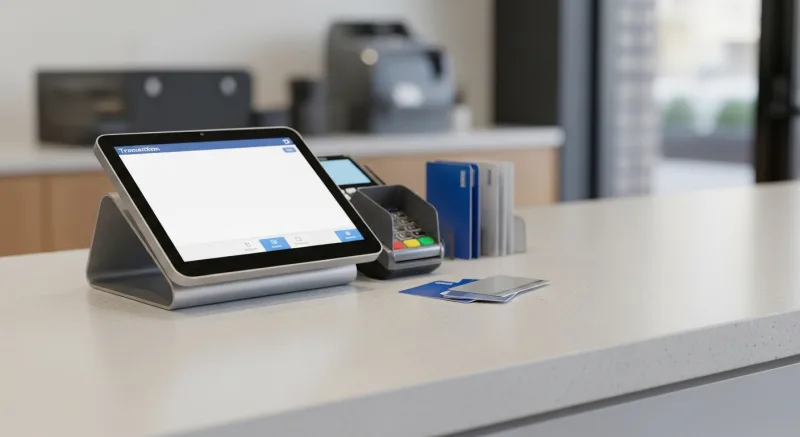
Can your current system generate 200 gift cards in a single batch? Track individual card balances across multiple locations? Email e-gift cards in bulk with custom branding? Pull a report showing how many corporate cards were redeemed, where, and how much the holders spent beyond the card value? Separate corporate gift card liability from retail gift card liability for accounting purposes?
If the answer to any of these is "no," your POS is the bottleneck.
KwickOS handles all of this natively. Batch gift card generation — physical or digital — with denomination, quantity, and activation controls. Multi-location redemption with real-time balance sync (critical for multi-unit operators like T. Jin China Diner, which runs 15 stores on 75 terminals). Corporate account tracking that separates B2B gift card revenue from walk-in gift card revenue. And reporting that shows your corporate clients exactly how their gift card program performed — redemption rates, average spend per card, breakage projections.
Because KwickOS is processor-agnostic, there's no processing markup eating into your gift card margins. When a customer redeems a $50 gift card, you're not paying 2.99% on that transaction to Toast or Square. You're paying your negotiated interchange-plus rate — or nothing at all if the entire purchase is covered by the gift card balance. On 200 corporate cards, that processing savings alone is $200 to $300 per order.
The hybrid local+cloud architecture also means gift card transactions process in 1ms locally — no cloud latency during busy lunch rushes when 15 corporate card holders show up at the same time. And if your internet drops, the system keeps processing. The cards still work. The balances still update. That reliability matters when a corporate client's employees are visiting your location.
Real-World Corporate Gift Card Revenue Projections
Let's get specific. Here's what a realistic corporate gift card program looks like after 12 months of active outreach:
| Month | Corporate Clients | Avg Order/Quarter | Quarterly Revenue |
|---|---|---|---|
| Month 1-3 | 3 clients | $2,500 | $7,500 |
| Month 4-6 | 6 clients | $3,000 | $18,000 |
| Month 7-9 | 9 clients | $3,500 | $31,500 |
| Month 10-12 | 12 clients (+ holiday spike) | $5,000 | $60,000 |
Year one total: $117,000 in corporate gift card sales. And that's before counting overspend revenue, breakage, and the lifetime value of new loyalty members acquired through corporate card redemptions.
Compare that to walking one mile and dropping off 30 gift cards at local businesses over two weeks. The investment is maybe $750 in sample cards and 15 hours of your time. The return is a six-figure revenue stream that grows every year as corporate clients reorder and refer other companies.
The 30-Day Corporate Gift Card Launch Plan
Stop thinking about it. Here's your action plan:
Week 1: Set up your POS for bulk gift card generation. Create your tiered pricing sheet. Build a one-page corporate gift card flyer (PDF or webpage). Print 30 sample $25 gift cards for drop-ins.
Week 2: Walk the one-mile radius. Visit 15 businesses. Drop off a gift card and pricing sheet at each one. Collect contact names and emails.
Week 3: Follow up with everyone from Week 2 via email. Send the "5 Employee Appreciation Ideas" value piece. Visit 15 more businesses with gift cards.
Week 4: Follow up with seasonal pitch. Close first orders. Set up invoicing for approved accounts. Schedule reorder reminders in your calendar.
Total investment: $750 in gift cards, 20 hours of your time, and a pricing sheet. Expected return by month 3: $7,500 or more in corporate orders.
Need a POS that handles bulk gift card operations, e-gift card distribution, multi-location redemption, and loyalty integration — all from one system? Schedule a KwickOS demo and see why 5,000+ businesses across 50 states trust us with their gift card and loyalty programs.
Turn Corporate Gift Cards Into Your Biggest Revenue Channel
KwickOS handles bulk gift card generation, e-gift card distribution, corporate invoicing, and loyalty integration — all from the same POS that runs your checkout. See it in action.
Get a Free Demo