 Tom Jin
Walk into almost any Mexican or Tex-Mex restaurant on a Friday night and look at what's on the tables. A plate of food, sure. But next to it, in front of nearly every adult in the room, is a margarita.
Now look at the math behind those two items. The plate of food took a line cook, a protein that costs you 30 cents on the dollar, prep labor, and a hot line running all night. The margarita took eight seconds at a frozen machine and costs you about a buck and a half.
Here's the problem: most operators price and obsess over the food, and treat the bar like an afterthought. They run a generic well margarita, never built a signature menu, never timed a happy hour, and have no idea what their actual pour cost is. They are leaving the easiest money in the entire restaurant sitting on the table — sometimes literally.
And it gets worse: when you don't control your drink program, you don't just miss profit you could have made. You bleed the profit you should already be keeping. Over-pours, comped rounds nobody tracked, happy hour prices rung at 9 pm, free shots for friends — industry research consistently points to liquor as one of the most theft-prone and variance-prone categories in any restaurant. A margarita program with no controls is a bucket with a hole in it.
This guide fixes all of that. We'll walk through the real economics of a margarita — why it's an 80%+ margin item, how fast a frozen machine pays for itself, how to cost and build a signature menu, how to price flights, and how to run a happy hour that actually adds covers instead of just discounting them. And we'll show you the point-of-sale features that protect every pour and turn a one-time guest into a regular.
Why the Margarita Is Your Highest-Margin Item
Let's start with the number that should change how you think about your menu. Here is the cost breakdown of a standard house margarita:
| Component | Pour / Amount | Cost |
|---|---|---|
| Well tequila (1.5 oz) | ~$0.95 | $0.95 |
| Triple sec / orange liqueur (0.5 oz) | ~$0.25 | $0.25 |
| Sweet-and-sour / lime mix | ~$0.30 | $0.30 |
| Salt, lime garnish, ice | ~$0.15 | $0.15 |
| Total liquid cost | ~$1.65 |
Sell that drink at $10 and your gross margin is 83.5%. Compare that to your food, which on a good day runs a 30% food cost — meaning a 70% margin before the line labor, prep, and waste that drinks barely have. Now you see it. The margarita isn't competing with your entrées for menu space. It's subsidizing them.
Here's the thing most owners miss: the percentage margin is only half the story. The real lever is volume. If your average table of four orders even two margaritas at $10, that's $20 of revenue carrying roughly $16.70 of profit — often more profit than the food those same four people ordered. Build a program that nudges that to three or four drinks a table and you've added thousands a month without touching your kitchen.
The Frozen Machine ROI Nobody Calculates
A commercial frozen drink machine runs between $4,000 and $9,000 depending on capacity and whether you buy single or double barrel. To a lot of owners that feels like a big, scary line item. So let's do the math they don't.
A frozen machine does two things a bartender can't: it pours a consistent drink in seconds, and it lets servers grab a margarita without tying up the bar. That removes the speed bottleneck, which means more drinks sold per hour during exactly the windows you make your money.
| Scenario | Frozen margaritas/day | Profit/drink | Monthly added profit |
|---|---|---|---|
| Conservative | 30 | $7.00 | ~$6,300 |
| Busy weekend concept | 70 | $7.00 | ~$14,700 |
| High-volume Tex-Mex | 120 | $7.50 | ~$27,000 |
Even at the conservative pace, a $6,000 machine pays for itself in under a month. After that, it's an appliance that prints roughly $75,000 a year in gross profit in the conservative scenario, and several times that in a busy room. There are very few $6,000 decisions in this business that pay back that fast.
The catch — and there's always a catch — is consistency. A frozen machine only delivers that margin if the mix-to-tequila ratio is dialed in and tracked. Pour too heavy "to be generous" and you've quietly turned an 83% margin into a 68% one. That's where your POS and inventory tracking earn their keep, and we'll get to that.
Recipe Costing: Know Your Number Before You Print the Menu
You cannot manage what you don't measure. Every margarita on your menu should have a costed recipe behind it — the exact ounces of each ingredient, the cost of each ounce, and the resulting pour cost. This is the single most-skipped step in building a drink program, and it's the reason so many "premium" margaritas actually make less money than the house pour.
Here's a quick framework. For every signature drink, calculate:
- Total liquid cost — add up the cost of every ingredient at your purchase price per ounce.
- Target pour cost percentage — most healthy bar programs aim for an 18% to 22% pour cost. Anything under 20% is excellent.
- Menu price — divide your liquid cost by your target pour cost. A $2.20 drink at a 20% target should be priced at $11.
- Dollar profit — the number that actually matters. A premium $14 margarita at a $2.80 cost makes $11.20 a drink — more real dollars than your $10 house pour, even though the percentage is similar.
Don't just chase the highest percentage. A spirit-forward, top-shelf margarita might run a 24% pour cost but deliver $12+ of profit per drink and signal quality that lifts your whole check average. Cost it, price it deliberately, and put it where guests will see it first. If you want to sanity-check your overall beverage and labor economics, run the numbers through our labor cost calculator alongside your pour-cost sheet — drinks are high-margin precisely because they carry so little labor, and seeing both side by side makes the case obvious.
Building a Signature Margarita Menu
The house margarita is your volume driver. Signature margaritas are your profit drivers and your marketing. A well-built signature menu does three things at once: it raises your average drink price, it gives guests a reason to come back and "try the next one," and it creates the photogenic, name-worthy items that get posted to social media and pull in new customers for free.
A strong signature lineup usually includes:
- A spicy option — jalapeño or mango-habanero. High perceived value, low added cost, enormous repeat appeal.
- A premium / top-shelf pour — your "treat yourself" drink, named after a reposado or añejo tequila, priced at $14 to $18.
- A seasonal or fruit-forward drink — prickly pear in summer, blood orange in winter. Rotate it to create urgency.
- A spirit-forward "Tommy's style" — for the guest who knows margaritas, this is how you earn credibility.
Here's a move most operators never make: build these as modifier-driven items in your POS, not as twelve separate buttons. One "Signature Margarita" base with structured choices — tequila tier, flavor, rocks or frozen, salt or no salt, spice level — lets your staff ring any combination in a couple of taps and sends a clean, unambiguous ticket to the bar. Operators like Shogun Japanese Hibachi proved how much customized station displays speed up a complex order line; a margarita station with the same clarity means fewer remakes and a faster bar. Fewer mistakes, faster service, and every customization tracked for costing.
Flights: Higher Checks Disguised as Fun
A margarita flight — typically four small 3 to 4 oz pours of different flavors or tequilas — is one of the most underused tools in the Mexican restaurant playbook. And it's a quiet profit machine.
Because each pour is smaller, your liquid cost for a four-pour flight runs about $2.50 to $3.50. Sell it at $18 to $22 and you've got a strong margin and a higher check than a single drink. But the real magic is what happens next: a guest who samples four flavors will almost always come back and order a full-size version of the one they loved. The flight is a paid tasting that sells your menu for you.
And it gets better: flights are intensely photogenic. Four colorful glasses lined up on a wooden paddle is exactly the kind of image that ends up on Instagram and TikTok. That's free, high-trust marketing that no ad budget can buy. Price the flight as a premium experience, name the pours, and make it look like a show. For more on turning visual moments into reservations, see our guide to bar profit optimization.
Happy Hour: Fill the Dead Hours Without Killing Margin
The fear with happy hour is always the same: "I'll just be giving away drinks I'd have sold at full price." That fear is valid only if you run happy hour blind. Run it with intention and data, and it's one of the highest-return promotions in the business.
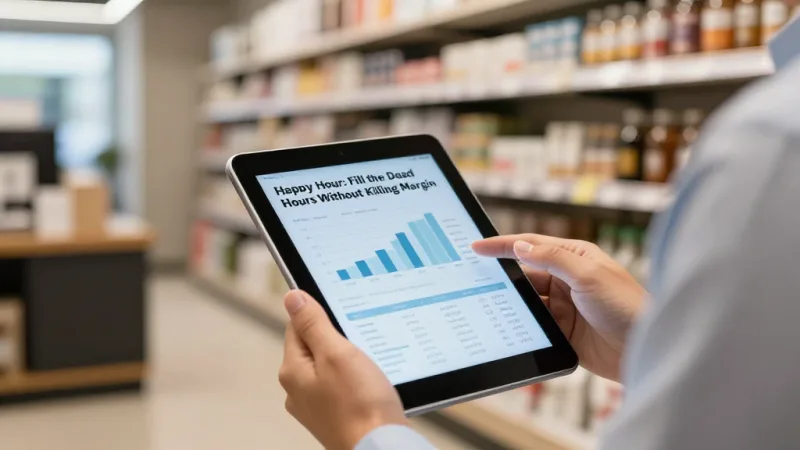
Start with the margin reality. A house margarita with a $1.60 cost, discounted from $10 to $6, still delivers a 73% margin and $4.40 of profit per drink. You are not losing money on the drink. You're using the drink as bait to fill the empty 3-to-6 pm window, drive food attachment, and convert first-timers into regulars.
Three rules make happy hour work:
- Time-gate it automatically. Your POS should apply the happy hour price only during the set window, so it physically can't be rung at 8 pm by a well-meaning server. This single control protects more margin than any other.
- Track attach rate. The goal isn't cheap drinks — it's covers and food sales. Watch whether happy hour guests add appetizers and stay for dinner. If they do, you're winning.
- Use it to capture, not just discount. Every happy hour guest is a chance to enroll a loyalty member or sell a gift card for their next visit.
For the full playbook on structuring and marketing these windows, see our restaurant happy hour strategy guide.
The POS Features That Protect Every Pour
A great margarita program lives or dies at the point of sale. The drink might be made at the bar, but the money is made — or lost — at checkout. Here is what your POS needs to do for a drink program to actually deliver the margins above.
First, checkout-stage upsell prompts. When a server rings a house margarita, the POS can prompt "premium tequila?" or "make it a flight?" That single nudge, applied consistently, lifts average drink revenue by dollars per check across a busy night.
Second, pour cost and variance tracking. Your POS should tie every drink sold to its costed recipe and reconcile it against your actual liquor depletion. When you sold 200 margaritas but poured 230 drinks' worth of tequila, the system flags it. That variance is theft, over-pouring, or untracked comps — and catching it protects the margin the whole program depends on.
Third, time-gated and rules-based pricing so happy hour, member pricing, and event specials apply exactly when they should and never when they shouldn't.
Fourth — and this is where most operators leave the biggest money on the table — gift cards, e-gift cards, and loyalty built into checkout. A margarita drinker is a high-frequency, high-margin customer. When your POS lets the bartender enroll them in a points or membership program in a couple of taps, sell a digital gift card during a holiday rush, and save their profile with the spicy mango margarita they loved, you turn one good night into a year of repeat visits at full price. KwickOS builds gift cards, e-gift cards, and loyalty directly into the payment screen — not bolted on as separate apps — so capturing a regular is as fast as ringing the drink.
And because KwickOS runs on a hybrid local-plus-cloud architecture, the bar keeps ringing and printing even when the internet drops mid-rush — the moment you can least afford a frozen terminal. It's processor-agnostic too, so you keep 100% of your processing freedom and negotiate your own rates instead of being locked into a vendor's markup on every one of those high-volume drink transactions. (For what that freedom is worth, see our comparison of KwickOS vs Toast, Square, and Clover.)
Putting It All Together
The margarita is the most profitable item you sell, and for most operators it's the most neglected. Fix that and you've found money that requires no new dishes, no more line labor, and no extra rent.
Buy the frozen machine — it pays for itself in weeks. Cost every recipe so you know your real number. Build a signature menu that raises your check and markets itself. Add flights to lift tickets and feed social media. Run a time-gated happy hour that fills your dead hours and captures regulars. And run all of it on a POS that prompts the upsell, guards the pour, and pulls every guest into loyalty and gift cards at checkout.
Do that, and your drink menu stops being a side note. It becomes the page in your menu that quietly carries the whole business. If you run a bar-forward concept, our bar & nightclub solutions and Mexican restaurant platform pages show exactly how the pieces fit together.
Make Your Drink Menu Your Most Profitable Page
KwickOS unifies modifier-rich drink ordering, pour-cost tracking, time-gated happy hour pricing, loyalty, and gift cards in one platform — on a hybrid system that never goes down mid-rush and lets you keep your own processor. See how it works.
Get My Free DemoFrequently Asked Questions
What is the profit margin on a frozen margarita?
A frozen house margarita built from a well tequila, triple sec, and a quality sweet-and-sour mix typically costs $1.40 to $1.80 in liquid and ingredients. Sold at $9 to $11, that is an 80% to 84% gross margin — far higher than food, which usually runs a 28% to 35% food cost. Premium and signature margaritas with top-shelf tequila can carry an even higher dollar profit per drink even at a slightly lower percentage margin.
How long does it take for a frozen margarita machine to pay for itself?
A commercial frozen drink machine costs roughly $4,000 to $9,000. If it adds just 30 frozen margaritas a day at about $7 of profit each, that is $210 a day, or about $6,300 a month in additional gross profit. At that pace a machine pays for itself in roughly four to six weeks of normal service, and everything after that is incremental profit on the highest-margin item on your menu.
How do you price a margarita flight?
A margarita flight is typically four 3 to 4 oz pours of different flavors or tequilas. Because each pour is smaller, your liquid cost for a four-pour flight runs about $2.50 to $3.50, and you can sell it for $16 to $22. That is both a strong margin and a higher check than a single margarita, while letting guests sample signature flavors that turn into full-size repeat orders. Flights also photograph well, which drives social-media exposure at no ad cost.
Does a happy hour margarita still make money?
Yes. A house margarita with a $1.60 cost discounted from $10 to $6 during happy hour still delivers about a 73% margin and $4.40 in profit per drink. Happy hour works because it fills otherwise empty 3 to 6 pm hours, drives food attachment, and converts first-time guests into regulars. The key is using your POS to time-gate the discount automatically so it cannot be rung at the wrong hour, and to track attach rate so you know happy hour is adding covers, not just discounting existing ones.
How can a POS system increase margarita sales?
A POS increases margarita sales by prompting upsells at checkout (suggesting a premium tequila or a flight), time-gating happy hour pricing automatically, tracking pour cost and variance so theft and over-pouring do not erode margin, and tying every drink to a loyalty or membership program. A modern all-in-one POS like KwickOS also sells gift cards and e-gift cards at checkout and saves customer profiles, so a guest who loved your spicy mango margarita gets pulled back in with a targeted offer.