 Ming Ye
Walk into almost any Indian buffet at 2:45 on a Tuesday afternoon.
The lunch rush is gone. The room is half-empty. And the buffet line is still stacked — full pans of butter chicken, a mountain of basmati, a tray of tandoori that's been drying under the heat lamp since noon. In fifteen minutes, most of it goes in the trash.
That's the quiet killer of the all-you-can-eat model. Not the guest who takes a fourth plate. The pans nobody ate.
Here's the thing most operators get backwards: they obsess over the "big eater" — the customer who supposedly ruins the economics by loading up. But a single guest can only fit so much food on a plate and in their stomach. Do the math on a $16.99 buffet and even a genuinely hungry person rarely eats more than $6 to $7 of actual food cost. The heavy eaters aren't your problem.
Your problem is the 30 to 40 pounds of curry you cooked, plated, held for three hours, and threw away. That's not a food cost you can see on a plate — it's an invisible one, buried in your prep, and it's the reason two buffets with the identical menu and the identical price can run a 31% food cost and a 45% food cost side by side.
This guide is about closing that gap. We'll walk through the five operational levers that actually decide whether your buffet prints money or bleeds it: replenishment timing, food cost control, waste tracking, peak vs. off-peak pricing, and display rotation. Then we'll cover the part most operators forget entirely — turning that high-volume lunch crowd into tracked, repeat, loyal customers at checkout.
Why the Indian Buffet Math Works (When You Let It)
Start with why this format is so profitable in the first place, because it explains everything that follows.
The dishes guests fill up on at an Indian buffet are, almost without exception, the cheapest food in the building. Dal makhani, chana masala, chole, aloo gobi, vegetable biryani, basmati rice, and fresh naan are built from lentils, chickpeas, potatoes, rice, flour, onions, and spice. A generous serving of dal costs you well under a dollar. Rice and naan are pennies. Even a rich, crowd-pleasing paneer dish lands cheap per portion.
The expensive items — tandoori chicken, lamb curry, goat, shrimp — are the ones you control with placement and pan size, not the ones guests build a meal around. Most people take a taste of the protein and fill the rest of the plate with curry, rice, and bread.
So the value equation is lopsided in your favor: a spread that looks like $40 of abundance costs you $5 to $6 per cover to actually serve, against a $15 to $18 menu price. That's how a buffet holds a 28% to 33% food cost while feeling like a generous deal to the guest.
But — and this is the whole game — that math only holds if you produce close to what gets eaten. Overproduce by 30% and your effective food cost climbs into the 40s no matter how cheap the ingredients are. Waste doesn't care that the dal was cheap. A dollar of dal in the trash is a dollar gone.
Lever 1: Replenishment Timing (Cook to the Room, Not the Pan)
The single biggest mistake in buffet operations is filling every chafing dish to the brim at open and topping it off whenever it looks low. That guarantees full, hours-old pans at close — the exact food you'll dump.
The fix is batch cooking on a schedule tied to guest count, not pan level. Here's the discipline:
- Small batches, frequent refills. Cook the high-volume curries in quantities that turn over every 30 to 45 minutes at peak, less as the rush fades. A pan that empties and refills often is a pan that's always fresh and never wasted.
- Taper hard in the final hour. The last 45 minutes before the buffet closes should see production drop sharply. Better to have a slightly thin line at 2:45 than three full pans at 3:00. Guests arriving late understand a winding-down buffet; they don't come back after eating dried-out food from a heat lamp.
- Half-pans for slow movers. Not every dish deserves a full pan. Run the second-tier items in half-size pans so a slow afternoon doesn't leave you with gallons of something nobody touched.
Here's what makes this possible: knowing your real-time cover count. If your kitchen can see that 140 guests came through by 1:00 versus a normal 190, they can throttle production before the waste happens. This is exactly the kind of live visibility a modern POS gives you — T. Jin China Diner runs real-time remote monitoring across 15 locations and 75 terminals, so an owner can watch cover pace and sales at every store from one screen and catch an overproducing kitchen the same day, not at month-end inventory.
Lever 2: Food Cost Control by Dish, Not by Guess
Most buffet operators track food cost as one blurry number at the end of the month: total food purchases divided by total sales. By then it's too late to do anything about it, and you have no idea which part of the buffet is leaking.
The operators who hold 31% do it by knowing their cost per dish and their production par by daypart. That means:
- Recipe-cost every buffet dish. Know that your dal costs $0.60 a serving, your tandoori chicken $2.10, your goat curry $3.40. Now pan placement and portion tools become deliberate decisions, not habits.
- Set par levels per daypart. A Tuesday lunch needs different production than a Saturday brunch. Write it down, cook to it, adjust weekly based on what actually sold and what got wasted.
- Watch the proteins. Your cheap curries won't sink you. Your expensive proteins will if you over-cook them. Keep tandoori, lamb, and shrimp in smaller pans, positioned so they're taken as an accent, not a base.
Run your own numbers on any dish before it goes on the line with our food cost calculator — and if you're deciding what to charge for the buffet itself, the menu price calculator works backward from a target food cost to the price on the sign.
Lever 3: Waste Tracking (The Number Nobody Logs)
Ask a struggling buffet operator how much they waste and you'll get a shrug. Ask a profitable one and they'll tell you within a few pounds, by dish, for last Tuesday.
Waste tracking is the highest-ROI five minutes in the whole operation, and almost nobody does it. At close, before anything hits the trash, the kitchen logs what's left in each pan: two-thirds of a pan of aloo gobi, half a pan of biryani, a full pan of that new okra dish nobody ordered. That log tells you three things instantly:
- What to cut back on next week. If the okra dish comes back full every day, drop it to a half-pan or off the line. You're paying to cook something guests don't want.
- Where your real food cost is hiding. The dishes you dump most are your actual cost problem — far more than any individual guest.
- Whether your replenishment timing is working. Consistent big waste at close means you're cooking too late into service. Taper earlier.
And it's not just a cost issue — it's a compliance one. Everything sitting in a chafing dish is a time-and-temperature liability, and a health inspector who finds product below 140°F on the hot line writes a violation. Digital temperature logging on the buffet line beats the paper clipboard nobody fills out honestly; we cover the full case for it in our guide to digital temperature monitoring. The same discipline that keeps you inspection-ready keeps your waste visible.
Lever 4: Peak vs. Off-Peak Pricing
Charging one flat buffet price all week is leaving money on both ends of the table — you're underpricing your busiest, highest-value services and overpricing the slow hours that could pull in more covers at a lower rate.
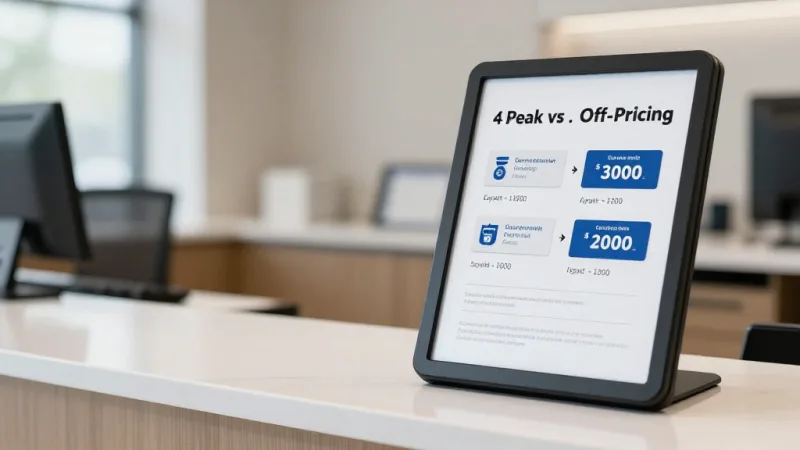
The profitable structure treats each service as its own business:
- Weekday lunch: your volume engine. Priced to fill seats from nearby offices — say $14.99 — and to move the cheap, high-margin curries in quantity. This is where loyalty pays off, because these are your three-times-a-week regulars.
- Weekend brunch: a premium at $19.99 to $22.99 with a wider spread, chaat station, and dessert selection. Families and groups come specifically for the occasion and will pay for the abundance.
- Dinner: often better run à la carte or as a higher-priced buffet, since evening diners order differently and a poorly-attended dinner buffet is a waste machine.
- Kids and seniors: age-based children's pricing and a senior discount at slow hours fill seats that would otherwise sit empty at near-zero marginal cost.
The reason most operators don't do this is friction: they don't trust cashiers to remember which price is live at which hour. That's a technology problem with a technology answer. A POS with time-based pricing rules applies the correct buffet price automatically based on the day and time, so the $14.99 lunch becomes the $19.99 brunch at the boundary you set, with zero cashier judgment involved. It's the same dynamic-pricing logic restaurants use to protect margins at peak demand — we break down the broader strategy in our guide to dynamic pricing for restaurants.
Lever 5: Display Rotation and Presentation
The buffet line isn't just a serving mechanism — it's a merchandising surface, and how you arrange it directly changes what guests eat and therefore what you spend.
- Cheap dishes first, proteins last. Guests fill their plate in the order they walk the line. Lead with rice, naan, salad, and the low-cost curries so plates are half-full before anyone reaches the tandoori. This isn't a trick to shortchange guests — a well-fed guest is a happy guest — it's simply arranging abundance in your favor.
- Rotate the expensive pans to smaller, refilled-often positions. A small pan of lamb that gets topped up frequently looks fresh and generous while capping how much sits out.
- Keep it looking full and fresh. A picked-over, crusty line signals "day-old" and pushes guests to over-take the fresh dishes while you dump the tired ones. Consolidate into smaller pans as service winds down so the line stays appealing to the last guest.
- Garnish and label. Fresh cilantro, a labeled spice level, a clean sneeze guard. Presentation is the difference between a buffet that feels premium at $19.99 and one that feels cheap at $12.99.
Crafty Crab Seafood runs 19 stores on 152 terminals with one-click menu sync and customized kitchen-display setups for special requests — the same infrastructure that lets a multi-location operator standardize a buffet line's dishes, pricing, and rotation across every store instead of hoping each location gets it right on its own.
Where the Buffet Actually Compounds: Checkout, Loyalty, and Gift Cards
Here's the part that separates a buffet that survives on thin volume from one that builds a base of regulars worth marketing to. It happens in the last five seconds — at checkout.
A buffet runs on frequency. The office worker who comes for the $14.99 lunch three times a week is the single most valuable guest you have, and at most Indian buffets that guest is completely anonymous. You never learn their name, you can't reach them on a slow week, and you have no idea they're a $2,300-a-year customer. That's a goldmine you're walking past every single day.
The fix is to capture it at the register, without slowing the line:
- Loyalty and points at the POS. A buffet is the ideal format for a points or membership program — "buy ten lunches, get the eleventh free," or points per visit tied to a customer profile. With an all-in-one POS, the cashier enrolls a guest or applies points in a couple of taps on the same payment screen. No punch card to lose, no line slowdown. Tiger Sugar built exactly this kind of minimal-step loyalty and electronic receipts into a two-kiosk operation — proof you don't need to be big to run a sharp retention loop.
- Gift cards and e-gift cards. A value-priced, crowd-friendly buffet is a natural gift-card sell — for coworkers, for family, for the regular who wants to treat a friend. E-gift cards spike hard around Diwali and the year-end holidays, and a share of every card sold never gets fully redeemed, which quietly lifts your margin. Selling one at checkout takes two taps on the same screen you just rang the buffet on.
- Save the customer profile. Tie the visit to a customer record and you can text your lunch regulars a slow-Tuesday offer, win back someone who's gone quiet, and finally see who your real base is.
This is where a POS stops being a cash register and becomes a marketing engine. When checkout, loyalty, points, gift cards, e-gift cards, and customer profiles all live in one platform instead of four apps that don't talk to each other, the buffet's greatest asset — its frequency — finally gets captured. The anonymous three-times-a-week lunch guest becomes a tracked member you can bring back fifty more times a year at full price.
The Platform Underneath
None of this works if the technology falls over on your busiest shift. A packed weekend brunch, a line of guests waiting to pay a flat buffet price, and one internet hiccup that takes a cloud-only POS dark is a disaster at the worst possible moment. A few things that matter specifically for a buffet operation:
- Hybrid local-plus-cloud. KwickOS keeps ringing at 1ms local speed even if the internet drops mid-rush, then syncs when the connection returns. Toast and most cloud-only systems go down when the Wi-Fi does.
- Time-based and multi-tier pricing built in. Lunch, brunch, dinner, kids, and senior prices apply automatically at checkout with no cashier guesswork.
- Real-time multi-location visibility. Watch cover pace and sales across every store from one screen, the way T. Jin China Diner does across 15 locations — so you catch an overproducing kitchen the day it happens.
- Processor-agnostic payments. Keep your own processor and negotiate your own rates, saving most restaurants $3,000 to $8,000 a year versus locked-in systems. On a high-volume, thin-margin buffet, that lands straight in your pocket — see how it stacks up in our platform comparison hub.
- Multi-language and fingerprint verification. English, Chinese, and Spanish built in so a multilingual team works fast, and 1:N fingerprint authentication that keeps time theft and unauthorized voids in check.
Operators ready to see it running across one location or fifty can start on our restaurant solutions page, and resellers who set these systems up for local operators can learn more through our partner program.
The Bottom Line
The Indian buffet is one of the best-margin formats in the restaurant business, and one of the easiest to give away. The dishes guests fill up on cost you pennies, but the pans you overcook and dump at 3:00 quietly turn a 31% food cost into a 45% one. The heavy eater was never your problem. Production without discipline is.
Fix it with the five levers: cook to the room instead of the pan, cost every dish and set a daypart par, log your waste before it hits the trash, price each service for what it's actually worth, and merchandise the line so abundance works in your favor. Then close the loop at checkout — capture every frequent, anonymous lunch guest into loyalty, sell a gift card, save the profile — so the volume you already have becomes a base of regulars you can market to. On a platform fast enough to keep the register from being the bottleneck and stable enough to survive the rush, that's the difference between an all-you-can-eat buffet that bleeds and one that actually profits.
Turn a Thin-Margin Buffet Into a Profit Machine
KwickOS unifies time-based buffet pricing, real-time cover visibility, loyalty, and gift cards in one platform — with hybrid local-plus-cloud that never goes down mid-rush. See how it works.
Get My Free DemoFrequently Asked Questions
What food cost percentage should an Indian buffet target?
A well-run Indian lunch buffet should hold a food cost around 28% to 33%. The math works because the highest-volume dishes guests fill up on — dal, chana masala, rice, naan, and vegetable curries — cost pennies per serving, while the perceived value of an unlimited spread lets you price at $14 to $18. The danger is not the menu price, it's over-production and waste. Cook to a rolling replenishment schedule instead of filling every chafing dish to the brim, track pan-by-pan waste at close, and the 31% target holds. Fill every pan full at 11:30 and dump half of it at 2:30, and the same buffet runs a 45% food cost.
How do you reduce waste on an all-you-can-eat Indian buffet?
Cook in small, timed batches and replenish on a schedule tied to real guest count, not to how empty a pan looks. Use half-pans for slow movers and full pans only for the three or four dishes guests actually load up on. Rotate expensive proteins like tandoori chicken and lamb to smaller pans that get refilled more often, so leftover product at close is minimal. Log what you dump at end of service by dish, feed that into next week's par levels, and taper production in the final 45 minutes before the buffet closes. A POS that shows you real-time cover counts lets the kitchen match production to the actual pace of the room instead of guessing.
Should an Indian restaurant charge different buffet prices at peak and off-peak times?
Yes. Weekday lunch, weekend brunch, and dinner buffets have very different cost structures and demand, so a single flat price leaves money on the table. A common structure is a lower weekday lunch price to drive volume when offices are nearby, a premium weekend brunch price with a wider spread, and either a higher-priced or à la carte dinner service. Children's pricing by age and a senior discount at slow hours fill seats that would otherwise sit empty. A POS with time-based pricing rules applies the right price automatically at checkout so cashiers never have to remember which rate is live.
Can a buffet restaurant run loyalty and gift cards effectively?
A buffet is one of the best formats for loyalty because it runs on frequency — the office worker who comes for the $14.99 lunch three times a week is exactly who a points or membership program is built for. A punch-style reward such as buy ten lunches, get the eleventh free, or a points program tied to the customer profile, turns an anonymous regular into a tracked, marketable one. Gift cards and e-gift cards sell well for a value-priced, crowd-friendly format and spike around Diwali and the holidays. The key is running all of it inside the POS at checkout so enrollment and redemption take a couple of taps and never slow the register.