 Tom Jin
Pull up last year's sales for the week of Halloween.
Now look at October 31 itself. For most restaurants, it's a flat line — a Tuesday that happened to have a holiday on it, indistinguishable from the Tuesday before. The kids were out trick-or-treating, the adults were home handing out candy, and the dining room was quiet.
Here's the thing: that empty room isn't because nobody wanted to go out. It's because you gave them no reason to choose you over their couch. Americans pour billions of dollars into Halloween every year, and a fast-growing share of it isn't candy — it's experiences. Costume parties, themed events, "let's do something fun" nights. That money is moving. The only question is whether it moves through your register or somebody else's.
And it gets worse if you do nothing: Halloween sits in a genuinely dead zone on the calendar — after the back-to-school slump, before the holiday-party rush kicks in around mid-November. A flat October 31 isn't a one-night miss. It's a missed chance to fill the slowest stretch of your fall and to load your marketing list right before the most lucrative quarter of the year.
This is the playbook that turns it around. A $4,000 Thursday isn't a fantasy — it's a costume contest, a tight themed menu, a photogenic room, a social push, and a checkout that captures every single guest who walks in. Let's build it.
Why Halloween Is the Most Under-Monetized Night on Your Calendar
Before you plan a single decoration, understand why this night is such an opportunity — because the reasons point straight at the strategy.
- It lands in a revenue valley. Late October is quiet for most concepts. There's no built-in occasion driving traffic the way Valentine's Day or Mother's Day does. That means almost any incremental event is pure upside — you're not cannibalizing a busy night, you're inventing one.
- It's an experience holiday, not a gift holiday. Unlike Christmas, Halloween spending flows toward doing things — dressing up, going out, being seen. Restaurants are perfectly positioned to sell exactly that, and most simply don't try.
- It's the most photographable night of the year. Costumes, decor, themed cocktails, candlelight — Halloween is engineered for the camera. Every guest is a potential billboard. A night built for sharing markets itself, and markets next year's event for free.
The takeaway: you don't need to discount your way to a busy Halloween. You need to give people an experience worth leaving the house for, then make it effortless to capture, pay, and remember them. Everything below does one of those two jobs.
The Themed Menu: A Few Signature Dishes Beat a Whole New Card
The fastest way to make a normal night feel like an event is the menu — but don't reinvent your entire kitchen. The mistake operators make is trying to "Halloween" everything and ending up with a logistical nightmare and a slow line.
Instead, build a tight limited-time Halloween menu: three to five signature items that photograph beautifully and cost you almost nothing to execute. A "blood orange" smoked cocktail, a charcoal-black bun burger, a dessert that arrives smoking with a little dry ice, a "witch's brew" punch for the table. The whole point is theater. These items aren't where you make your margin in volume — they're the reason a table books, the thing they Instagram, and the anchor that makes the rest of the check feel like part of an occasion worth paying for.
Scarcity is the multiplier. Label these items "October 31 only" or "until they're gone" and you stack urgency on top of novelty — the same engineered FOMO that sells out a daily special by 7pm. (Our guide to scarcity and urgency marketing breaks down exactly why "only 12 made tonight" outperforms an open-ended offer.)
This is also where multi-location operators win cleanly. A group like Crafty Crab Seafood (19 stores, 152 terminals) or T. Jin China Diner (15 stores, 75 terminals) pushes one themed Halloween menu to every location with one-click sync, then watches from a single dashboard which items and which stores are converting — no per-store rebuild, no version drift, no manager going rogue with the punch recipe. For the mechanics of rolling a seasonal menu across many locations without chaos, see our multi-location menu management guide.
The Costume Contest: Your Cheapest, Highest-ROI Event
If you do only one thing this Halloween, do this. A costume contest is the single highest-return play on the list because it transforms guests from passive diners into active participants — and participants stay longer, spend more, and post constantly.
The structure is simple and it matters. Set a clear judging time (say, 9pm) so people arrive early and stay for it — that's two to three extra hours of bar and table revenue per guest you wouldn't have had. Offer a prize with real pull: a $100 gift card, a free dinner for four, a bar tab. Make the prize an e-gift card and you've done something clever — the "prize" is a future visit you've now guaranteed, handed to your most enthusiastic customer.
Then engineer the share. Make voting happen by social media — guests post their costume with your hashtag and tag your location, and the most-liked photo wins. Now every contestant is recruiting their own followers to come see (and vote), and your Halloween night is trending in your own zip code. This is the kind of content that turns a quiet kitchen into a destination; our TikTok marketing guide shows how to give these moments the best shot at traveling.
Kids' Events: Own the Afternoon Everyone Else Ignores
Halloween isn't only a nighttime adult occasion. There's a whole second event hiding in the afternoon — and it fills the deadest hours on your clock.
Families with young kids aren't out at 9pm; they're looking for something to do at 3pm to 6pm on Halloween, exactly when your dinner kitchen is idle. Own that window with a family-friendly Halloween afternoon: in-restaurant trick-or-treating (stations where kids collect a treat), a pumpkin-decorating or cookie-decorating table, a "kids in costume eat free with a paying adult" hook, and an early, simple themed menu.
The economics are excellent because you're selling found time. The same off-peak afternoon that Tiger Sugar International Dessert turns into traffic with minimal-step kiosk ordering, or that a hibachi concept like Shogun Japanese Hibachi turns into a show with its themed station displays, is exactly the hour Halloween hands you a built-in family crowd. Tie the "kids eat free" offer to a loyalty sign-up and you convert a one-afternoon visit into a family on your list — more on why that's the whole game in a minute.
Haunted & Immersive Dining: Sell the Experience, Charge a Cover
For the right concept, Halloween is permission to do something most restaurants never dare: charge admission.
An immersive or "haunted" dining experience — a transformed dining room, staff in character, a themed multi-course menu, maybe a spooky storytelling element — can carry a ticketed cover charge or a prepaid prix-fixe. That changes your entire risk profile for the night. Instead of hoping people show up, you sell tickets in advance, you know your covers, you prep precisely, and you've collected the revenue before a single guest arrives.
Prepaid, ticketed events also kill the no-show problem that wrecks special nights. When a guest has already paid, they show up — and the deposit or full prepayment runs cleanly through your POS as a stored-value or prepaid transaction. This is the same model that makes high-end seatings and special events predictable instead of nerve-wracking; the difference between a chaotic Halloween and a sold-out one is almost entirely whether you collected commitment up front.
Decoration ROI: One Photo Wall Beats a Thousand Cobwebs
Here's where restaurants waste the most money: scattering a few thousand dollars of generic decorations around the room where they blur into background noise and photograph terribly.
Flip the logic. Decorations are a marketing investment measured in social reach, not a seasonal cost measured in square footage covered. Take your whole decor budget and put most of it into one genuinely spectacular, intensely photogenic feature: a dramatic transformed entrance, a single dedicated "photo wall" or selfie corner with great lighting, a signature centerpiece guests can't walk past without pulling out a phone.
That one installation does what a hundred cobwebs never will — it manufactures shareable content. Every guest who poses there and posts is buying you free, hyper-local, trusted advertising to exactly the audience you want. Add a small printed sign with your handle and hashtag right at the photo spot so every share is tagged. And buy durable pieces you can reuse year after year, so the per-night cost of your signature feature drops every Halloween while the payoff compounds.
The Social Run-Up: Build the Crowd Before the Doors Open
A great Halloween event with no audience is just an expensive private party. The marketing has to start weeks out, and it should be relentlessly specific.
- Three weeks out: Announce the event — date, costume contest, prize, themed menu teaser. Post the headline items. Open ticket sales if you're running a ticketed haunted dinner.
- The week of: Daily build-up — behind-the-scenes decor setup, the bartender testing the smoking cocktail, staff costumes, a countdown. This is the content that performs, because it's real and it builds anticipation.
- Halloween day: A final "tonight!" push across social, plus a direct email and SMS blast to your existing list — your warmest, cheapest, highest-converting audience. A reminder text at 4pm to people who already love you fills more tables than any paid ad.
Don't lean only on the algorithm. Your owned list — email and SMS — is what reliably fills the room, because those people already chose you once. For the timing-and-frequency playbook on which channel drives actual visits, see our guide to email and SMS marketing for restaurants. Pair it with an updated Google Business Profile so the "things to do near me on Halloween" searches at 5pm find you.
The Checkout, Gift Cards & Loyalty Engine That Makes It Compound
This is where most Halloween campaigns leak all their value — and where the real money is. You can run every play above and still get nothing lasting if the moment of payment is a dead end. The checkout is where a one-night crowd either converts into a holiday-season relationship or vanishes into the night, never to return.
Three systems have to live in one place for that to work:
- A fast, offline-proof POS checkout. A costume-contest night means a packed bar, big split-the-tab parties, and a rush all hitting at once. A POS that splits checks by seat or item, takes Apple Pay and Google Pay tableside, and runs on hybrid local-plus-cloud architecture — roughly 1ms local latency, and it keeps ringing orders even if the internet drops mid-rush — is what keeps your biggest night of the fall from collapsing at the register. On the one night you've packed the room, a frozen cloud terminal is the failure you can't afford.
- Gift cards and e-gift cards in the same system. Halloween is the front edge of the gifting season — the perfect launch point for your holiday gift card push. Run a bonus offer ("Buy $50, get a $10 bonus card") while the dining room is full and in a spending mood, hand the costume-contest winner an e-gift card prize, and merchandise cards at the register for the early holiday shopper. The cash lands tonight, the visit comes later, and the share of every batch that's never fully redeemed quietly pads your margin. For the campaign structure behind seasonal gifting, our holiday gift card sales strategy lays out the bonus-card mechanics that perform best.
- Loyalty, points, and membership baked into the transaction. This is the multiplier. Tie the costume-contest entry and the "kids eat free" hook to a loyalty sign-up, and a tap-to-pay POS with built-in CRM links each guest's name, contact, and order history to a profile automatically — no clipboard, no separate ask, no friction on a busy night.
When checkout, gift cards, e-gift cards, and loyalty all run on one platform, capturing a customer is one tap for the server instead of three clunky workflows. That's the difference between collecting a payment and collecting a relationship. If you're weighing platforms before the fall events, our KwickOS vs. Toast comparison spells out the offline-mode, processor-freedom, and built-in-loyalty differences that decide nights exactly like this one.
Turn One Spooky Night Into Your Whole Holiday Quarter
Everything to this point fills the room on October 31. This last step is what makes it pay off through December.
The crowd you pack in on Halloween is the warmest possible audience for the most lucrative ten weeks of your year. Capture them properly and you don't just win one night — you build the marketing list that drives your Thanksgiving catering, your holiday-party bookings, and your December gift card campaign. So make capture automatic: enroll every guest at checkout, hand each table a return offer that expires in a few weeks to pull them back during the early-November lull, and let your CRM remember them.
That collected list — names, contacts, what they ordered, who came as a family — becomes a warm audience you can market your entire holiday season to at near-zero cost, with automated triggers doing the work while you run the restaurant: a "thanks for celebrating with us" message the next morning, a holiday-booking nudge in mid-November, a points-balance reminder before Christmas. Our guide to loyalty marketing automation shows how to set those sequences once and let them run.
And if you partner with or resell to restaurants, this is one of the easiest wins to show: a single themed event that visibly builds a marketing asset feeding the whole holiday quarter is exactly the story operators want to see. More on the channel side at our partner program.
The Halloween Event Checklist
Pull this out in early October, three to four weeks before the 31st:
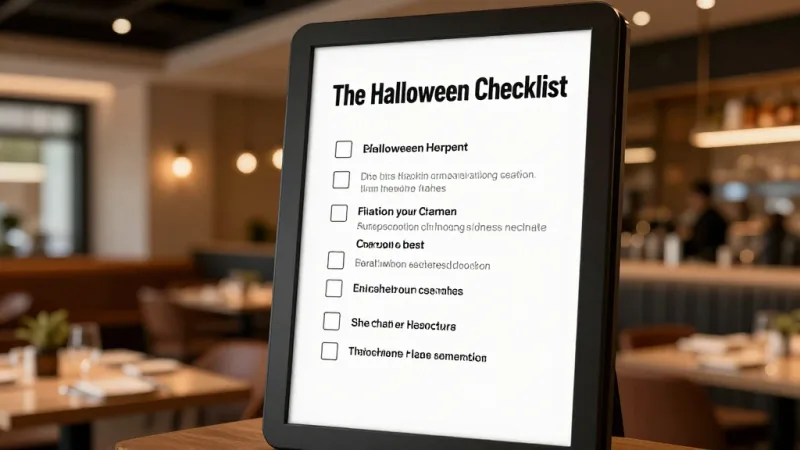
- Lock the format: Decide your headline event — costume contest, kids' afternoon, ticketed haunted dinner, or a combination — and set the dates, times, and prize.
- Design the menu: Build three to five photogenic, low-complexity themed items and price them as occasion anchors, not volume plays. Label them "October 31 only."
- Build the POS layout: Pre-load every themed item and combo as one-tap buttons, set split-check and tap-to-pay defaults for big parties, and configure the loyalty and "kids eat free" logic to fire automatically.
- Invest the decor budget right: Put most of it into one spectacular, reusable photo feature with your hashtag posted beside it. Skip the scattered filler.
- Stand up the gift card push: Bonus-card promotion live for the night, e-gift cards ready as contest prizes, cards merchandised at the register for early holiday shoppers.
- Run the social run-up: Announce three weeks out, build daily the week of, and send a "tonight!" email and SMS blast to your list on Halloween day. Update your Google Business Profile.
- Capture everyone: Loyalty and points enrollment at every checkout, a short-fuse return offer to every table, and the membership tie-in on every contest entry and kids' meal.
- Review the next morning: Pull POS reports — covers, average check, themed-item take rate, gift card sales, new loyalty sign-ups — and write down what to repeat and what to cut for next year while it's fresh.
Halloween only stays flat for the restaurants that treat it like an ordinary Tuesday with pumpkins. Treat it as an event — engineered offers, a room built for the camera, a checkout that captures every guest, and a loyalty program that keeps them — and October 31 stops being a night you ignore and becomes the launchpad for your best quarter of the year.
Build Your Halloween Event on a POS That Captures Every Guest
KwickOS runs your biggest fall night with offline-proof checkout, one-tap themed-menu and split-check buttons, built-in gift cards and e-gift cards, loyalty enrollment at the terminal, and your own payment processor. See how it turns a one-night crowd into a year-round customer list.
See KwickOS for RestaurantsFrequently Asked Questions
Is Halloween actually a good night for restaurants?
It can be one of the best, but only for the operators who treat it as an event instead of an ordinary night. Halloween falls in late October, a quiet stretch between the back-to-school slump and the holiday rush, and it lands on a different weekday every year. Restaurant industry data suggests consumers spend billions on Halloween annually, and a meaningful share of that is on experiences and dining out. A restaurant that builds a themed event — costume contest, special menu, decor, social-media moment — can turn an unremarkable Thursday into a packed, high-check night, while the restaurant next door treats October 31 like any other shift and captures none of it.
What are the best Halloween promotions for a restaurant?
The highest-performing Halloween promotions are built around participation and shareability: a costume contest with a real prize and a social-media tie-in, a limited-time themed menu with a few signature spooky dishes and cocktails, a family-friendly kids' afternoon with trick-or-treating and crafts, and for the right concept, a haunted or immersive dining experience with a ticketed cover. Each one gives guests a reason to choose you over staying home, and a reason to post about it — which markets next year's event for free.
How much should a restaurant spend on Halloween decorations?
Treat decorations as a marketing investment with a measurable return, not a seasonal expense. A focused budget of a few hundred dollars on one genuinely photogenic feature — a dramatic entrance, a single "photo wall," or a signature centerpiece — outperforms a few thousand dollars of scattered cobwebs. The metric that matters is social reach: one share-worthy installation that guests photograph and post turns your decor budget into free local advertising. Reuse durable pieces year over year to drive the per-night cost down further.
How do gift cards fit into a Halloween restaurant campaign?
Halloween sits right at the front edge of the gifting season, so it is the moment to launch your holiday gift card push. Run a bonus offer ("Buy $50, get a $10 bonus card") starting on Halloween night while the dining room is full and engaged, sell e-gift cards as instant prizes for the costume contest, and merchandise cards at the register for the early holiday shopper. The cash lands now, the redemption visit comes later, and the slice of every batch that is never fully redeemed pads your margin.
How do you turn a one-night Halloween crowd into repeat customers?
Capture every guest at checkout. Enroll them in your loyalty, points, or membership program right at the terminal, tie the costume-contest entry or a return offer to signing up, and let a tap-to-pay POS with built-in CRM link each guest's contact and order history to a profile automatically. A packed Halloween night then becomes a warm marketing list you can use for the entire holiday season — Thanksgiving catering, holiday party bookings, and gift card campaigns — at near-zero cost.