 Kelly Ho
You just hired a new server. They have three years of experience — at a casual Italian place. They can carry plates and smile. But they have never decanted a Barolo tableside, never memorized a 14-course tasting menu, and never managed a table of six where three guests have different dietary restrictions and one is celebrating a promotion they have not announced yet.
Here is the problem: most fine dining restaurants hand new hires a binder, pair them with a senior server for three shifts, and throw them on the floor. The result? According to restaurant industry data, the average fine dining establishment loses $5,800 per bad hire in direct costs alone. Factor in lower check averages, comped plates, and the one-star review that mentions "our server seemed lost" — and you are looking at $14,000 to $28,000 in damage before that person either improves or quits.
But it gets worse: turnover in full-service restaurants runs around 75% annually. That means you are repeating this expensive cycle three or four times per position, every single year.
The restaurants that break this cycle — the ones with servers who make $400 tables feel like $4,000 experiences — all share one thing. They do not "onboard" staff. They run a structured 30-day training program that transforms competent servers into polished professionals.
This is that program.
Why Structured Training Pays for Itself in 30 Days
Before we walk through the program day by day, let us talk money — because if you cannot justify the investment, the rest does not matter.
A properly trained fine dining server generates 15-22% higher check averages than an undertrained one. On a $120 average check, that is $18-$26 more per table. Multiply by 20 tables per shift, five shifts per week, and you are looking at $1,800 to $2,600 per server per month in additional revenue.
And that is not all: trained servers also turn tables 12% faster without guests feeling rushed, because they know the service choreography. They hit their marks. Drinks arrive before menus close. Appetizers land during conversation lulls. The check appears the moment the last coffee cup goes down.
Industry research suggests restaurants with structured training programs see 40% lower staff turnover. When replacing a server costs $5,800, keeping four extra servers per year saves you $23,200 — before counting the revenue difference.
Now here is the open loop: the program below is organized into three phases. Phase 1 (Days 1-10) builds the foundation. Phase 2 (Days 11-20) develops the art. Phase 3 (Days 21-30) proves competency on the floor. But there is a secret weapon in Phase 2 that most training programs miss entirely — and it is the single biggest driver of check-size increases.
Phase 1: Systems, Standards, and POS Mastery (Days 1-10)
The first ten days are about removing uncertainty. A new server who does not know where the extra napkins are stored, how to ring in a substitution, or what the allergy protocol is — that server is operating in survival mode, not service mode.

Days 1-2: Orientation and Observation
Day one is not about the new hire doing anything. It is about watching. Pair them with your strongest server — not your most experienced, your strongest — and have them shadow a full dinner service. No serving, no side work, just observation with a notepad.
Before the shadow shift, spend 90 minutes covering:
- Your service philosophy in three sentences or fewer. At Shogun Japanese Hibachi, this is: "Every guest should feel like the only guest. Speed is invisible. Surprises are always positive."
- The physical layout — kitchen flow, server stations, storage, restrooms, emergency exits, POS terminal locations.
- The dress code and grooming standards — down to nail length, fragrance policy, and shoe requirements.
Day two is a reverse shadow: the new hire attempts to narrate the service sequence while observing. "Now she is presenting the wine list because the guest ordered a cocktail first, which means..." This narration reveals gaps immediately.
Days 3-5: Menu Mastery
Here is the thing: memorizing a menu is not the same as knowing a menu. Your servers need to eat every dish on the menu. Not taste — eat. A full portion, with the intended plating, garnish, and sauce. This costs money. It is the best money you will spend on training.
Each day, cover one section of the menu:
- Day 3 — Appetizers and soups. For each dish: ingredients, preparation method, allergens, dietary flags (GF, vegan, can-be-modified), the chef's inspiration, and two personal descriptors the server will use ("the burrata is impossibly creamy — the tomato confit gives it this slow-roasted sweetness").
- Day 4 — Entrees. Same depth, plus cooking temps for proteins, standard sides, available modifications, and which dishes take longer (so the server can manage expectations).
- Day 5 — Desserts, cheese courses, and after-dinner offerings. This is where gift cards and loyalty programs become natural conversation tools — "We also offer e-gift cards if you would like to share this experience with someone."
End each day with a verbal quiz: 20 rapid-fire questions. "What is in the bouillabaisse?" "Can the risotto be made vegan?" "Which entree takes the longest?" Minimum passing score: 90%.
Days 6-8: POS System Proficiency
This is where most training programs collapse. They spend three hours showing the new hire how to ring in orders and move on. But the POS is the central nervous system of service — and in fine dining, the server who fumbles at the terminal loses the room.
Your POS training should cover, at minimum:
- Order entry and modifiers — Every modification, allergy flag, and special request the kitchen needs to see, entered correctly on the first try.
- Course firing — How to hold courses, fire courses, and coordinate multi-course service through the POS so the kitchen is never guessing.
- Split checks and payment processing — Including credit card, cash, gift card redemption, and e-gift card lookup. A server who says "I'm not sure how gift cards work" at a $600 table has lost the room.
- Loyalty and membership enrollment — How to mention the loyalty program during payment without making it feel transactional. "Would you like me to add your points to tonight's dinner? We have a program that rewards our returning guests."
- Void and comp procedures — When to comp, when to void, what requires manager approval, and how to document everything.
With a system like KwickOS, this process is dramatically faster. The hybrid local+cloud architecture means the POS responds in 1ms locally — no lag between touching a modifier and seeing it register. Servers coming from cloud-only systems like Toast are visibly surprised by the speed. At Shogun Japanese Hibachi, new operators reached proficiency in under 5 minutes because the interface mirrors how a server actually thinks about an order — courses, modifiers, and timing — rather than forcing them to navigate through nested menus.
The fingerprint 1:N authentication also eliminates a common fine dining friction point: server handoffs. When a captain transfers a table to a closer, both authenticate with a fingerprint — no shared PINs, no "who rang this in?" confusion during reconciliation.
Days 9-10: Side Work, Setup, and Service Choreography
Assign the new hire a full section setup — alone. Table settings, glassware placement, candle heights, menu positioning. Then have your front-of-house manager inspect against the standard. Every millimeter matters in fine dining, and this exercise builds the muscle memory.
Day 10 ends with a written exam covering everything from Phase 1: menu, POS procedures, service standards, emergency protocols, and allergen handling. Minimum score: 85%. If they do not pass, extend Phase 1 by three days. Rushing this phase costs more than repeating it.
Phase 2: Wine, Guest Reading, and the Art of the Upsell (Days 11-20)
This is where good servers become great ones. And here is the secret weapon we mentioned earlier: guest reading — the ability to identify what kind of experience a table wants within 90 seconds of greeting them.
Days 11-14: Wine and Beverage Mastery
Your servers do not need to be sommeliers. They need to be confident enough to make one excellent recommendation per table.
Structure it as four sessions:
- Day 11 — Wine regions and grape varieties relevant to your list. Skip the textbook approach. Teach them to say "This is a Willamette Pinot Noir — it's lighter and more earthy than what you'd get from Sonoma" instead of reciting acidity levels.
- Day 12 — Food and wine pairing principles. Three rules only: match weight, complement or contrast flavors, consider sauce over protein. Practice with your actual menu items.
- Day 13 — Tableside wine service. Opening, presenting, pouring, decanting. Practice until the foil comes off clean every time and the pour stops at exactly six ounces without looking at the glass.
- Day 14 — Cocktails, spirits, and non-alcoholic pairings. Non-alcoholic pairing is the fastest-growing segment in fine dining — a server who can recommend a craft mocktail with the same confidence as a Burgundy is a revenue asset.
The revenue impact: according to industry data, fine dining tables where the server makes a specific wine recommendation order a bottle 34% more often than tables where the server simply asks "Would you like to see the wine list?"
Days 15-17: Guest Reading
This is the skill that separates fine dining from expensive dining. Guest reading is the ability to identify, within 90 seconds of greeting, which of four service profiles a table needs:
- The Celebration — Anniversary, birthday, promotion. These tables want attention, surprises, and a story to tell. Upsell: champagne, tasting menu, dessert with a candle, a gift card for their next visit.
- The Business Dinner — Clients, negotiations, interviews. These tables want efficiency, control, and zero interruptions. Upsell: a great bottle of wine (ordered once, poured silently), premium entrees.
- The Foodie — Regulars, critics, chefs. These tables want information, insider knowledge, and kitchen access. Upsell: tasting menu, wine pairings, chef's off-menu specials.
- The First-Timer — First visit, possibly first fine dining experience ever. These tables want guidance without condescension. Upsell: guided recommendations ("May I suggest..."), loyalty program enrollment for their return.
How do you identify the profile? Arrival cues. The celebration table arrives excited, dressed up, taking photos. The business table arrives with a handshake and an agenda. The foodie asks about the specials before sitting down. The first-timer reads the menu with wide eyes.
Practice this with role-playing. Three rounds per day, with the trainer playing different guest profiles. After each round, the trainee identifies the profile and adjusts their service approach. By Day 17, identification should be automatic.
Days 18-20: The Revenue Conversation
Here is where you teach servers to sell without selling. The framework is Recommend, Reason, Relate:
- Recommend specifically: "The dry-aged ribeye tonight" — not "our steaks."
- Reason personally: "Chef aged it 45 days in-house — the flavor is nuttier and more intense than anything I've had anywhere else."
- Relate to the guest: "Since you mentioned you love bold flavors, this would be perfect with the 2019 Barolo."
Practice scripts for the five highest-margin items on your menu. Practice dessert closes. Practice the gift card mention that does not feel forced: "If you enjoyed tonight, our e-gift cards let you share this with someone — we can set one up right at the table."
Track the numbers. Your POS should show per-server check averages, wine attachment rates, and dessert conversion rates. With KwickOS, these metrics update in real time — managers can check a trainee's performance on their phone mid-service using the mobile reporting dashboard. This immediate feedback loop is what makes Phase 2 training stick.
Phase 3: Supervised Floor Service (Days 21-30)
The trainee is on the floor now. But they are not alone — and the supervision decreases gradually over ten days.
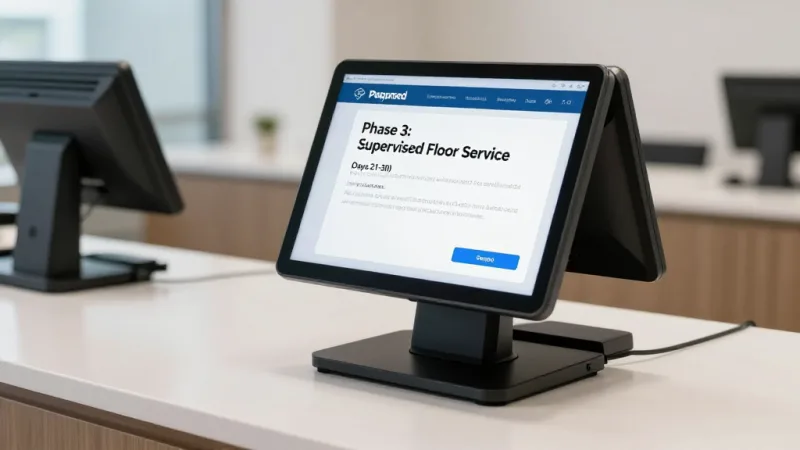
Days 21-23: Paired Service (Full Supervision)
The trainee works a full section alongside a senior server. The trainee leads every interaction — greeting, ordering, serving, payment — while the senior observes and only intervenes when necessary. After each shift, a 20-minute debrief covers what went well, what needs work, and specific corrections.
Critical checkpoint: by Day 23, the trainee should process payments confidently — including split checks, gift card transactions, and loyalty point enrollment — without hesitation. At T. Jin China Diner, where 15 locations run 75 terminals, standardized POS training means a server trained at one location can work at any of the other 14 without retraining on the system. That is the value of a processor-agnostic, consistent platform.
Days 24-27: Supported Service (Light Supervision)
The trainee works their own section independently, but a senior server is assigned as a safety net on an adjacent section. The trainer checks in twice per shift — once during service, once after — rather than observing continuously.
During this phase, introduce two controlled challenges:
- The Allergy Test — Have a manager sit in the section and mention a nut allergy. Evaluate the trainee's response: Do they flag it in the POS? Inform the kitchen? Confirm with the guest before serving? Follow up after the dish arrives?
- The Recovery Test — Simulate a minor service failure (delayed course, incorrect modification) and evaluate the trainee's recovery. Do they acknowledge, apologize, offer a solution, and follow up? Do they know when a comp is appropriate and how to process it through the POS?
Days 28-30: Independent Service (Final Evaluation)
Full section, no safety net, but with a structured evaluation. The front-of-house manager evaluates three shifts against a rubric covering:
| Metric | Target | How to Measure |
|---|---|---|
| Average check size | Within 10% of house average | POS per-server report |
| Wine/beverage attachment | 65%+ of tables | POS attachment rate |
| Dessert conversion | 40%+ of tables | POS dessert category report |
| Table turn consistency | Within 5 min of house average | POS time tracking |
| Guest satisfaction | Zero complaints, positive feedback | Manager observation + reviews |
| POS accuracy | <2% void/comp rate | POS void report |
If the trainee meets all targets across three evaluation shifts, they graduate. If they miss on one or two metrics, extend by one week with focused coaching on the gap areas. If they miss on three or more, have an honest conversation about fit.
The Technology That Makes Training Stick
Here is the thing about even the best training program: it falls apart if your technology fights your service standards.
A POS that lags during order entry breaks the rhythm of tableside service. A system that requires managers to be physically present to run reports means trainee performance goes unmonitored during busy shifts. A platform that locks you into one payment processor means you are paying a premium on every transaction — $3,000 to $8,000 more per year — that could fund your training program instead.
KwickOS was built for exactly this kind of operation. The hybrid local+cloud architecture delivers 1ms response times at the terminal — no waiting, no lag, no awkward silence while the system thinks. The mobile reporting lets managers monitor trainee metrics in real time from anywhere. The multi-language support (English, Chinese, Spanish) means training materials and POS interfaces work for your entire team.
And because KwickOS is processor-agnostic, you are not bleeding an extra $4,000-$8,000 per year to a locked-in processor like Toast. That savings alone covers your annual training investment — and then some.
Crafty Crab Seafood runs this approach across 19 locations and 152 terminals. Their standardized POS training means a server trained at one location transfers to another with zero system retraining — just menu and culture adaptation. That portability cuts onboarding time at new locations by over 60%.
Building a Training Culture, Not Just a Training Program
The 30-day program gets new hires to competency. But the restaurants that consistently deliver extraordinary service go further — they build a training culture where learning never stops.
- Weekly wine flights — 15 minutes before service, every Tuesday. Three wines, staff tastes blind, then learns region and pairing notes. This keeps wine knowledge fresh and builds team culture.
- Monthly menu updates — When the chef changes dishes, every server eats the new items. No exceptions. Use this as an opportunity to refresh upselling scripts.
- Quarterly performance reviews — Use POS data (check averages, attachment rates, void percentages) as objective benchmarks. With KwickOS, you can pull per-server reports in seconds and compare against house averages over any time period.
- Peer mentorship — Assign senior servers as ongoing mentors, not just during training. Schedule monthly one-on-ones where the mentor reviews a recent shift together with the mentee.
- Guest feedback loops — Route review mentions of specific servers back to them — both positive and constructive. A server who sees "Our waiter Michael made the evening unforgettable" in a review is a server who stays.
Diva Nail Beauty took a similar approach in the beauty space — their structured training and automated commission tracking across 4 stores produced a 90% efficiency increase. The principle is the same: when staff know exactly what is expected, how they are measured, and that the system is fair, performance follows.
The 30-Day Investment That Pays for Years
Let us bring it back to numbers. A 30-day structured training program costs approximately $2,000-$3,500 per hire when you factor in reduced productivity during training, food tastings, and manager time. That sounds like a lot until you compare it to the alternative.
Without structured training, you are paying $5,800 per bad hire in direct costs, losing $14,000-$28,000 in indirect costs, and cycling through 3-4 servers per position per year. That is $60,000+ in annual waste for a restaurant with just five server positions.
With structured training, you invest $12,000 to train four servers who stay 18 months instead of 6 months, generate 18% higher per-cover revenue, and contribute to the kind of consistent service that builds a reputation.
Your food can be replicated. Your decor can be copied. But a service culture built on a structured 30-day training program, supported by technology that makes excellence frictionless, and reinforced by data that makes performance visible — that is a competitive advantage nobody can take from you.
Build Training on a Platform That Keeps Up
KwickOS gives fine dining teams 1ms POS response times, real-time per-server reporting, and processor-agnostic freedom that saves thousands per year. See how it transforms your front of house.
Schedule a Demo