 Kelly Ho
Here's the situation you're in, whether you've noticed it or not.
Every few weeks, a customer pulls out their phone instead of their wallet and asks if you take crypto. It's still rare — but it's not zero anymore. And every time you say "no," you feel a tiny flicker of doubt: Am I behind? Is this the future? Am I about to look like the store that refused to take credit cards in 1995?
Then you read a headline about Bitcoin crashing 40% in a week, and the doubt flips the other way: Why would I ever let my revenue ride on that rollercoaster?
So you do nothing. Which might be the right call — or might be leaving money and customers on the table. The problem is, almost nobody actually runs the numbers before deciding. They react to hype or to fear, not to math.
Let's fix that. This is the honest, no-hype breakdown of what accepting cryptocurrency really costs, what it really earns, who really wants it, and whether it belongs anywhere near your POS checkout in 2026. By the end you'll be able to answer that counter question with a decision, not a shrug.
The Number Everyone Argues About: How Many Customers Actually Want This?
Start here, because everything else depends on it. The whole case for crypto rests on demand — and the demand is real but small.
Survey data across the U.S. retail market consistently lands in a narrow band: somewhere around 2% to 4% of consumers say they'd choose to pay with cryptocurrency if given the option at a physical store. Call it roughly 1 in 40 customers. Ownership is higher — depending on the survey, 15% to 20% of American adults hold some crypto — but holding it and wanting to spend it at your café are two very different things. Most holders treat it as an investment, not a checking account.
Here's the thing, though: that small percentage isn't spread evenly. It clusters hard around specific customer profiles:
- Age. Crypto interest skews heavily toward the 18–40 range. If your customer base is young, the "2%" at the population level might be 8% or 10% in your actual line.
- Tech and gaming. Computer shops, gaming lounges, co-working spaces, and anything adjacent to the tech industry see far higher demand.
- International and travel. Tourists and immigrants sometimes prefer crypto to avoid foreign-exchange fees and card-abroad surcharges.
- High-ticket and luxury. Jewelers, electronics, furniture, and premium services see crypto used on big purchases where buyers want to move value without a wire transfer.
So the real first question isn't "does anyone want crypto?" It's "do my customers?" A downtown bubble-tea shop near a university campus and a suburban dry cleaner will get wildly different answers. Keep that in mind — it's the fork in the road that most of this article comes back to.
What It Actually Costs (Spoiler: Less Than Your Credit Card Fees)
This is the part that surprises people, because the hype cuts both ways. Crypto skeptics assume it's expensive and complicated. On the pricing side, the opposite is true.
When you accept crypto through a payment processor — the sane way to do it, which we'll get to — the typical merchant fee is around 1% per transaction. Compare that to the 2.5% to 3% effective rate most small businesses pay on credit cards, and crypto is genuinely cheaper per dollar.
| Payment method | Typical fee | Chargebacks? | Settlement |
|---|---|---|---|
| Credit card (flat-rate) | 2.6% + $0.10 | Yes — can be reversed for months | 1–2 days |
| Credit card (interchange-plus) | ~2.1%–2.4% | Yes | 1–2 days |
| Crypto (via processor, auto-convert) | ~1% | No — payments are final | Next business day |
And that second column is the underrated one. Crypto payments have no chargebacks. Once a blockchain transaction confirms, it's settled — there's no card network for a customer to call and dispute the charge weeks later. For businesses that get hammered by friendly fraud (online orders, high-ticket retail, anything shipped), eliminating chargebacks can be worth more than the headline fee savings.
But — and this is the catch that deflates the whole "crypto is cheaper!" pitch — a 1.5% saving only matters on the sales where it actually happens. If crypto is 2% of your volume, you're saving about 1.5% on 2% of sales. That's a rounding error on your P&L. The pricing advantage is real; the scale is not. Hold that thought, because it's the crux of the whole "worth it or hype" question.
The Volatility Fear — And Why It's Mostly Solved
"But what if a customer pays me $50 in Bitcoin and it's worth $32 by dinner?" This is the objection that stops most owners cold. It's also the one that's easiest to make disappear.
The solution is auto-conversion, and it's the default setting on every reputable crypto processor. Here's how it works: at the moment the customer pays, the processor locks the exchange rate, accepts the crypto, and instantly converts it to U.S. dollars. You get $50. Your bank account gets $50. What Bitcoin does an hour, a day, or a month later is completely irrelevant to you, because you never held it.
In practice, accepting an auto-converted crypto payment feels no different from a card sale. Money comes in as dollars. You never open a crypto wallet, never watch a chart, never think about the price. The volatility is the processor's problem for the few seconds they hold the coin — and they hedge it.
Volatility only becomes your risk if you deliberately choose to hold the crypto instead of converting it — betting the price goes up. Some owners do this. For the overwhelming majority of small businesses, that's speculation, not payment acceptance, and it doesn't belong in your operating account. Convert to dollars, sleep at night, move on.
Setup: It's a QR Code, Not a Terminal
Another myth worth killing: you don't need special hardware. Nobody's selling you a $600 "crypto terminal."
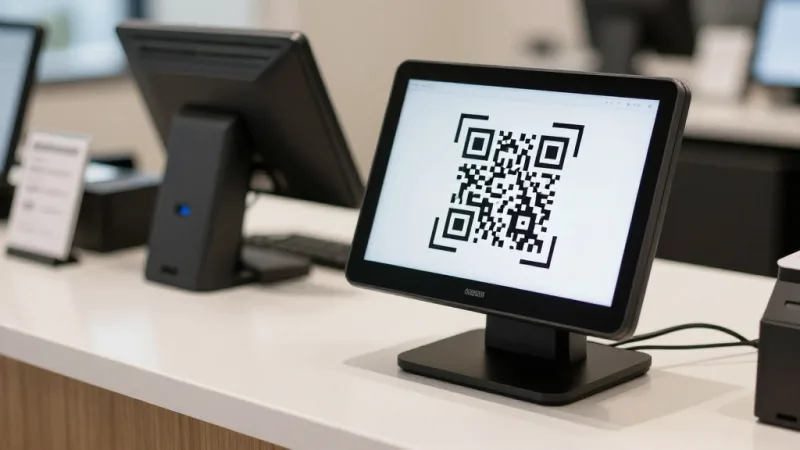
To accept crypto in person, you sign up with a processor — the common names are BitPay, Coinbase Commerce, and Strike — and the checkout flow looks like this:
- Your POS or the processor's app generates a QR code showing the amount due (say, $50, displayed in the customer's chosen coin).
- The customer scans it with their crypto wallet app and confirms.
- The transaction confirms on the blockchain — usually seconds for modern networks — and the processor shows a "paid" checkmark.
- You're settled in dollars the next business day.
For online orders, it's even simpler: the processor drops a "Pay with Crypto" button into your checkout page, the same way you'd add a "Pay with PayPal" option. No terminal, no wallet management, no blockchain knowledge required from you or your staff.
The one real friction point is that crypto sits outside most POS systems as a bolt-on. You're often reconciling a separate processor dashboard against your sales reports at the end of the day. That's fine at low volume — but it's exactly the kind of side-system sprawl that a unified platform is built to absorb. On a processor-agnostic setup like KwickOS, you're already free to plug in the payment rails that fit your business rather than being locked into one vendor's mandatory processing, which is the same freedom that lets a merchant add a low-fee crypto option without ripping anything out. (More on why that freedom matters in our credit card processing fees guide.)
The Tax Reality Nobody Mentions in the Sales Pitch
Here's where "just hold the Bitcoin, it might moon" quietly turns into a bookkeeping nightmare. Pattern interrupt: the IRS does not think of crypto as money.
In the United States, the IRS treats cryptocurrency as property, not currency. What that means for you depends entirely on whether you convert:
- If you auto-convert to dollars at checkout: life is easy. You record ordinary business income at the dollar amount you received — identical to a card sale. Your accountant never has to know a coin was involved.
- If you hold the crypto: every future moment you sell it, spend it, or convert it is a separate taxable event. You have to track the value when you received it (your cost basis) and the value when you disposed of it, and report the capital gain or loss on each one. Do that across hundreds of transactions and you've created a part-time accounting job for yourself.
This is the single strongest argument for auto-conversion, and it has nothing to do with price risk. It's about keeping your books boring. Boring books are cheap books. The moment you start holding crypto, you've signed up for capital-gains tracking that will cost you more in accountant hours than the payment ever earned you.
None of this is tax advice — talk to your CPA before you flip any switch — but the direction is clear: convert to dollars and your tax treatment stays as simple as the day before you added crypto.
So… Worth It or Hype? Here's the Honest Verdict
After all that, you want a straight answer. Here it is, split by who you actually are.
Crypto is probably worth it if…
- Your customers skew young, tech-forward, gaming, or international.
- You sell high-ticket items where a 1.5% fee saving on a $2,000 sale is real money and chargeback elimination matters.
- You want a low-cost marketing signal — "We accept crypto" is a genuine differentiator that earns social posts, press mentions, and a certain kind of customer loyalty. For a small business, being the first in your neighborhood to accept it can be worth more as a story than as a payment method.
- You're online-first and already fighting chargeback fraud.
Crypto is mostly hype if…
- You run an everyday quick-service, convenience, or personal-services business with an older or local customer base.
- Your average ticket is small, so per-transaction fee savings are trivial.
- You're hoping it'll meaningfully grow revenue. It won't — not at 2% demand. It's a convenience and a signal, not a growth engine.
The fair conclusion for the average operator: accepting crypto is a cheap, low-risk add-on that occasionally delights a customer and makes a nice marketing line — but it is nowhere near the top of the list of things that will actually move your numbers. Which brings us to what is.
The Payment Play That Beats Crypto for Almost Everyone
Here's the uncomfortable truth the crypto conversation distracts from: while you're debating a payment method that 2% of customers want, there's a set of tools that every customer can use and that reliably pull cash forward into your business. Prepaid value.
Gift cards and e-gift cards, stored-value top-up accounts, and loyalty and membership programs do something crypto can't: they get customers to pay you before they consume, often with a bonus incentive, and they tie that customer to your brand every time they reload. Think about the mechanics:
- A gift card collects revenue today for a visit that might happen next month — and 10% to 15% of the value typically goes unredeemed, which is pure margin (breakage). Our gift card program launch checklist walks through standing one up in about two weeks.
- A stored-value account with a "load $100, get $115" bonus turns a one-time buyer into a prepaid regular whose next several visits are already funded.
- A loyalty or membership program with points and rewards changes behavior at the checkout — customers spend more and come back more to hit the next tier. If you're weighing structures, our points vs. membership comparison lays out which fits which business.
Here's the contrast that should reframe the whole decision. Crypto is a cheaper way to accept a payment from a tiny slice of customers. Gift cards, e-gift cards, and loyalty are ways to collect more revenue, earlier, from all of them. One is a fee optimization on the edge. The other is a growth lever in the middle. On KwickOS, all of it — POS checkout, gift cards, e-gift cards, stored value, and points — lives in one platform at no extra processing markup, so the money you save on fees isn't clawed back by add-on subscriptions.
That's not an argument against crypto. It's an argument for perspective: add crypto if it fits your crowd, but don't let a shiny payment method pull your attention away from the prepaid-and-loyalty stack that will do far more for your bottom line.
A Practical Path Forward
If you've read this far and you're leaning "let's try it," here's the low-risk way to start without betting the business on it:

- Confirm the demand first. For two weeks, have staff note every time a customer asks about crypto. If it's happening several times a week, there's a case. If it's crickets, you have your answer.
- Pick a processor and turn on auto-conversion. BitPay, Coinbase Commerce, or Strike. Convert to dollars every time. Never hold.
- Keep it as a QR add-on, not a replacement. Cards and prepaid stay your backbone; crypto is the extra option.
- Market the fact that you accept it. The signal is where most of the value is — a window sticker and a social post cost nothing and reach exactly the customers who care.
- Put your real energy into the prepaid stack. Gift cards, stored value, and loyalty first — crypto second.
Want to see how the whole payment mix — cards, prepaid, loyalty, and optional add-ons — nets out for your specific volume? Run your numbers through our processing fee calculator, or compare platforms head-to-head on our POS comparison pages. And if you run a restaurant or retail shop and want to see how checkout, gift cards, and loyalty fit together in one system, our restaurant platform overview and retail overview show the full picture. Resellers building a payments-and-loyalty offer for their own merchants can find the same tools on our partner program page.
Build a Checkout Customers Actually Use
KwickOS puts POS checkout, gift cards, e-gift cards, stored value, and loyalty in one processor-agnostic platform — so you keep more of every dollar and add the payment options that fit your business. See how much the right mix saves you.
Calculate Your SavingsFrequently Asked Questions
How do I accept cryptocurrency payments at my small business?
You use a crypto payment processor such as BitPay, Coinbase Commerce, or Strike. The customer scans a QR code at checkout, the processor converts the crypto to dollars instantly at the moment of sale, and you receive U.S. dollars in your bank account the next business day. You never have to hold the coin or watch its price. Setup is a QR code on your existing screen or a link in your online checkout — no special terminal required.
What does it cost to accept crypto payments?
Most crypto payment processors charge about 1% per transaction, which is lower than the 2.5% to 3% you typically pay on credit cards. There are no chargebacks, because blockchain payments are final once confirmed. The trade-off is low customer demand — only a small share of shoppers currently want to pay in crypto — so the savings apply to a thin slice of your sales.
Do I have to worry about Bitcoin's price crashing after a customer pays?
No, as long as you use auto-conversion. Reputable crypto processors lock the exchange rate for a few minutes at checkout and settle you in U.S. dollars, so a $50 sale is a $50 deposit regardless of what Bitcoin does an hour later. Volatility only becomes your problem if you choose to hold the cryptocurrency yourself instead of converting it, which most small businesses should not do.
How are crypto payments taxed for a small business?
The IRS treats cryptocurrency as property, not currency. If you auto-convert to dollars at the point of sale, you simply record ordinary business income at the dollar amount received, just like a card sale. If you hold the crypto, every later sale or spend of it is a taxable event that can create a capital gain or loss you must track. Auto-conversion keeps your bookkeeping identical to normal card revenue. Always confirm your situation with a CPA.
Is accepting crypto worth it for most small businesses in 2026?
For most everyday retail and restaurant businesses, crypto is a low-cost, low-effort add-on rather than a game-changer, because demand is still small. It makes the most sense as a marketing and differentiation play, or for businesses serving tech-forward, younger, or international customers. Prepaid gift cards, stored-value accounts, and loyalty programs will move far more revenue for the average operator, and cost less to run.