
 Tom Jin
You open at 6 AM. It's raining. The street is empty. The morning rush that usually brings 90 customers between 7 and 9? Today it's 41.
That's $220 in lost revenue before lunch. And there's nothing you can do about it — the rain, the construction on Main Street, the holiday weekend that sent everyone to the beach. Traditional coffee shop revenue is hostage to factors completely outside your control.
But it gets worse: while your revenue fluctuates wildly, your costs stay perfectly fixed. Rent doesn't care about the weather. Your baristas don't work for free on slow days. That $0.65 latte you prepped at 5:30 AM costs the same whether someone buys it or not.
Here's the thing: some coffee shops have figured out how to make revenue as predictable as rent. They charge customers $29 per month for one drink per day. The customer feels like they're getting a deal. The shop gets guaranteed money deposited on the 1st of every month, regardless of rain, construction, or holidays.
340 members × $29/month = $9,860 in recurring revenue. That covers rent and then some — before you sell a single walk-in cup.
This is the coffee subscription model. And it's not a gimmick. It's the most significant shift in coffee shop economics since the loyalty punch card. This guide breaks down exactly how to build one — the pricing math, the break-even analysis, the POS setup, and the retention strategies that keep members paying month after month.
Why Coffee Subscriptions Work (The Psychology and the Math)
Coffee subscriptions exploit a well-known principle in consumer psychology: people overestimate how often they'll use something they've already paid for. It's the same reason gym memberships are wildly profitable. The average gym member goes 4.5 times per month despite paying for unlimited access. Coffee subscriptions work the same way.
A subscriber paying $29/month for one drink per day has access to 30 drinks. But according to restaurant industry data, the average subscriber redeems 16 to 18 drinks per month. Some power users come every day. Many come 12 to 14 times. A meaningful percentage come fewer than 10 times.
Here's the math that makes it work for your shop:
| Variable | Value |
|---|---|
| Subscription price | $29/month |
| Average cost per drink (ingredients + cup) | $0.65 |
| Average drinks redeemed per member | 17/month |
| Cost per member per month | $11.05 |
| Profit per member per month | $17.95 |
Now multiply that across your membership base:
| Members | Monthly Revenue | Monthly Cost | Monthly Profit | Annual Profit |
|---|---|---|---|---|
| 50 | $1,450 | $553 | $898 | $10,770 |
| 150 | $4,350 | $1,658 | $2,693 | $32,310 |
| 340 | $9,860 | $3,757 | $6,103 | $73,236 |
And that's not all: the profit from the subscription itself is only half the story. The real goldmine is what subscribers buy on top of their free drink.
The Food Upsell Effect: Where the Real Money Hides
When a customer walks in knowing their coffee is "already paid for," something interesting happens at the POS checkout. Their mental accounting shifts. The $5.50 latte was the big purchase decision. Now that it's gone, the $4.50 croissant feels like a small add-on rather than part of a $10 morning expense.
Industry research suggests that subscription members purchase food items on 40% to 55% of their visits, compared to 25% to 30% for non-subscribers. That's nearly double the food attachment rate.
Let's put numbers on it:
| Non-Subscriber | Subscriber | |
|---|---|---|
| Visits per month | 8 | 17 |
| Food purchase rate | 28% | 47% |
| Food purchases per month | 2.2 | 8.0 |
| Avg food item price | $4.50 | $4.50 |
| Monthly food revenue | $9.90 | $36.00 |
| Monthly food profit (60% margin) | $5.94 | $21.60 |
That extra $21.60 in food profit per member per month adds $7,344 per month with 340 subscribers. Combined with subscription profit, you're looking at $13,447/month — or $161,364/year — in total profit from the program.
But here's the kicker: subscribers don't just buy food. They also buy drinks for friends who are with them. They upgrade to larger sizes. They add an extra shot. The subscriber's "free" drink becomes the anchor that pulls in additional spend on every visit.
Pricing Your Subscription: The Three-Tier Strategy
One price point is a take-it-or-leave-it gamble. Three price points use proven membership tier psychology — most customers default to the middle option, giving you control over where the majority lands.
Tier 1: The Drip — $19/month
One drip coffee or cold brew per day. No espresso drinks. This tier exists to anchor the perceived value of the middle tier. It also captures price-sensitive customers who might not subscribe otherwise. Your cost per redemption is roughly $0.35 (drip coffee is cheaper than espresso), so even daily users are profitable.
Tier 2: The Regular — $29/month
One drink per day, any menu item up to a large. This is where you want most subscribers. At $0.65 average cost and 17 average redemptions, your profit margin is 62%. The name "The Regular" subtly reinforces the identity — subscribers start thinking of themselves as regulars, which increases retention.
Tier 3: The VIP — $39/month
One drink per day (any size, any customization) plus 10% off all food and merchandise purchases. This tier exists to capture your highest-value customers and make the $29 tier look even more reasonable by comparison. The 10% food discount actually increases food purchases enough that total food profit goes up despite the lower margin.
According to industry research, three-tier pricing typically results in a 15/60/25 split — 15% choose basic, 60% choose middle, 25% choose premium. That blended average of $29.50/member is right where you want it.
And that's not all. Every subscription tier should include automatic enrollment in your loyalty and rewards program. Subscribers earn points on food purchases and merchandise, creating a second layer of engagement. Double points for VIP tier members. Birthday rewards for all members. This stacks two retention systems — the subscription keeps them paying monthly while the loyalty program keeps them buying food daily.
The Gift Card Connection Most Shops Miss
Here's a pattern interrupt for you: gift card subscriptions are the fastest-growing segment of coffee subscription programs, and almost no independent shop is doing it.
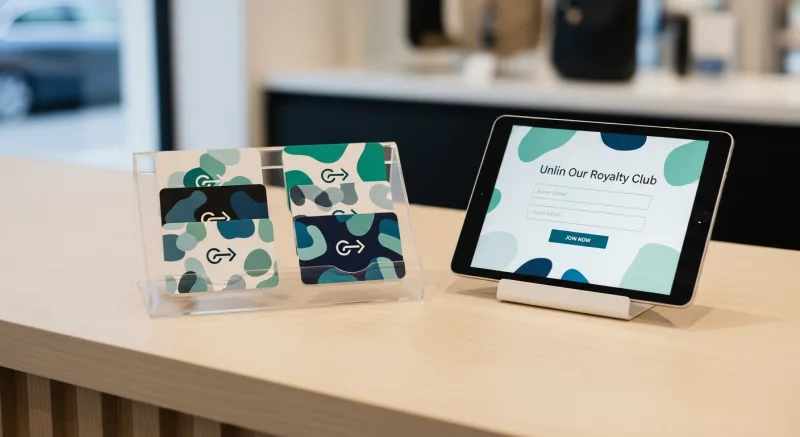
The concept is simple. Instead of — or in addition to — the drink-per-day model, you offer a stored-value subscription: customers load $40 onto their digital gift card each month and receive $50 in credit. That's a 25% bonus that costs you far less than 25% because of breakage (unused balance) and the time value of receiving cash upfront.
This model works especially well for customers who don't visit daily but want the feeling of a deal. It also converts naturally into e-gift card purchases — subscribers who love the program buy gift subscriptions for friends, family, and coworkers. During the holiday season, gift subscriptions can generate more revenue than regular subscriptions.
Your POS system needs to handle both models seamlessly. Auto-billing, balance tracking, daily redemption limits, and the ability to send e-gift cards directly from the checkout terminal are all essential. Systems that can't do this force you into spreadsheet tracking, which breaks down the moment you pass 50 members.
Setting Up Your POS for Subscription Success
The operational backbone of any subscription program is your POS system. If your POS can't identify members at checkout, track daily redemptions, auto-bill monthly, and report on member behavior, your program will either fail or become a management nightmare.
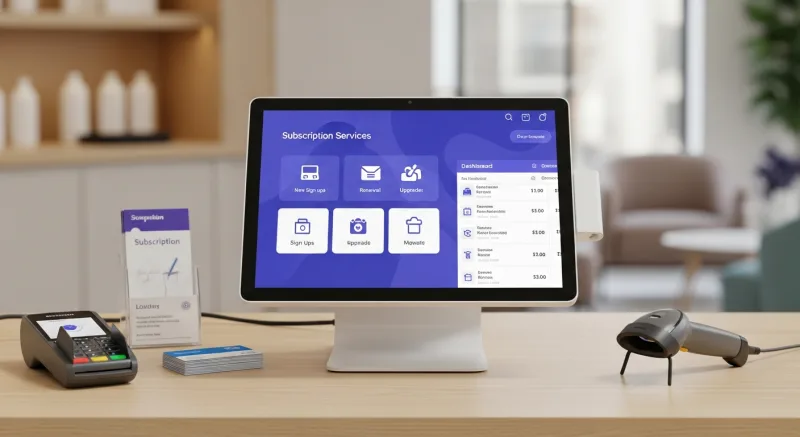
Here's what your POS checkout flow should look like for a subscription member:
- Member identification — Customer scans their phone (QR or app), taps their loyalty card, or the barista pulls up their profile by name or phone number. KwickOS supports fingerprint 1:N identification, meaning a member can simply touch the reader and be identified in under a second — no cards, no apps, no friction.
- Subscription validation — The system checks: Is their subscription active? Have they already redeemed today? What tier are they on? This happens instantly and displays on the barista's screen.
- Order entry — The barista enters the drink. If it's within their tier allowance, the subscription covers it. If they want add-ons outside their tier (extra shot, larger size), the POS shows the difference to charge.
- Upsell prompt — The POS displays a food suggestion based on the time of day: pastries in the morning, sandwiches at lunch. This isn't accidental — programmed upsell prompts increase food attachment by up to 15%.
- Payment and points — The food and any upgrades are charged. Loyalty points are earned. The receipt shows their remaining subscription benefits and points balance.
This entire process should take under 15 seconds. Anything longer and you're creating a bottleneck during morning rush — exactly when your subscription members are most likely to visit.
One thing most coffee shops overlook: your POS should also track which drinks subscribers order most frequently. This data tells you what to stock, what to promote, and what to include in your limited-time seasonal offerings. With KwickOS processing over $2M in daily transactions across 5,000+ businesses, this kind of pattern data is already built into the reporting dashboard.
The Break-Even Analysis: When Does This Pay Off?
Before you launch, you need to know your numbers. Here's the honest break-even calculation:
Setup costs:
- POS configuration for subscription management: $0 (if your POS supports it natively)
- In-store signage and counter displays: $150–$300
- Social media content and launch promotion: $200–$500
- Staff training (1 hour): minimal
Total launch investment: $350 to $800.
At $17.95 profit per member per month (subscription profit alone, not counting food upsells), you need 20 founding members to cover your launch costs in month one and start generating pure recurring profit from month two onward.
But it gets worse — for your competitors, that is. Because while they're fighting for every walk-in customer, chasing Yelp reviews, and praying for good weather, you're collecting $9,860 on the 1st of every month regardless. That predictability changes everything about how you run your business. You can forecast inventory. You can schedule staff with confidence. You can negotiate better terms with suppliers because you can guarantee volume.
Member Retention: The Strategies That Keep Cancellation Below 6%
The subscription model only works if members stay. According to industry data, the average subscription service loses 8% to 12% of members per month. Coffee subscriptions perform better — typically 4% to 7% monthly churn — because the product is a daily habit rather than an occasional purchase.
Here are the retention tactics that keep your churn at the low end:
1. The "Pause, Don't Cancel" option. When a member clicks cancel, offer a pause instead — one month free, then auto-resume. According to industry research, 40% of would-be cancelers choose pause, and 60% of those eventually resume their subscription.
2. Usage nudges. If a member hasn't visited in 5 days, send an automated text: "Your morning latte misses you. Come in this week and add a free flavor shot to any drink." This costs you $0.15 in syrup and saves you $29/month in subscription revenue.
3. Surprise upgrades. Once per month, randomly upgrade a subscriber's drink — free extra shot, free size upgrade, free flavor add-on. The barista says "This one's on us today." The cost is negligible. The emotional impact is enormous. This is the "variable reward" principle that makes slot machines and social media feeds addictive.
4. The annual plan discount. Offer 2 months free when subscribers commit to an annual plan ($290/year instead of $348). This locks in revenue, reduces churn to near-zero for 12 months, and gives you cash upfront. Frame it as "Get 14 months of coffee for the price of 10" — that loss-aversion framing converts 20% to 30% of monthly subscribers to annual.
5. Member-only perks. First access to seasonal drinks. A members-only menu item. Priority in the mobile order queue. These cost nothing but create a sense of exclusivity that makes the subscription feel valuable beyond the drink itself.
Launch Sequence: Your First 30 Days to 200 Members
Don't just turn it on and hope. Here's the launch sequence that creates urgency:
Week 1–2 (Pre-launch): Announce the program on social media and in-store. "Something new is coming on [date]." Use a signup form to collect email addresses from interested customers. Offer "Founding Member" pricing — $25/month instead of $29, locked in for life. This scarcity creates urgency and rewards your most loyal existing customers.
Week 3 (Launch week): Open enrollment. Founding Member pricing expires Friday. Every barista mentions it at checkout: "Have you heard about our new subscription? One coffee a day for $29 a month." Put a counter card next to the register. Post daily on social media with a member count: "127 members and counting."
Week 4 (Referral push): Give every member a referral link or code. When a friend signs up, the referring member gets a free week added to their subscription. The new member gets their first month at $25. This viral loop is how subscription programs grow exponentially.
Throughout the launch, your POS should be tracking everything — who signed up, when they redeem, what else they buy, which barista enrolled the most members. This data drives your strategy for month two and beyond.
What About Processing Costs?
Every subscription payment hits your payment processor. At $29/transaction with 340 members, that's $9,860 in recurring charges running through your terminal every month. If you're on a locked POS system paying 2.99% + $0.15 per transaction, you're giving up $346/month in processing fees on subscription payments alone.
With a processor-agnostic system, you negotiate your own interchange-plus rate. At interchange + 0.20% + $0.10, that same $9,860 costs approximately $247 in processing — saving you $99/month or $1,188/year. On subscription revenue that's supposed to be your guaranteed income, every basis point matters.
Better yet, some shops set up ACH or bank debit for subscription billing, which costs as little as $0.25 per transaction flat — bringing 340 transactions down to $85/month total. Your POS needs to support multiple payment methods for recurring billing to give you this flexibility.
Real-World Lessons from Multi-Location Operators
Subscription programs scale beautifully across multiple locations. Tiger Sugar, running 2 stores with self-ordering kiosks, found that subscriptions were a natural fit for their high-frequency, customization-heavy business model. Customers who already visit 4 to 5 times per week for their personalized bubble tea were the easiest subscription converts — they were already spending $25+ weekly.
The key insight from multi-location operators: subscriptions should work at any location. A member who subscribes at your downtown shop should be able to redeem at your airport kiosk or your suburban drive-through. This requires a POS platform with centralized member management and real-time sync across locations — exactly the kind of hybrid local+cloud architecture that keeps checkout at 1ms response time even when syncing member data across stores.
Ready to Launch Your Coffee Subscription?
KwickOS handles subscription billing, member management, daily redemption tracking, and upsell prompts — all from one platform. See how 5,000+ businesses use KwickOS to build recurring revenue.
Get a DemoFrequently Asked Questions
How much should I charge for a coffee subscription?
Most successful coffee subscriptions price between $25 and $39 per month for one drink per day. The sweet spot for many shops is $29/month. At that price, a member who visits 20 days per month pays $1.45 per visit — well below your menu price — while members who visit less frequently generate pure profit on unused days. The key is pricing below perceived value but above your average cost per drink.
What is the break-even point for a coffee subscription program?
If your average drink costs $0.65 to make and a subscriber visits 20 times per month, your cost per member is about $13/month. At a $29/month subscription price, you profit $16 per member. Most shops break even on program setup costs (POS configuration, marketing materials, signage) within the first month with just 15–20 founding members.
Do coffee subscription members actually buy food too?
Yes. Industry data suggests that subscription members purchase a food item on 40–55% of their visits, compared to 25–30% for non-subscribers. Because the coffee feels "free," members are psychologically more willing to add a $4.50 pastry or $6 sandwich. This food upsell revenue often exceeds the profit from the subscription fee itself.
How do I handle subscription management in my POS system?
A POS system with built-in membership and loyalty features can automate the entire process — auto-billing, visit tracking, daily drink redemption, and member identification at checkout. KwickOS handles subscription management natively, including auto-renewal, pause/cancel options, and real-time reporting on member visits and upsell revenue. Avoid manual tracking with spreadsheets, which breaks down past 50 members.
What happens when a subscriber doesn't use all their drinks?
Unused drinks are pure profit for your shop — this is called breakage revenue. On average, subscribers use their benefit 16–18 out of 30 days, meaning 40–47% of the subscription value goes unused. This is similar to how gym memberships work. The subscribers who visit daily are offset by those who visit 10–12 times per month, keeping your blended cost well below the subscription price.