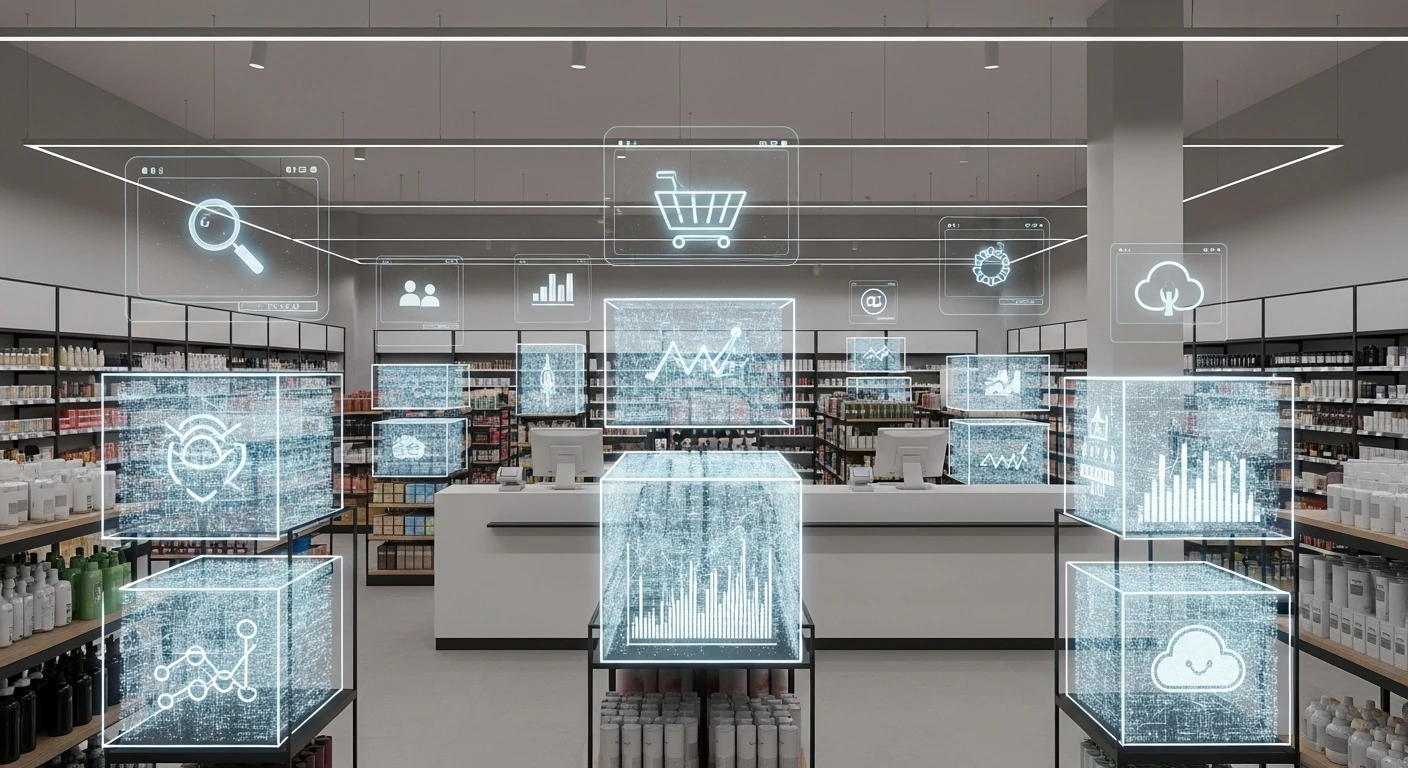
The retail technology landscape is dominated by tools built for either online-only or in-store-only operations. Shopify excels at e-commerce but its in-store POS is an afterthought. Square excels at in-store checkout but its e-commerce is limited. Neither provides deep inventory management, loyalty programs, customer CRM, or employee scheduling without third-party apps — each with their own monthly fee, their own database, and their own view of the customer. The result is a fragmented technology stack that costs $200-500/month, creates data silos, and makes the simple question "who are my best customers?" impossible to answer without exporting data from 3 systems and merging it in a spreadsheet.
An operating system eliminates the fragmentation. One platform handles in-store POS, online ordering, inventory with real-time sync, loyalty with unified customer profiles, CRM with purchase history across all channels, digital signage for in-store marketing, and employee management. The cost is lower than the combined patchwork, and the data is unified from day one.
The Unified Commerce Problem
Retail's biggest technology challenge in 2026 is "unified commerce" — the ability to serve customers consistently across in-store, online, and mobile channels. Major retailers (Target, Nordstrom, Best Buy) invest millions in unifying their channels. Independent retailers need the same capability but cannot build custom integrations.
The practical failures of fragmented systems play out daily:
- A customer buys online and wants to return in-store. The POS cannot see the online transaction.
- A loyalty member earns points online but cannot see them in-store. Or earns in-store but not online.
- Inventory shows available online but is already sold in-store. The customer orders, then receives a cancellation.
- The email marketing tool sends a promotion for an item that sold out yesterday because the inventory system did not sync.
Each of these failures costs one customer interaction. Multiplied by 5 incidents per week, 52 weeks per year, that is 260 customer disappointments annually — any one of which could permanently lose a customer worth $500+/year.
What a Retail OS Includes
1. Unified POS for In-Store and Online
One checkout system that processes in-store transactions at the counter and online transactions through a web storefront. The same product catalog, same pricing, same promotions, same inventory pool. When a product sells in-store, it is immediately unavailable online (and vice versa). No sync delay, no overselling, no customer disappointment.
KwickOS provides the in-store POS, and KwickMenu provides the online ordering/e-commerce storefront — both running on the same database, the same inventory, and the same customer profiles.
2. Real-Time Inventory Management
Retail inventory shrinkage costs the US retail industry $112 billion annually. The primary cause: inaccurate inventory records that result from delayed sync between systems. An OS tracks inventory in real time across all channels: every sale (in-store or online), every return, every adjustment, and every transfer between locations updates the master inventory count instantly.
Low-stock alerts trigger automatically when items approach reorder points. Purchase orders can be generated from the same system. Inventory counts (cycle counts or full inventory) are conducted on the same platform. The annual inventory audit becomes a verification of known data rather than a discovery of unknown shrinkage.
3. Customer CRM With Full Purchase History
The OS maintains one customer profile per person, regardless of how they interact with the store. In-store purchases, online orders, loyalty point activity, email engagement, gift card usage, and return history all live in one record. When a repeat customer walks in, the staff can see their complete history — "Sarah usually buys skincare products, she's in our Gold tier, and she has $12 in loyalty rewards available."
4. Loyalty and Gift Cards
Our retail loyalty guide covers program design. The OS integration ensures loyalty works identically online and in-store: same points earning rate, same redemption options, same tier status. Gift cards purchased in-store can be used online. Digital e-gift cards purchased online can be redeemed in-store. No channel creates a different loyalty experience.
5. Digital Signage for In-Store Marketing
KwickSign displays promotional content, new arrivals, and sale items on in-store screens. The content updates automatically from the product catalog — when a product goes on sale in the POS, the signage reflects it immediately. When an item sells out, it disappears from the signage. This dynamic merchandising replaces printed signs that are outdated before the ink dries.
6. Employee Management
Fingerprint authentication for employee access, clock-in/clock-out, register access, and void/discount authorization. Scheduling tools show labor cost as a percentage of projected revenue. Performance tracking shows sales per employee, average transaction value per associate, and conversion rates — data that drives coaching and compensation decisions.
Hybrid Cloud for Retail Reliability
Retail stores depend on their POS for every transaction. An internet outage during Saturday afternoon — the busiest shopping period — is devastating for cloud-only systems. Square stores cannot process any transactions during outages. Shopify POS loses sync with the online store.
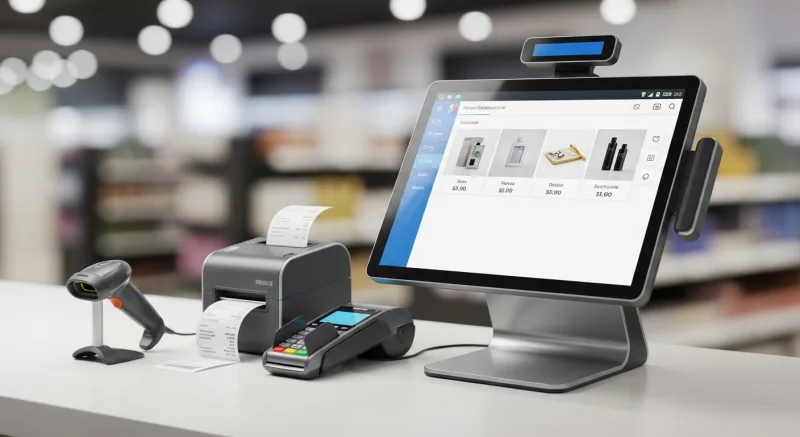
KwickOS continues processing in-store sales, applying loyalty points, and updating inventory locally when the internet drops. Customers experience zero disruption. When connectivity returns, all data syncs to the cloud and the online store inventory is updated.
Processor Freedom for Retail Margins
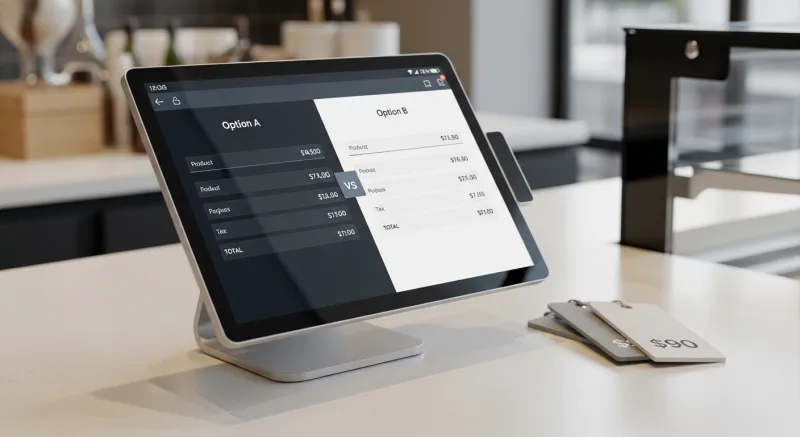
Retail transactions vary widely: from $5 impulse purchases to $500 major purchases. Square charges 2.6% + $0.10 on every transaction. On a $5 purchase, that is $0.23 (4.6% effective rate). On a $500 purchase, it is $13.10 (2.62%). With KwickOS and a processor offering interchange-plus pricing, the $5 transaction might cost $0.15 and the $500 transaction might cost $7.50. The savings scale with volume: a retail store doing $50,000/month in card sales saves $500-1,500/month by choosing a competitive processor — a choice that only processor-agnostic systems like KwickOS allow.
Cost Comparison
| System | Patchwork | KwickOS |
|---|---|---|
| E-commerce (Shopify) | $39-399/month | All included |
| In-Store POS (Square) | $30-79/month | |
| Loyalty (third-party) | $45-199/month | |
| Inventory Management | $49-200/month | |
| Email Marketing | $20-50/month | |
| Total | $183-927/month | One unified price |
Implementation: Retail OS in 10 Days
Days 1-3: Installation and product catalog import. Migrate products with images, descriptions, pricing, and inventory counts from existing systems. Configure categories, variants (size, color), and barcode/SKU mapping.
Days 4-5: Staff training. Cashiers learn checkout and returns (1 hour). Managers learn inventory management and reporting (2 hours). Owner learns CRM, loyalty configuration, and financial reporting (2 hours).
Days 6-7: Activate online storefront through KwickMenu. Configure loyalty program and gift cards. Set up digital signage templates.
Days 8-10: Full launch. Run operations on the OS while verifying inventory accuracy against physical counts. Decommission legacy systems once verified.
Baked Cravings' self-serve kiosk at Lego Land on a PaxA35 terminal demonstrates the OS simplicity even in retail environments: one device handles ordering, payment, loyalty enrollment, and inventory tracking. For a full retail store, the same OS scales to multiple terminals, an online storefront, and a complete back-office management suite.
End the 5-Tool Data Silo Problem
KwickOS gives retail stores POS, e-commerce, inventory, loyalty, CRM, and signage in one platform. One customer profile, one inventory count, one monthly bill.
Book Your Free Demo