
 Ming Ye
Open your bank account right now. Look at the balance.
Now look at what's due in the next 14 days — rent, payroll, vendor invoices, loan payments, insurance.
If those two numbers made your stomach drop, you're not alone. According to industry research, 82% of small businesses that fail cite cash flow problems as the primary cause. Not bad food. Not a lack of customers. Cash flow.
Here's the thing: most of these businesses were profitable. They had revenue. They had customers. They had margins that looked perfectly healthy on a quarterly P&L. But profit and cash are not the same thing — and confusing the two is the single most expensive mistake a business owner can make.
This guide gives you the exact weekly system that keeps cash flowing. It's the same framework used by multi-location operators managing 15+ stores and $2M+ in monthly revenue. And it works whether you run a single coffee shop or a 19-location restaurant group.
Why Profitable Businesses Run Out of Cash
Let's start with the problem most business owners don't see coming.
Imagine you own a restaurant doing $80,000/month in revenue with a 10% net profit margin. On paper, you're making $8,000/month. Healthy. Sustainable. Nothing to worry about.
Then three things happen in the same week:
- Your food distributor changes payment terms from net-30 to net-15 — $12,000 due two weeks earlier than expected
- A $4,800 equipment repair bill lands on your desk
- Payroll of $22,000 hits on Friday
That's $38,800 going out in a single week. Your bank account has $31,000. You're $7,800 short — and your credit line is already tapped from last month's slow period.
You're profitable and broke at the same time.
But it gets worse: this scenario is completely predictable. Every one of those cash demands could have been anticipated, planned for, and managed — if you had a weekly cash flow system instead of a monthly "check the bank balance and hope" approach.
The Weekly Cash Flow Review: 30 Minutes That Save Your Business
Forget monthly financial reviews. By the time you spot a cash shortfall on a monthly statement, you're already 2-4 weeks behind. The fix is a 30-minute weekly review that takes the surprises out of your finances.
Here's the exact process:
Step 1: Record Your Starting Cash Position (5 minutes)
Every Monday morning, write down three numbers:
- Bank balance — the actual number in your account right now
- Pending deposits — credit card settlements in transit (your POS daily reports tell you exactly what's coming)
- Available cash — the sum of both, minus any holds or minimum balance requirements
If your POS system provides real-time revenue dashboards — like KwickOS's mobile reporting — you can pull Saturday and Sunday numbers from your phone before you even sit down. T. Jin China Diner uses this across 15 locations to know their exact cash position at 7 AM every Monday without calling a single store.
Step 2: Map Your Cash Outflows for the Next 4 Weeks (10 minutes)
List every payment due in the next 28 days. Every single one:
| Category | Week 1 | Week 2 | Week 3 | Week 4 |
|---|---|---|---|---|
| Payroll | $22,000 | — | $22,000 | — |
| Rent | — | — | — | $8,500 |
| Food vendors | $6,200 | $5,800 | $6,400 | $6,100 |
| Beverage | $2,100 | — | $2,100 | — |
| Insurance | — | $1,800 | — | — |
| Loan payment | — | — | $3,200 | — |
| Total outflow | $30,300 | $7,600 | $33,700 | $14,600 |
And that's not all: this table instantly reveals that Week 3 is a cash crunch week — payroll plus loan payment plus vendors. You know this 21 days in advance. That's 21 days to prepare instead of scrambling on a Thursday night.
Step 3: Estimate Your Cash Inflows (10 minutes)
Now project what's coming in. Your POS system is your best friend here. Pull the same week's revenue from last year (or average the last 4 weeks) and adjust for any known changes:
- Daily POS revenue — use your trailing 4-week average by day of week
- Catering or corporate orders — confirmed bookings with deposits
- Gift card sales — especially powerful during holiday seasons when gift card revenue can spike 300-400% over baseline
- Loyalty program redemptions — these represent cash already collected, so they reduce food cost without reducing cash inflow
- Online ordering revenue — track separately since third-party platforms hold funds for 3-7 days
Here's a critical detail most owners miss: credit card settlement timing matters. If your processor settles in 2 business days, Monday's sales don't hit your bank until Wednesday. Friday's sales don't arrive until Tuesday. A POS system with auto-batch settlement at close — which KwickOS handles automatically — ensures the fastest possible deposit timing.
Step 4: Calculate the Gap (5 minutes)
For each of the next 4 weeks:
Starting Cash + Projected Inflow - Projected Outflow = Ending Cash
If any week shows a negative ending cash position, you have a problem — and now you have time to solve it. Move a vendor payment forward. Push a supply order back. Accelerate a catering deposit. Launch an e-gift card flash sale to bring in immediate cash.
This is the power of the weekly system: problems become planning exercises instead of emergencies.
The 5 Cash Flow Killers Every Small Business Must Watch
Once you're running weekly reviews, you'll start spotting patterns. These five killers account for the vast majority of cash flow crises:
1. The Timing Gap Between Revenue and Cash
You made $4,200 in sales on Saturday night. But when does that money actually arrive?
- Cash sales — immediate (but shrinking as a percentage; industry data shows cash now represents only 15-20% of restaurant transactions)
- Credit card sales — 1-3 business days depending on your processor and POS batch timing
- Third-party delivery — 3-7 business days (DoorDash pays weekly; UberEats pays weekly)
- Catering invoices — net-15 to net-30 if you allow payment terms
This is why processor-agnostic POS systems matter for cash flow, not just processing fees. When you choose your own processor, you can negotiate same-day or next-day funding. Locked POS systems like Toast and Square dictate settlement terms you can't change.
With KwickOS's processor-agnostic architecture, operators like Crafty Crab Seafood — processing across 19 locations and 152 terminals — negotiate settlement terms directly with their processor. Some locations get same-day funding, which means Saturday's $4,200 is in the bank by Monday morning instead of Wednesday.
2. Inventory Tied Up as Cash
Every dollar sitting in your walk-in cooler is a dollar not in your bank account. A restaurant carrying $18,000 in food inventory when $12,000 would suffice has $6,000 in unnecessary cash tied up — every single week.
The fix: use your POS inventory tracking to match purchasing to actual usage. KwickOS's real-time inventory module tracks depletion by item and generates purchase orders based on par levels, not guesswork. When Shogun Japanese Hibachi implemented this system, their hibachi stations ran leaner without a single stockout — and freed up thousands in working capital.
3. Seasonal Revenue Swings
January is the cruelest month for most restaurants. Holiday season spending is over, customers are dieting and cutting expenses, and gift card redemptions bring people in but don't generate new cash (that cash came in during December). Meanwhile, your fixed costs — rent, insurance, loan payments — don't care what month it is.
The seasonal survival strategy:
- Build reserves during strong months. Automate a transfer of 3-5% of weekly revenue into a separate savings account from March through November.
- Launch gift card pushes in November-December. Gift cards are pure cash flow: you collect the money now and fulfill the obligation later. A $15,000 holiday gift card campaign funded through your POS's integrated e-gift card system puts $15,000 in your bank before January hits.
- Create January-specific promotions. Loyalty program double-points events drive traffic during slow periods. Members who've accumulated points feel compelled to visit — and they spend 22-35% more than non-members per visit, according to restaurant industry data.
4. Uncontrolled Labor Costs
Labor is typically 28-35% of restaurant revenue, and it's the expense that swings most wildly week to week. One sick call leads to overtime for someone else. A slow Tuesday still costs you a full staff. A server no-show means the manager jumps on the floor — but you're still paying the manager's salary.
The cash flow connection: labor is your largest controllable cash outflow. Even a 2% reduction in labor cost percentage on $80,000/month in revenue saves $1,600/month — $19,200/year straight to your cash position.
Use your POS labor reports to track labor cost as a percentage of revenue daily, not just when payroll runs. KwickOS displays real-time labor percentage on the manager dashboard so you can make cut decisions during a shift, not after it's too late. Fingerprint 1:N authentication ensures every clock-in is legitimate — no buddy punching inflating your labor numbers.
5. Payment Processing Delays and Hidden Fees
Processing fees are a cash flow drain that hits twice: once as a percentage of every transaction, and again when your processor holds funds longer than necessary.
A restaurant processing $40,000/month at 2.99% + $0.15 per transaction (Toast's standard rate) loses approximately $1,367/month — $16,400/year — in processing fees alone. Switch to an interchange-plus processor through a processor-agnostic POS and that drops to roughly $970/month. That's $397/month — $4,764/year — back in your cash flow.
Use our processing fee calculator to see exactly what you'd save.
Building Your Cash Reserve: The 2-5-10 Method
Every business needs a cash reserve. The question is how much and how to build it without starving operations.
The 2-5-10 method works for businesses of any size:
- Start at 2%. Transfer 2% of weekly revenue into a separate savings account. On $20,000/week in revenue, that's $400/week — $20,800/year. You won't feel it.
- Graduate to 5%. After 3 months, increase to 5%. On $20,000/week, that's $1,000/week — $52,000/year. This is where your reserve starts to become meaningful.
- Target 10 weeks of fixed expenses. Once your reserve equals 10 weeks of fixed operating costs, maintain that level and redirect the percentage back to operations or growth.
For a restaurant with $12,000/week in fixed costs (rent, insurance, base payroll, loan payments), the target reserve is $120,000. At 5% of $20,000/week revenue, you'll reach that in about 2.3 years. It sounds slow — until you consider that without a reserve, one bad month can end your business permanently.
Gift Cards and Loyalty Programs: Your Secret Cash Flow Weapons
Most owners think of gift cards and loyalty programs as marketing tools. They are. But they're also two of the most powerful cash flow instruments available to any small business.
Gift Cards: Cash Today, Obligation Later
When someone buys a $50 gift card, you get $50 in cash right now. The food cost to fulfill that card — roughly $15 at a 30% food cost — doesn't happen until the card is redeemed. That could be weeks, months, or never. Industry research suggests 10-15% of gift cards go unredeemed entirely.
A strategic gift card program through your POS can generate significant cash during predictable slow periods:
- Holiday push (November-December): "Buy $50, get $10 bonus" — customers buy for others, you get cash now
- Valentine's Day packages: Bundle gift card + reservation for a premium price
- Corporate bulk orders: Businesses buy gift cards for employee rewards — often $2,000-$10,000 in a single order
- E-gift cards on social media: Zero physical cost, instant delivery, 24/7 availability through your digital gift card platform
Tiger Sugar runs their gift card program through KwickOS's integrated system across 2 stores and 2 kiosks. Customers can buy, reload, and check balances at any terminal — and e-gift cards purchased online are instantly available at every location.
Loyalty Programs: Predictable Future Revenue
A loyalty program doesn't just bring customers back — it makes your revenue more predictable, which makes your cash flow more manageable.
When you have 2,000 active loyalty members visiting an average of 2.3 times per month with an average spend of $28, that's $128,800/month in semi-predictable revenue. You can forecast against that. You can plan inventory against that. You can schedule labor against that.
And that's not all: loyalty members are less price-sensitive, less likely to defect to competitors, and more likely to buy gift cards for friends. Every percentage point increase in loyalty enrollment translates directly to more predictable cash flow.
Explore how restaurants use integrated loyalty to stabilize revenue across seasons.
Accounts Receivable: Stop Being a Bank
If your business extends payment terms to anyone — catering clients, corporate accounts, event deposits — you're functioning as a bank. And unlike a bank, you're not charging interest.
Rules for protecting your cash flow from AR problems:
- Require deposits upfront. For catering and events, collect 50% at booking and 50% the day before the event. No exceptions.
- Shorten payment terms. If you offer net-30, switch to net-15. If you offer net-15, switch to due-on-receipt. Every day a receivable sits outstanding is a day your cash is in someone else's account.
- Automate invoicing. Late invoicing leads to late payment. Your POS system should generate invoices automatically for corporate and catering orders.
- Track aging weekly. Any invoice over 30 days should trigger a phone call, not another email. AR over 60 days has less than a 50% collection probability.
The Emergency Cash Playbook
Even with the best weekly system, emergencies happen. Equipment fails. Pipes burst. A pandemic shuts down dining rooms. Here's your emergency cash playbook, in order of speed:
- Flash e-gift card sale (same-day cash). Send an email to your loyalty members: "Buy $50 in e-gift cards, get $10 free — today only." This generates immediate cash with minimal effort through your POS gift card system.
- Prepaid meal packages (same-week cash). Sell 10-meal punch cards at a 15% discount. Customers pay upfront; you fulfill over weeks.
- Vendor negotiation (buys 2-4 weeks). Call your top 3 vendors and ask for extended terms. Most will accommodate a good customer who communicates proactively.
- Menu engineering (adds margin within 1 week). Promote your highest-margin items. Use your POS data to identify which dishes have the best food cost ratio and feature them as specials.
- Line of credit (access in 1-3 days if pre-arranged). Establish a line of credit BEFORE you need it. A $50,000 line costs nothing until you draw on it — and it's nearly impossible to get one when you're already in trouble.
Technology That Makes Cash Flow Visible
The right POS system transforms cash flow management from guesswork into data. Here's what to look for:
- Real-time revenue dashboards. Know today's sales at 2 PM, not next Tuesday when your accountant sends a report. KwickOS's hybrid local+cloud architecture means your dashboard updates with 1ms local latency — no waiting for cloud sync.
- Daily labor cost percentage. See labor as a percentage of revenue in real time, so you can cut staff during slow shifts before the money is spent.
- Inventory valuation. Know exactly how much cash is sitting in your walk-in and dry storage at any moment.
- Gift card liability tracking. See outstanding gift card balances — this is future cash that's already been collected.
- Multi-location consolidation. If you operate multiple locations, you need a single view of cash position across all stores. Diva Nail Beauty manages 4 locations with automated commission tracking that directly feeds their cash flow projections — knowing exactly what each stylist earns before payroll runs.
- Processor-agnostic settlement. Choose processors that offer same-day or next-day funding. Every day faster means better cash position.
Compare how KwickOS stacks up against Toast, Square, and Clover on the features that matter for cash flow management.
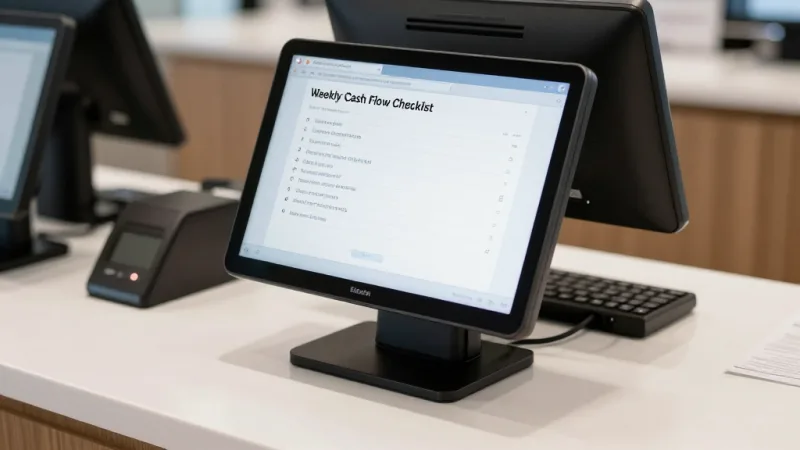
The Weekly Cash Flow Checklist
Print this. Tape it to your office wall. Do it every Monday morning:
- Record bank balance and pending deposits
- List all payments due in the next 28 days
- Project revenue for the next 4 weeks using POS trailing averages
- Calculate weekly ending cash positions
- Flag any week where ending cash drops below your minimum threshold
- Check AR aging — follow up on anything over 15 days
- Review labor cost percentage from the prior week
- Check inventory levels against par — flag over-ordering
- Transfer reserve percentage to savings account
- Update your 90-day cash flow forecast
Total time: 30-45 minutes. Total value: the difference between a business that survives and one that doesn't.
See Your Cash Flow in Real Time
KwickOS gives you daily revenue, labor costs, inventory value, and gift card liability across every location — all from your phone. Stop guessing. Start knowing.
Get a Free Demo