
 Tom Jin
Open your last sales tax filing. Look at the total you remitted.
Now ask yourself: are you absolutely certain that number is correct?
If you hesitated even slightly, you are not alone. According to restaurant industry data, tax compliance errors are among the most common financial mistakes restaurant owners make — and they are almost always discovered during an audit, not before.
Here's the thing: a restaurant in Texas got hit with a $23,000 assessment after an auditor discovered they had been exempting to-go food orders from sales tax for three years. The owner assumed takeout food was taxed like grocery items. It is not. In Texas, all prepared food is taxable regardless of how it leaves the building.
That $23,000 came out of the owner's pocket. Not the business account. The owner's personal savings. Because in many states, responsible officers are personally liable for unpaid sales tax.
This guide breaks down exactly what is taxable, what is not, and how to configure your POS system so the math is right on every single transaction — before a state auditor does the math for you.
The Prepared Food vs. Grocery Food Distinction
The single most important tax concept for restaurant owners is the difference between "prepared food" and "grocery food." Most states that have sales tax treat these two categories very differently.
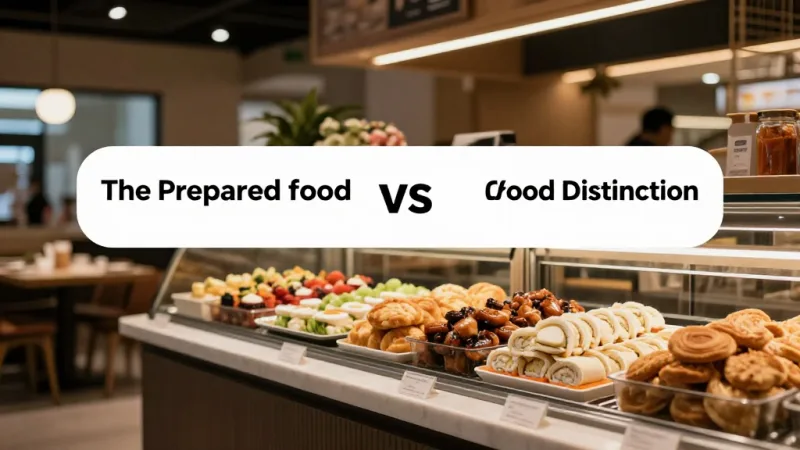
Prepared food — anything heated, combined, served with utensils, or sold ready to eat — is taxable in nearly every state that levies sales tax. This includes dine-in meals, takeout orders, delivery orders, buffet food, and items from a hot bar or steam table.
Grocery food — unheated, unmodified, sold in original packaging — is exempt or taxed at a reduced rate in about 30 states. This matters if you sell bottled beverages, packaged snacks, or retail grocery items alongside your restaurant menu.
But it gets worse: the line between "prepared" and "grocery" is not always obvious.
- A bottle of water from your cooler? Grocery (exempt in most states).
- That same water served at a table with a meal? Prepared food (taxable in many states).
- A whole uncut cake from your bakery display? Often grocery.
- A slice of that same cake plated with a fork? Prepared food, taxable.
The distinction often comes down to whether utensils are provided, whether the food is heated, and whether it is sold as part of a combination. And that's not all: some states like New York have a dollar threshold — food items under a certain price may be exempt while the same item over that price is taxable.
State-by-State Tax Variation: Why One Rate Does Not Fit All
If you operate in a single location, you only need to know one state's rules. But if you run multiple locations — like T. Jin China Diner with 15 stores across multiple states, or Crafty Crab Seafood with 19 locations — the complexity multiplies fast.
Here is a snapshot of how differently states treat restaurant sales tax:
| State | Prepared Food Tax Rate | Grocery Food | Key Note |
|---|---|---|---|
| California | 7.25%+ (local varies) | Exempt | Hot food always taxable; cold to-go may be exempt |
| Texas | 6.25% + local (up to 8.25%) | Exempt | All restaurant food taxable, including takeout |
| New York | 4% + local (up to 8.875%) | Exempt | Food under $1.50 may be exempt; heated food always taxable |
| Florida | 6% + local (up to 7.5%) | Exempt | All prepared food taxable, bakery items can be exempt |
| Illinois | 6.25% + local (up to 11%) | 1% (reduced rate) | Prepared food at full rate; grocery at reduced 1% |
| Oregon | No sales tax | No sales tax | One of 5 states with no sales tax |
Now here is where it gets interesting for multi-location operators. If you manage 15 stores across 4 states like T. Jin China Diner, you potentially need to track dozens of different tax rates — state, county, city, and special district. Configuring this manually is how errors happen. Configuring it once in a centralized POS system that pushes rates to every terminal is how you prevent them.
Alcohol: The Tax Within the Tax
Alcohol is taxable in every state that has sales tax — no exceptions. But in many states, alcohol is taxed at a higher rate than food, and some localities add additional taxes on top of that.
For example:
- Chicago: Restaurant food is taxed at 10.25%, but liquor by the drink gets an additional 1% city liquor tax.
- Washington, D.C.: Restaurant meals at 10%, alcohol at 10.25%.
- Many counties: Add a per-drink tax on top of the percentage-based sales tax.
Here's the thing: if your POS system applies one flat tax rate to every item, you are either overtaxing food (alienating customers) or undertaxing alcohol (owing money to the state). Neither is acceptable.
Your POS needs item-level tax assignment. Every menu item should be tagged with its correct tax category — food, alcohol, non-taxable, retail — and the system should automatically apply the right rate at checkout. KwickOS supports unlimited tax categories per item, with location-specific overrides for multi-location operators.
Delivery Orders: The Tax Gray Area
Delivery has exploded since 2020, and the tax rules have not kept up. The result is a patchwork of regulations that confuse everyone — including accountants.
The core question: is the delivery fee itself taxable?
The answer depends on your state and how the fee is structured:
- Taxable delivery fees: Texas, New York, and several other states tax delivery charges when they are connected to the sale of taxable food. If you charge $5 delivery and the food is taxable, the $5 is also taxable.
- Exempt delivery fees: Some states exempt delivery charges if they are separately stated on the receipt and the customer had the option to pick up instead.
- Third-party complications: When DoorDash or UberEats handles your delivery, they typically collect and remit tax on the food. But if you use your own delivery — like restaurants using KwickDriver at a flat $2 + $6.99 per delivery instead of 25% commissions — you are responsible for collecting the correct tax on both the food and the delivery charge.
This is another area where POS configuration matters enormously. Your system should distinguish between dine-in, takeout, and delivery order types, and apply the correct tax rules to each. A manual workaround — "just add 8% to everything" — will eventually fail an audit.
Gift Cards: The Tax Timing Trap
Gift cards are one of the most misunderstood items in restaurant sales tax. Here is the rule, and it is simple once you know it:
Gift card purchases are NOT taxable. Gift card redemptions ARE taxable (on the items purchased).
When a customer buys a $50 gift card, you collect $50 — no tax. The gift card is stored value, not a taxable sale. When that customer (or the gift recipient) comes back and uses the $50 card to buy a meal, you collect tax on the meal at that point.
But it gets worse: if your POS is misconfigured and charges tax on gift card sales, you are double-taxing the customer — once on the purchase, once on the redemption. This creates refund liability and customer complaints.
E-gift cards follow the same rules. Whether the card is physical or digital, the tax treatment is identical. This is especially important during holiday seasons when gift card and e-gift card sales can represent 15-20% of a restaurant's December revenue. Getting the tax wrong on that volume creates a significant liability.
KwickOS handles this automatically: gift card purchases are flagged as non-taxable stored value, and tax is calculated on the underlying items when the card is redeemed — regardless of whether it is a physical card, an e-gift card sold online through KwickOS gift card platform, or a promotional gift card issued as a loyalty reward.
Loyalty Rewards and Points: When Free Is Not Tax-Free
Your loyalty program can create tax headaches if you do not understand how your state handles discounts and free items.
The general rule: sales tax is calculated on the amount the customer actually pays, not the menu price. If a loyalty member earns a free appetizer and pays $0 for it, there is no taxable amount on that item. If they redeem 500 points for $5 off their bill, tax is calculated on the reduced total.
But — and here is the pattern interrupt you need — some states treat "buy one get one free" promotions differently than point-based discounts. In certain jurisdictions, if the "free" item still has value (like a BOGO where the customer pays full price for one item), the tax may be calculated on the combined value of both items, then the discount applied after tax.
The safest approach is to configure your loyalty and membership program through your POS so that point redemptions are applied as discounts before tax calculation. KwickOS loyalty module does this by default — points reduce the taxable subtotal, and tax is calculated on the discounted amount. This is the correct treatment in the vast majority of states.
Catering and Private Events: Different Rules, Higher Stakes
Catering introduces additional tax complexity because of service charges, gratuities, and off-premises delivery.
Key distinctions:
- Mandatory service charges (like an 18% automatic gratuity) are taxable in most states because they are part of the total sale price. The customer cannot opt out, so the state treats it as revenue.
- Voluntary tips left by the customer are NOT taxable in any state.
- Equipment rental (tables, chairs, chafing dishes) is taxable as a tangible property rental in some states and exempt in others.
- Off-premises catering may be taxed based on the delivery location, not your restaurant's location — which matters if you cater events across county or city lines with different rates.
For operators doing significant catering volume, this means your POS needs to support per-order tax rate overrides. The tax on a catering order delivered to a venue in the next county may differ from your standard dine-in rate.
How to Configure Your POS for Tax Compliance
Every tax error starts with a configuration mistake. Here is the checklist for getting your POS tax setup right:
- Set up item-level tax categories. At minimum: prepared food, alcohol, non-taxable (gift cards), and retail/grocery. Each category should map to the correct tax rate for your jurisdiction.
- Configure location-specific rates. If you have multiple locations, each store needs its own tax rate profile reflecting state, county, city, and special district taxes.
- Separate order types. Dine-in, takeout, and delivery should have configurable tax rules. Some states tax these differently.
- Tag gift cards as non-taxable. This applies to both physical and e-gift card sales. Tax should only be collected on redemption.
- Handle discounts before tax. Loyalty points, coupons, and employee discounts should reduce the taxable subtotal. Your POS should calculate tax on the post-discount amount.
- Generate tax summary reports. You need a report that breaks down tax collected by category (food, alcohol, non-taxable) for each filing period. This is what you submit to the state.
KwickOS provides all six of these capabilities out of the box. Tax categories are assigned at the item level, rates are configured per location, and the system generates filing-ready tax reports broken down by category and period. For multi-location operators like Crafty Crab Seafood managing 19 stores across different tax jurisdictions, this centralized configuration eliminates the manual rate-tracking that causes errors.
Want to see how your current POS compares? Check our POS comparison pages to see which systems support the tax features your business needs.
Surviving a Sales Tax Audit
If you are selected for a sales tax audit — and most restaurants will face at least one over a 10-year period — your POS data is your primary defense.
Auditors want to see:
- Transaction-level detail showing the tax collected on each sale
- Tax category breakdowns proving you applied the correct rate to each item type
- Filing records matching what you remitted to what you collected
- Gift card records showing that tax was collected on redemption, not purchase
- Discount and comp records showing how free items and loyalty rewards were treated
A POS system with proper reporting makes an audit straightforward. You pull the reports, hand them to the auditor, and the numbers match. A POS system with sloppy tax configuration — or worse, a cash register with manual tax calculation — turns an audit into an expensive nightmare.
Here is the loss aversion math: a clean POS tax configuration costs you nothing beyond the initial setup time. A failed audit costs $5,000 to $50,000+ in back taxes, penalties, and accounting fees. The ROI on getting this right is infinite.
The POS Checkout Flow: Where Tax Meets the Customer
Tax compliance is not just a back-office issue. It shows up at the point of sale on every transaction.
When a customer orders a steak dinner ($34), a glass of wine ($12), and purchases a $25 e-gift card for a friend, your POS checkout needs to:
- Apply food tax rate to the steak dinner
- Apply alcohol tax rate to the wine (which may be higher)
- Apply zero tax to the gift card purchase
- Display the itemized tax on the customer's receipt
- Record all three tax categories in your reporting
If the customer is also a loyalty member redeeming 200 points for $2 off, the system recalculates tax on the reduced food subtotal before processing payment.
This all needs to happen in seconds, invisibly, with zero manual intervention from your staff. The alternative — training every server and cashier on tax rules — is unrealistic. Your POS handles the compliance; your staff handles the hospitality.
KwickOS processes this entire flow automatically with its hybrid local+cloud architecture, calculating taxes at 1ms local latency even if your internet drops. Because tax errors do not wait for your WiFi to reconnect.
Common Tax Mistakes That Trigger Audits
Based on industry data and patterns we see across 5,000+ KwickOS merchants, here are the mistakes that most commonly trigger state attention:
- Flat-rating everything. Applying one tax rate to all items when alcohol, food, and retail items have different rates. This is the number-one configuration error.
- Taxing gift cards at purchase. Creates double-taxation liability and customer complaints.
- Ignoring delivery order tax. Treating delivery the same as takeout when your state applies different rules.
- Missing local tax rate changes. Cities and counties update rates regularly. If your POS is not updated, you are under-collecting.
- Pocketing over-collections. If you collect more tax than you owe (because of rate errors), you are required to remit the excess. Keeping it is fraud.
Use our free business tools to audit your current tax configuration and identify potential gaps before the state does.
Get Tax Compliance Right — Automatically
KwickOS configures item-level tax rates, location-specific rules, and generates audit-ready reports for 5,000+ businesses across 50 states. See how it works for your restaurant.
Get a Free Demo