 Ming Ye
Open Google Maps. Search "office buildings" within 3 miles of your restaurant.
Count them.
If you're in any metro area, you just found 10 to 30 buildings, each housing companies with 20 to 200 employees who eat lunch five days a week. According to restaurant industry data, the average corporate lunch order runs $15 to $22 per person. A single office of 50 people ordering twice a week is $1,500 to $2,200 — every week, on autopilot.
Here's the thing: most restaurants never go after this money. They wait for catering orders to come in through the front door. They list "catering available" on their website and wonder why the phone doesn't ring.
That's $78,000 to $114,000 per year you're leaving on the table — per corporate client. And you don't need a catering kitchen, a box truck, or a sales team to get it.
You need a system. This guide is that system.
Why Corporate Catering Is the Highest-Margin Revenue You're Not Chasing
Most restaurant owners think of catering as weddings and banquets — high-stress, one-off events that require specialized equipment and extra staff. Corporate catering is the opposite. It's predictable, recurring, and operationally simple.
Here's why the math works so well:
- Higher per-person spend. Corporate budgets average $15-$22 per head, compared to $12-$16 for individual dine-in lunch tickets.
- Bulk prep efficiency. Cooking 50 portions of the same three dishes is faster and cheaper per unit than cooking 50 individual orders from a full menu.
- Off-peak labor utilization. Catering prep happens between 9 and 11 AM — when your kitchen staff is already clocked in but your dining room is empty.
- No third-party commission. Unlike delivery apps taking 15-25%, your catering revenue goes straight to your bottom line.
- Recurring revenue. One corporate client ordering twice a week generates $150,000+ per year. That's not a one-time event — it's a revenue stream.
But it gets worse for restaurants that don't pursue catering: the offices near you are already ordering from someone. Every week you wait, that competitor locks in another recurring account.
The Prospecting Playbook: How to Find Corporate Clients
Forget cold calls. Forget mass email blasts. Corporate catering clients are won with targeted outreach and free food. Here's the exact system that works:
Step 1: Map Your Delivery Radius
Draw a 3-mile circle around your restaurant. Within this radius, identify every office building, co-working space, tech company, medical office, law firm, and corporate headquarters. You need addresses, company names, and — most importantly — the name of the office manager or executive assistant.
And that's not all: don't overlook non-traditional corporate clients. Real estate agencies, car dealerships, construction companies, and government offices all have lunch budgets and meeting catering needs.
Step 2: The Free Sample Drop
This is the highest-converting sales tactic in corporate catering. Prepare a sample tray — enough food for 8-10 people — and deliver it personally to the office manager. Include your catering menu, a business card, and a handwritten note.
The cost: roughly $40-$60 in food. The potential return: $1,500-$2,000 per week in recurring orders.
Target Tuesday through Thursday for drop-offs. Monday mornings are chaotic and Fridays are half-empty. Show up between 11:00 and 11:30 AM when people are thinking about lunch.
Step 3: Follow Up Like a Professional
After the sample drop, follow up within 48 hours. Not with a sales pitch — with a question: "How did the team enjoy the food? I'd love to put together a customized menu for your next lunch meeting."
Here's where most restaurants fail. They drop off samples and never follow up. Or they follow up once and give up. Industry research suggests that it takes 3-5 touchpoints to convert a corporate catering prospect into a regular client. Build a CRM follow-up system — even a simple spreadsheet — that tracks every prospect, every contact, and every follow-up date.
KwickOS has built-in CRM and customer tracking that lets you tag corporate accounts, set follow-up reminders, and track order history per client. When that office manager calls back three weeks later, you can pull up exactly what they ordered and what they liked.
Step 4: Register on Corporate Catering Platforms
Platforms like ezCater, CaterCow, and Fooda connect restaurants with corporate buyers. These platforms charge 15-20% commission (yes, that cuts into margins), but they're worth using as a lead generation tool. Once you've fulfilled a few orders through the platform and built a relationship with the client, offer them a direct ordering option with a 10% discount — still cheaper for them, and far more profitable for you.
Designing Your Corporate Catering Menu
Your dine-in menu is not your catering menu. Corporate catering requires a different approach to menu design:
The Package Model
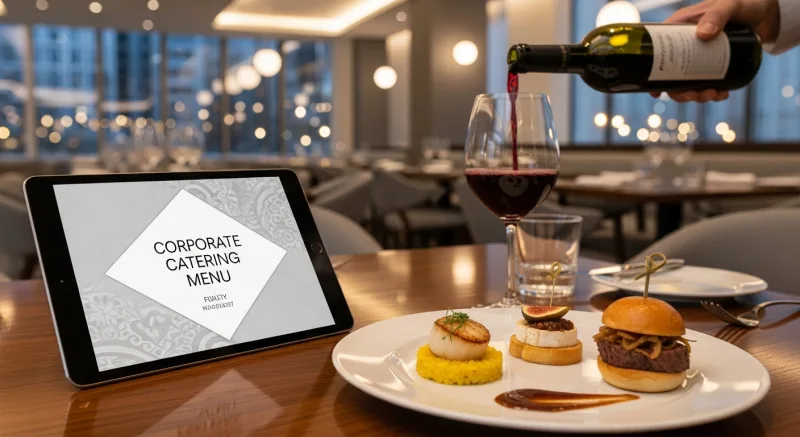
Offer 3-5 pre-designed packages at fixed per-person prices. This simplifies ordering for the office manager (they don't want to build a custom menu every time) and simplifies prep for your kitchen.
| Package | Includes | Per Person | 50-Person Order |
|---|---|---|---|
| Essential Lunch | 1 entree, 1 side, bottled water | $14.99 | $749 |
| Business Lunch | Choice of 2 entrees, 2 sides, drinks, cookies | $18.99 | $949 |
| Executive Lunch | Choice of 3 entrees, 3 sides, drinks, dessert | $22.99 | $1,149 |
| Meeting Package | Finger foods, sandwiches, fruit, beverages | $16.99 | $849 |
Notice the pricing structure. The middle option (Business Lunch) is where most clients land — it's the sweet spot between value and variety. The Executive package exists as an anchor that makes the Business package feel reasonable.
Menu Rules for Catering
- Choose dishes that travel well. Crispy items go soggy. Delicate sauces separate. Build your catering menu around proteins, grains, and vegetables that hold temperature and texture for 30-45 minutes.
- Include dietary options. Every corporate order needs at least one vegetarian and one gluten-free option. Label allergens clearly.
- Think family-style, not individual plates. Tray-style service is faster to prep, easier to transport, and more cost-effective than individually boxed meals. Offer individual boxing as a premium upgrade (+$2/person).
- Rotate weekly specials. For recurring clients, offer a rotating weekly menu to prevent order fatigue. "This week's special: Korean BBQ bowls" gives the office manager something new to announce.
Delivery Logistics That Don't Break Your Operation
Here's where most catering programs fall apart. Delivery logistics that seem simple on paper turn into chaos during lunch rush.
The Prep Timeline
Corporate lunch delivery windows are tight: 11:30 AM to 12:30 PM. That means your catering prep needs to be complete and loaded by 11:00 AM. Work backward:
- 8:00 AM: Cold prep — salads, fruit trays, desserts, beverages packed
- 9:00 AM: Hot prep begins — proteins, sides, starches
- 10:30 AM: Final cook, portion into transport containers
- 10:45 AM: Quality check, label, and load
- 11:00 AM: Driver departs
This entire timeline happens before your lunch rush starts, using labor you're already paying for.
Delivery: Own It, Don't Outsource It
Third-party delivery makes no sense for catering. A DoorDash driver showing up with $1,000 worth of food in the back of a Honda Civic is not the impression you want to make.
You need a dedicated catering driver (or one of your existing staff who drives before their shift). With KwickDriver integration, you pay a flat $2 + $6.99 per 5 miles instead of 15-25% commission. On a $1,000 order, that's $8.99 versus $150-$250 in third-party fees. The savings alone justify hiring a part-time driver.
Invest in proper transport equipment: insulated food carriers ($150-$400 each), chafer setups for hot items, and branded delivery bags. The professionalism of your delivery presentation directly impacts reorder rates.
The Checkout and Invoicing System
Corporate clients don't pay like walk-in customers. They need invoices, purchase orders, net-30 terms, and receipts that their accounting department can process. And that's not all — they often need to split costs across departments or expense codes.
This is where your POS system earns its keep. A system that only handles walk-in transactions will leave you creating manual invoices in Word and chasing payments via email.
KwickOS handles catering orders through the same POS checkout flow your staff already knows. Ring up the catering order, apply the corporate account, generate an invoice with one tap, and email it directly to the client's accounts payable. Payment terms, tax exemption certificates, and recurring order schedules are all stored in the customer profile.
For recurring weekly orders, set up auto-invoicing: the system generates and sends the invoice every Wednesday for Thursday's delivery, with a net-15 payment term. No manual follow-up. No chasing checks.
Accept Every Payment Method
Corporate clients pay in different ways — company credit cards, ACH transfers, checks, and purchase orders. Being processor-agnostic means you can accept any payment method at competitive rates. Restaurants locked into Toast or Square's processing pay 2.49-2.99% + $0.15 on every transaction. On a $1,000 catering order, that's $25-$30 in processing fees. With interchange-plus pricing through your own processor, the same transaction costs $18-$22. Over a year of weekly $1,000 orders, you save $360-$520 just on processing — and that's from a single client. Use our processing fee calculator to see what your catering processing costs should actually be.
Gift Cards and Loyalty: The Corporate Catering Multiplier
Here's a revenue angle most restaurants miss entirely.
Corporate clients don't just order lunch. They buy gift cards — in bulk. Client appreciation gifts, employee rewards, holiday bonuses, and welcome packages all create demand for restaurant gift cards. A single HR department might purchase $3,000-$5,000 in gift cards per quarter.
When you're already delivering lunch to their office every week, the gift card conversation is natural: "We also offer bulk gift cards for employee rewards — I can set up a corporate account with 10% bonus value on orders over $500." According to restaurant industry data, about 15% of gift card value goes unredeemed (breakage), making bulk gift card sales one of the highest-margin products you can offer.
E-gift cards make it even easier. The office manager can purchase 50 digital gift cards, each customized with the company logo, and have them emailed to employees instantly. No physical cards to manage, no shipping costs, no waiting.
On the loyalty side, create a corporate loyalty program separate from your consumer program. For every $5,000 in catering orders, the company earns a free lunch delivery for 20 people. This isn't just a perk — it's a retention mechanism that makes the office manager look good to their team and creates a switching cost for your competitors.
KwickOS manages both consumer and corporate loyalty tiers through the same CRM platform, tracking points, redemptions, and lifetime value per corporate account.
Scaling from 1 Client to 8: The Growth Playbook
Landing your first corporate client proves the concept. Scaling to 8-10 recurring clients is where the real revenue transformation happens.
Month 1-2: Proof of Concept
Target 3-5 office buildings for sample drops. Convert 1-2 into recurring accounts. Refine your menu, delivery timing, and packaging based on real feedback. Your goal: 2 recurring clients, $2,000-$3,000/week.
Month 3-4: Systematize and Expand
With 2 clients running smoothly, hire a part-time catering coordinator (or assign the role to an existing manager). This person handles prospecting, order management, and client communication. Double your sample drop radius to 5 miles. Register on ezCater and CaterCow. Your goal: 4-5 recurring clients, $4,000-$6,000/week.
Month 5-6: Lock In and Upsell
Offer your recurring clients a "Catering Partnership" — a 10% discount on all orders in exchange for a 6-month commitment of minimum 2 orders per week. This locks in revenue and gives you forecasting confidence. Start upselling: holiday party catering, board meeting packages, and bulk gift card programs.
T. Jin China Diner, operating 15 locations with 75 terminals on KwickOS, uses centralized menu management to push catering specials across all locations simultaneously. When a corporate client's second office is in a different part of town, the same menu and pricing are available at the nearest T. Jin location — seamless for the client, zero extra setup for the restaurant.
What Crafty Crab Taught Us About Multi-Location Catering
Crafty Crab Seafood operates 19 locations with 152 terminals. When they launched corporate catering, the challenge wasn't cooking — it was consistency. A client ordering from their downtown location expected the same menu, the same quality, and the same invoice format as their suburban location.
With KwickOS's one-click menu sync, Crafty Crab pushed their catering menu to all 19 locations in under 5 minutes. Pricing, modifiers, package descriptions — all identical. When they update the weekly rotating special, every location gets the change simultaneously. No phone trees. No "I think the price changed but I'm not sure."
For multi-location operators, this is the difference between a catering program that scales and one that collapses under its own complexity.
The Technology Stack That Makes It Work
Corporate catering runs on systems, not hustle. Here's what your tech needs to handle:
- Online catering portal. Let clients browse menus, customize packages, and place orders online. The fewer phone calls, the fewer errors.
- CRM with corporate tagging. Every corporate client needs a profile with order history, preferences, dietary restrictions, delivery instructions, and billing information.
- Automated invoicing. Generate, send, and track invoices without manual intervention.
- Kitchen routing. Catering orders need to route to a separate prep station or KDS screen so they don't get mixed with dine-in orders.
- Delivery tracking. The client should know when their food is on the way. KwickDriver provides real-time delivery tracking for catering orders.
- Reporting. Track catering revenue separately from dine-in so you can measure the program's ROI.
KwickOS runs on a hybrid local+cloud architecture — 1ms local latency for in-restaurant operations, with cloud sync for remote management. This means your catering coordinator can manage orders, invoices, and client communications from anywhere, while your kitchen team gets instant ticket routing without internet dependency. Even if your WiFi drops during prep, the local system keeps running.
And because KwickOS supports English, Chinese, and Spanish natively, your kitchen staff sees tickets in whatever language they're most comfortable with — no translation delays, no misread modifiers.
Common Mistakes That Kill Catering Programs
Before you start prospecting, learn from the restaurants that tried and failed:
- Underpricing. Your catering price should be 20-40% above dine-in equivalent. You're providing packaging, delivery, setup, and convenience. Charge for it.
- No minimum order. Set a minimum of $200-$300 per delivery. Below that, your delivery cost eats the margin.
- Ignoring the follow-up. 80% of sample drops don't convert immediately. The restaurants that win are the ones that follow up 3, 5, even 7 times.
- Mixing catering prep with dine-in prep. Separate the workflows. Use a dedicated prep station and KDS screen for catering. Otherwise, your lunch rush tickets get delayed by catering prep.
- No corporate billing. If you can't send an invoice and accept net-30 terms, you can't serve corporate clients. Period.
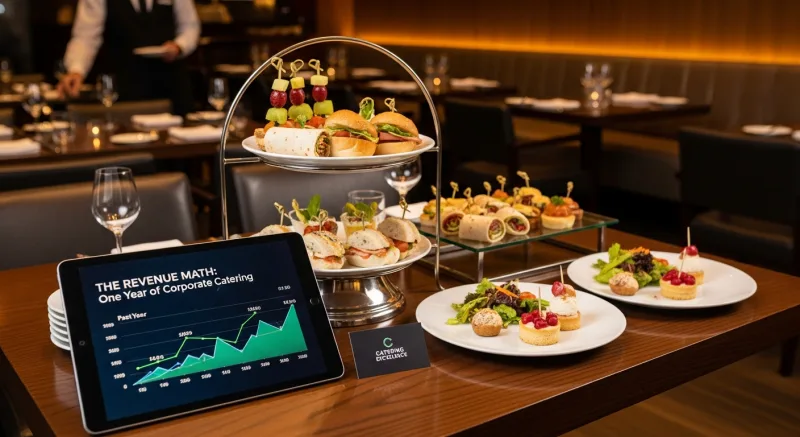
The Revenue Math: One Year of Corporate Catering
Let's run the numbers for a restaurant that builds a modest catering program over 12 months:
| Timeline | Recurring Clients | Weekly Revenue | Monthly Revenue |
|---|---|---|---|
| Month 1-2 | 2 clients | $2,500 | $10,000 |
| Month 3-4 | 4 clients | $5,000 | $20,000 |
| Month 5-8 | 6 clients | $7,500 | $30,000 |
| Month 9-12 | 8 clients | $10,000 | $40,000 |
Year 1 total: approximately $300,000 in catering revenue. At 35-45% food cost (lower than dine-in because of bulk prep efficiency), that's $165,000-$195,000 in gross profit from a program that uses labor and kitchen capacity you're already paying for.
For a restaurant operating on 8-10% net margins, adding $165,000 in gross profit is the equivalent of adding $1.6 million in dine-in revenue. That's the power of high-margin, recurring corporate catering.
Ready to Build Your Catering Pipeline?
KwickOS gives you the CRM, invoicing, delivery tracking, and kitchen routing you need to run corporate catering at scale. See how 5,000+ businesses use KwickOS to grow revenue.
Get a Free Demo