 Ming Ye
You opened a Korean BBQ restaurant because you love the concept. Sizzling grills, communal tables, banchan spread across the surface like a colorful mosaic. Guests love it. Social media loves it. The experience sells itself.
But then the food cost report comes in.
Your AYCE price is $25.99 per person. Your average meat consumption is running 1.2 pounds per guest. Your beef supplier just raised brisket prices 8%. And that table of six college students in the corner? They have been here for two hours and 37 minutes, and they just ordered their ninth round of bulgogi.
You are not running a restaurant. You are running a casino — and the house does not always win.
Here's the thing: the most profitable Korean BBQ restaurants in North America are not the ones charging the highest prices. They are the ones who have engineered every detail — from menu tiers to banchan timing to POS-tracked waste — so that "unlimited" actually has very specific, very profitable limits.
This guide shows you exactly how they do it.
The AYCE Math: Why $25.99 Works (When You Do It Right)
Let us start with the numbers that matter. A Korean BBQ AYCE restaurant charging $25.99 per person needs to keep food cost under 35% to hit a healthy 28% net profit after labor, rent, and overhead. That means your total food cost per guest cannot exceed $9.10.
Sounds impossible when you are serving unlimited meat? It is not — if you understand what the average guest actually consumes.
According to restaurant industry data, the average AYCE diner eats between 0.75 and 1.1 pounds of raw meat per visit. Not 3 pounds. Not 5 pounds. Less than a pound and a half for the vast majority of your guests.
Here is what that looks like in dollar terms:
| Item | Avg. Consumption | Cost/lb | Cost/Guest |
|---|---|---|---|
| Beef (brisket, bulgogi, short rib) | 0.55 lb | $7.20 | $3.96 |
| Pork (belly, shoulder, jowl) | 0.30 lb | $3.80 | $1.14 |
| Chicken & seafood | 0.15 lb | $4.50 | $0.68 |
| Banchan (8 sides) | — | — | $1.60 |
| Rice, lettuce, condiments | — | — | $0.45 |
| Total food cost per guest | $7.83 |
$7.83 out of $25.99 is a 30.1% food cost. That is not just survivable — it is strong. And it gets even better when you add the profit levers we will cover next.
But it gets worse if you do not manage it. The top 15% of heavy eaters — the ones who come specifically to "get their money's worth" — consume 1.5 to 2.0 pounds of meat. Their food cost per visit hits $13 to $16. Those guests are eating your profit on every visit.
The solution is not to ban heavy eaters. The solution is to design a system where the 85% of normal eaters subsidize the 15% of heavy ones — and to minimize heavy-eater behavior through smart operations.
Tiered Pricing: The Single Biggest Profitability Lever
If you are running a one-tier AYCE menu, you are leaving thousands of dollars on the table every month.
The most profitable Korean BBQ restaurants operate three pricing tiers:
| Tier | Price | Avg. Food Cost | Food Cost % | % of Guests |
|---|---|---|---|---|
| Basic (pork, chicken, standard beef) | $21.99 | $6.20 | 28.2% | 30% |
| Premium (prime brisket, short rib, shrimp) | $29.99 | $9.50 | 31.7% | 55% |
| Wagyu (A5 wagyu, king crab, lobster tail) | $42.99 | $16.80 | 39.1% | 15% |
And that's not all: the psychology of three tiers does something powerful. Most guests pick the middle option. According to restaurant industry data, the Premium tier captures 55% of guests in a three-tier AYCE setup — which is exactly where you want them, because that $29.99 tier at 31.7% food cost is your profit sweet spot.
Without tiers, you price at $25.99 and serve the same protein to everyone. With tiers, your blended revenue per guest jumps to $29.34 and your blended food cost holds at 32.4%. That is $3.35 more per guest — and on 150 covers per night, that is $502 per night, or $15,000 per month in additional revenue from the same kitchen.
Your POS system needs to handle this cleanly. Every table must be tagged by tier at seating so the kitchen knows what proteins they can order. With KwickOS for Korean restaurants, each tier is a separate menu in the system — servers select the tier at checkout and only the corresponding items appear for ordering. No confusion, no accidental wagyu on a basic table.
Meat Cost Management: Where the Real Money Is Made or Lost
Meat is 60-70% of your food cost in Korean BBQ. Controlling it is not optional — it is survival.
Here's the thing: the difference between a profitable KBBQ and a struggling one often comes down to three decisions about protein procurement and portioning.
1. Buy Whole Primals, Not Portion Cuts
A case of pre-sliced bulgogi from your distributor runs $8.50 to $10.00 per pound. The same USDA Choice chuck roll, bought whole at 15-20 pounds, costs $4.80 to $5.50 per pound. You slice it in-house with a deli slicer in under 10 minutes per primal.
On 200 pounds of beef per week, that is a savings of $740 to $900 per week — or $38,000 to $46,000 per year. One deli slicer costs $800. The ROI is measured in days, not months.
2. Portion by the Plate, Not by Request
Every plate that goes to the table should contain exactly 3 to 4 ounces of raw protein. Not a heaping pile. Not "whatever fits." Exactly 3 to 4 ounces, spread thin and arranged attractively on the plate.
This accomplishes two things: it looks generous because thin-sliced meat covers a full plate, and it controls consumption because guests order by the plate — and most will not order more than 4 to 5 plates of any single protein before switching or slowing down.
3. Lead with Pork and Chicken
Your menu sequence matters. List pork belly and chicken first. Feature them with attractive photos. Name them well — "Honey Garlic Samgyeopsal" sounds better than "pork belly sliced." When guests start with pork belly at $3.80/lb instead of brisket at $7.20/lb, your average food cost per guest drops meaningfully.
This is where your POS checkout flow plays a critical role. If your digital ordering or server tablet shows proteins in a strategic sequence — pork and chicken first, premium beef later — you steer consumption toward lower-cost items without the guest ever feeling limited.
Time Limits and Table Turns: Capping the Downside
A 90-minute time limit is standard for Korean BBQ AYCE, and it is non-negotiable for profitability.
Here is why: the average guest's consumption curve follows a predictable pattern. Heavy ordering happens in the first 30 to 40 minutes. By minute 60, most guests have shifted to light grazing and conversation. By minute 90, they are done eating even if they do not realize it.
Without a time limit, that "conversation" phase stretches to 150 or 180 minutes. Your 6-top that should have turned at 8:30 PM is still occupying the table at 9:45 PM. On a Friday night with a 45-minute wait, that is one lost turn per table — $150 to $180 in revenue gone because you were too polite to set a timer.
But it gets worse: the guests who stay longest are also the ones who eat the most. Extending their stay does not just block the table. It increases their consumption from the profitable 0.8-pound range into the money-losing 1.5-pound range.
Set the timer at seating. Display it on the table's order screen. Give a 15-minute warning. Frame it as a positive: "Your 90-minute grill experience starts now!" Not punitive. Experiential.
KwickOS tracks table time automatically. The system starts counting when the first order is placed, and the server gets an alert at the 75-minute mark to offer last call. At 90 minutes, the table status changes on the host screen so the next party can be seated. No awkward confrontation. No guessing. Just operations running on data.
Banchan: Your Secret Profitability Weapon
Eight small plates of banchan cost you approximately $1.60 per guest. That is 6% of your AYCE price — and it is the single most effective tool for controlling meat consumption.
Here's the thing: banchan fills stomachs. Kimchi, pickled radish, japchae, egg custard, seasoned spinach — these dishes take up stomach space at a fraction of the cost of beef.
The most profitable Korean BBQ operators use banchan strategically:
- Serve banchan immediately at seating — before the first meat order arrives. Guests snack on banchan while the grill heats, and by the time the brisket arrives, they have already consumed 15% of their stomach capacity on $1.60 worth of sides.
- Offer generous banchan refills — a full banchan refill costs $0.80. A plate of brisket costs $1.80. Every banchan refill that replaces a meat order saves you a dollar.
- Rotate seasonal banchan — this keeps regulars interested and lets you use whatever vegetables are cheapest that week. Zucchini in summer, root vegetables in winter. Your POS waste tracking tells you which banchan items are getting returned uneaten so you can rotate them out.
For multi-location KBBQ operations, standardizing banchan recipes across stores is critical. Crafty Crab Seafood — a 19-location chain running on KwickOS — uses one-click menu sync to push banchan recipe changes to all locations simultaneously. When they swap out a seasonal banchan, all 19 stores update in minutes rather than relying on phone calls and printed memos that get ignored.
Drink Upsells: The 80% Margin Lifeline
Here is a number that should change how you think about your beverage program: a $7 soju cocktail has a food cost of $1.05 — an 85% margin.
Compared to meat at 30-40% food cost, every drink you sell dramatically improves your blended margin per guest. A table that orders two rounds of drinks sees their per-person profit contribution jump by $8 to $12 — enough to cover the heavy eater at the table and then some.
The highest-performing Korean BBQ restaurants generate 22% to 28% of total revenue from beverages. If your beverage mix is under 15%, you are missing the biggest profitability lever after tiered pricing.
Tactics that work:
- Soju towers and sharing bottles — the communal format matches the communal dining experience. A soju tower costs $3.50 to make and sells for $25 to $35.
- Korean beer and soju pairings — printed pairing cards on the table suggesting specific drinks with specific meats. "Pair your galbi with our yuzu soju" increases drink orders per table.
- Non-alcoholic specialty drinks — Korean melon soda, sikhye (sweet rice drink), yuja-cha. These cost $0.40 to make and sell for $4 to $5. Families and non-drinkers still contribute beverage revenue.
Your POS should prompt drink suggestions at specific points during the meal. KwickOS supports automatic server prompts — when a table's first meat order fires, the system reminds the server to offer beverages. According to our data from 5,000+ businesses, prompted drink suggestions increase beverage attachment rates by 18% to 25%.
Waste Prevention: The $2 Plate Rule
Food waste is the silent profit killer in AYCE. Guests order more than they can eat, plates come back with untouched meat, and your food cost creeps up 3 to 5 percentage points above where it should be.
The industry standard solution is a waste penalty: $2 to $3 per plate of uneaten food, clearly posted on the menu and communicated at seating.
And that's not all: the penalty is not really about collecting the $2. It is about changing ordering behavior. When guests know uneaten food costs extra, they order 2 plates at a time instead of 6. They finish what is on the grill before ordering more. Waste drops 40% to 60% simply by posting the policy.
Track waste through your POS. When closing a table, the server logs any waste plates. Over time, this data reveals patterns:
- Which proteins get wasted most (often premium cuts that guests order for status but do not actually enjoy)
- Which table sizes generate the most waste (large parties, especially groups of 8+)
- Which servers have higher waste tables (indicating they are not managing order pacing)
KwickOS tracks waste per table, per item, and per server. The waste report runs automatically at shift close, so you see the data the next morning without pulling it manually. Restaurants using this data have reduced food waste by an average of 35%, according to platform data from KwickOS merchants processing $2M+ in daily sales.
Gift Cards and Loyalty: Turning AYCE Guests into Repeat Revenue
Korean BBQ has a built-in advantage for loyalty and membership programs: the experience is inherently social and repeat-worthy. Guests do not come alone — they bring friends, they celebrate birthdays, they make it a regular outing.
This makes KBBQ ideal for e-gift card programs. A $50 gift card to a Korean BBQ restaurant is one of the most giftable items in food service because the experience is unique and the price point feels generous. Industry data shows that gift card recipients spend an average of 20% to 35% above the card value when redeeming — meaning a $50 gift card generates $60 to $67 in revenue.
Run an e-gift card promotion during Korean holidays (Chuseok, Lunar New Year) and American holidays (Mother's Day, Christmas). KwickOS supports digital gift cards with custom branding — guests buy and send them via text or email directly from your website.
For loyalty, a points-based system works perfectly with AYCE because the spend-per-visit is predictable. A simple structure: 1 point per dollar spent, 100 points = $10 reward. At $30 average per person, a guest earns a reward every 3 to 4 visits — frequent enough to drive return visits, infrequent enough to protect margins.
Tiger Sugar — a KwickOS customer with 2 stores and 2 self-service kiosks — saw redemption-driven return visits increase 22% after launching their points program. The same model applies to Korean BBQ with even higher per-visit spend.
POS Configuration: What Korean BBQ Specifically Requires
Generic POS systems break in Korean BBQ. The ordering pattern — multiple small orders per table, shared across the group, with tier restrictions and time tracking — is fundamentally different from a standard restaurant where each guest orders one entree.
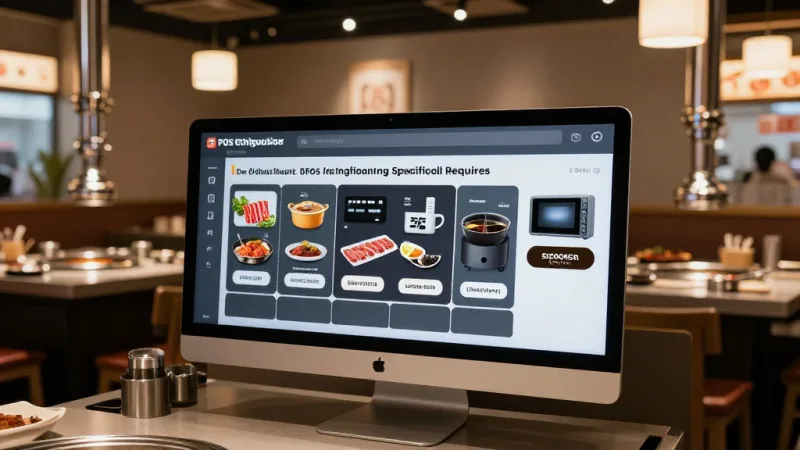
Here is what your POS must handle for Korean BBQ:
- Tier-locked menus — each table is assigned a tier at seating, and only that tier's proteins appear in the order screen.
- Group ordering mode — one check per table, not per guest. All items fire to the same grill station.
- Rapid-fire ordering — guests order 2 to 4 plates every 5 to 10 minutes. The ordering interface must be fast — two taps to add an item, not five.
- Table timer — visible countdown from the host view and the server view.
- Waste logging — a quick button at table close to log waste plates with item and quantity.
- Per-person checkout — even though the order is per-table, the check often splits by headcount. The POS must split evenly with one tap.
- Bilingual tickets — Korean and English on kitchen tickets so both Korean-speaking kitchen staff and English-speaking servers read the same ticket.
KwickOS handles all of these natively. The system was built for complex Asian restaurant formats — dim sum, hot pot, KBBQ — where standard POS workflows fail. Bilingual support (English, Chinese, Korean, Spanish) is built in, not bolted on. And because KwickOS runs on a hybrid local+cloud architecture, order routing to the kitchen happens in 1ms locally — not 20ms through a cloud server. When your guests are ordering every 5 minutes, that speed difference eliminates order backlogs.
And because KwickOS is processor-agnostic, you choose your own payment processor instead of being locked into Toast's 2.99% + $0.15 or Square's 2.6% + $0.10. On a Korean BBQ restaurant processing $80,000/month in card transactions (typical for a 120-seat AYCE), switching from Toast's locked rate to interchange-plus pricing saves $3,000 to $8,000 per year. Use our processing fee calculator to see your exact savings.
Real Numbers: A 120-Seat Korean BBQ P&L
Let us put it all together with a realistic monthly P&L for a well-managed Korean BBQ AYCE restaurant.
| Line Item | Monthly | % of Revenue |
|---|---|---|
| Revenue | ||
| Food (AYCE + a la carte) | $135,000 | 76% |
| Beverage | $38,000 | 21% |
| Gift cards & other | $5,000 | 3% |
| Total Revenue | $178,000 | 100% |
| Costs | ||
| Food cost | $43,200 | 24.3% |
| Beverage cost | $7,600 | 4.3% |
| Labor | $49,800 | 28.0% |
| Rent | $18,000 | 10.1% |
| Utilities (gas is high for KBBQ) | $6,200 | 3.5% |
| Other operating | $8,900 | 5.0% |
| Total Costs | $133,700 | 75.1% |
| Net Profit | $44,300 | 24.9% |
A 25% net margin on a Korean BBQ restaurant is achievable. It requires disciplined purchasing, tiered pricing, beverage focus, time management, waste tracking, and a POS system that supports every one of these levers.
T. Jin China Diner — a 15-store chain managing 75 terminals remotely through KwickOS — uses this same discipline across all locations. Real-time dashboards show food cost, waste, and revenue per seat across every store. When one location's food cost creeps above target, the operator sees it the same day — not at the end of the month when thousands have already been lost.
Run Your Korean BBQ on the OS Built for It
KwickOS handles tier-locked AYCE menus, table timers, waste tracking, bilingual tickets, and processor-free payment — all in one platform. See how it works for Korean BBQ.
Explore Korean BBQ SolutionsFrequently Asked Questions
What is a good food cost percentage for Korean BBQ all-you-can-eat?
A well-run Korean BBQ AYCE restaurant should target 30-35% food cost. Premium-tier AYCE (with wagyu or prime cuts) can run 38-42% food cost but compensates with higher per-head pricing. The key is balancing high-cost proteins with low-cost banchan, rice, and vegetables that fill guests up before they over-consume expensive meats.
How do Korean BBQ restaurants make money on all-you-can-eat?
Korean BBQ AYCE profits come from several levers: tiered pricing (basic $21.99, premium $29.99, wagyu $39.99), drink upsells at 75-80% margins, time limits (usually 90-120 minutes) that cap consumption, strategic menu design that steers guests toward lower-cost cuts, banchan that fills stomachs cheaply, and waste penalties ($2-3 per plate of uneaten food) that discourage over-ordering.
What is the average consumption per person at Korean BBQ AYCE?
Industry data suggests the average AYCE diner consumes 0.75 to 1.1 pounds of raw meat per visit. Women average around 0.6 pounds, men around 1.0 pound, and heavy eaters top out at 1.5-2.0 pounds. Menu design, banchan variety, and pacing strategies can keep the average closer to 0.8 pounds — which is where profitability lives.
Should I use time limits for Korean BBQ all-you-can-eat?
Yes. A 90-120 minute time limit is standard in the Korean BBQ AYCE industry and serves two purposes: it caps individual consumption (most guests naturally slow down after 60-75 minutes) and it increases table turnover during peak hours. Without time limits, weekend dinner tables can sit for 2.5-3 hours, cutting your covers per night significantly.
How do I track food waste in a Korean BBQ restaurant?
Use a POS system with waste tracking integration. Staff should log returned plates and uneaten portions at the end of each table's visit. Track waste as a percentage of total food served per guest. A well-managed AYCE restaurant keeps waste under 8% of total food cost. POS-integrated tracking like KwickOS lets you see waste trends by day, shift, and server — so you can identify which staff need coaching on portion pacing.