 Tom Jin
You are paying $8,000 a month in rent for a kitchen that runs at 40% capacity outside of your dinner rush.
That means 60% of your lease, your equipment depreciation, and your base labor costs are producing exactly zero revenue. Every hour your kitchen sits underutilized, you are losing money you already spent.
But it gets worse. Your competitors — the ones who figured out multi-brand ghost kitchens — are running three, four, even five delivery brands from a kitchen the same size as yours. They are pulling $180,000 or more in additional annual revenue from the same square footage, the same equipment, and in many cases the same staff.
The difference is not a bigger kitchen. It is not more equipment. It is an operational system that can manage multiple brands, route orders to the right station, track shared inventory across separate menus, and report profitability by brand — all without turning your kitchen into chaos.
This guide covers exactly how to build that system. I have spent 30 years in IT and 20 years in the restaurant industry, and I have helped operators from single-location restaurants to 600+ location chains like Haidilao design the technology backbone for multi-brand operations. Here is what works.
Why Multi-Brand Ghost Kitchens Are the Highest-ROI Move in Delivery
The economics are straightforward. Your fixed costs — rent, base utilities, equipment — are already paid. Every additional brand you add operates at near-marginal cost: you need ingredients, some additional packaging, and maybe one or two extra line cooks during peak hours.
Here is what the numbers typically look like:
| 1 Brand | 3 Brands | 5 Brands | |
|---|---|---|---|
| Monthly delivery revenue | $25,000 | $62,000 | $95,000 |
| Fixed costs (rent, equipment, base labor) | $12,000 | $12,000 | $12,000 |
| Variable costs (food, packaging, extra labor) | $10,000 | $24,800 | $38,000 |
| Monthly profit | $3,000 | $25,200 | $45,000 |
That is not a typo. Going from one brand to five brands does not 5x your revenue — it more like 4x it — but it nearly 15x your profit because fixed costs stay flat. And that's not all: you also gain category diversification. If burger delivery slows down in your area, your wing brand and your poke bowl brand keep the orders flowing.
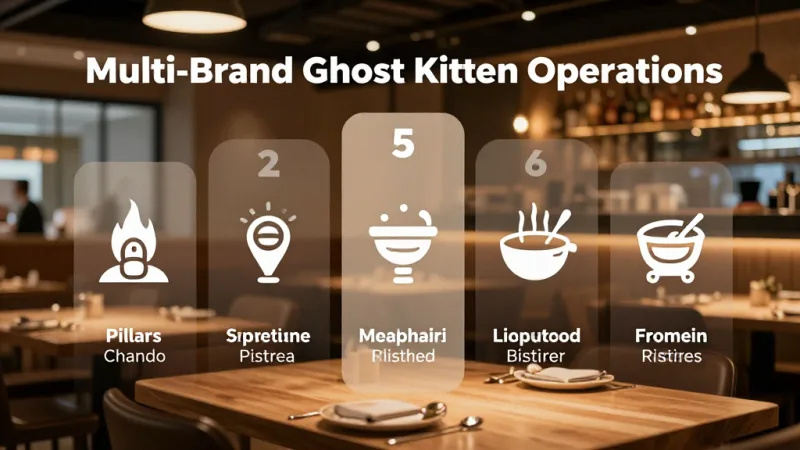
The 5 Pillars of Multi-Brand Ghost Kitchen Operations
Running multiple brands from one kitchen is not difficult conceptually. It is difficult operationally. Here are the five systems you need to get right.
Pillar 1: Brand Separation on Delivery Platforms
Each brand needs its own storefront on DoorDash, UberEats, and Grubhub. This is non-negotiable. Customers should never know that "Seoul Bowl Korean Kitchen" and "Crispy Wings Co." share a kitchen. Each brand needs distinct branding, a focused menu (15-25 items max), unique food photography, and separate customer reviews.
Here's the thing: the delivery platforms actually reward this. Their algorithms favor specialists over generalists. A focused wing brand with 20 items will rank higher in the "wings" category than a full-service restaurant with 120 items that happens to include wings.
Set up each brand as a separate "virtual restaurant" in the platform's merchant portal. Use different email addresses, brand names, and logos. But link them all to the same physical address and kitchen — the platforms allow this and even encourage it.
Pillar 2: Unified Order Routing
This is where most multi-brand operations fail. Orders come in from five brands on three platforms — that is potentially 15 incoming order streams hitting your kitchen simultaneously during a Friday dinner rush. Without a unified system, you end up with a tangle of tablets on the counter, each beeping independently, and a kitchen team that cannot prioritize.
The solution is a single POS system that ingests all orders from all platforms and all brands, then routes each order to the correct kitchen station with the correct branding. When a Seoul Bowl order comes in, the KDS shows it on the Korean station screen. When a Crispy Wings order comes in, it shows on the fry station screen. When both come in at the same time, the system sequences them by prep time so they finish together if they are going to the same driver.
This is exactly what Crafty Crab Seafood solved when they scaled to 19 locations with 152 terminals. The challenge was not the number of locations — it was routing orders correctly when multiple concepts ran through the same kitchen infrastructure. Their one-click menu sync across locations meant a new brand could be pushed to every kitchen in minutes, not hours.
Your POS checkout flow should handle this seamlessly. When your staff processes an order, the system should automatically apply the correct brand's pricing, modifiers, and packaging instructions without the cashier needing to switch between brand profiles manually.
Pillar 3: Shared Inventory with Per-Brand Costing
Here is where the profit magic happens — and where poor systems will destroy it.
A well-designed multi-brand ghost kitchen shares 70-80% of its base ingredients across brands. Chicken breast becomes a Korean rice bowl in Brand A, a buffalo chicken sandwich in Brand B, and a Caesar chicken wrap in Brand C. The sauces, toppings, and presentation change. The protein does not.
But your inventory system needs to track this at the recipe level. When Brand A sells one Seoul Chicken Bowl, the system should deduct 6 oz chicken breast, 8 oz rice, 2 oz gochujang sauce, and 1 oz sesame seeds from a single shared inventory pool. When Brand B sells a Buffalo Sandwich, it deducts 6 oz chicken breast from that same pool, plus 2 oz buffalo sauce and 1 bun from Brand B's specific ingredients.
This unified tracking prevents the two biggest inventory problems in multi-brand kitchens:
- Over-ordering: Without shared tracking, each brand's manager orders chicken independently, and you end up with 200 lbs when you need 120.
- Invisible food cost: Without per-brand recipe costing, you know your overall food cost is 34%, but you do not know that Brand A runs at 28% (great) while Brand D runs at 42% (bleeding money). You need per-brand P&L to make smart menu decisions.
According to restaurant industry data, operators who implement unified inventory tracking across multiple brands reduce food waste by 15-25% compared to those managing each brand's inventory separately.
Pillar 4: Kitchen Workflow Design
Your kitchen layout needs to support parallel brand production without cross-contamination of workflow (or allergens). The best approach is station-based production, where each station handles a category of prep rather than a specific brand.
A typical multi-brand ghost kitchen layout:
- Protein station: Handles all grilled, fried, and sautéed proteins for all brands
- Assembly station 1: Bowls and salads (Brand A, Brand C)
- Assembly station 2: Sandwiches and wraps (Brand B, Brand E)
- Fry station: All fried items across all brands (wings, fries, tempura)
- Expo/packaging: Final assembly, brand-specific packaging, quality check
Each station has its own KDS screen showing only the items relevant to that station, regardless of which brand the order belongs to. The expo station is where brand separation happens — that is where orders get assembled into the correct branded packaging with the correct branded receipt.
This is similar to what Shogun Japanese Hibachi achieved with their customized KDS station displays. They needed each cooking station to see only the items that station was responsible for, with clear visual cues for special requests. Staff were fully operational in under 5 minutes — proof that a well-designed station display eliminates the complexity that scares operators away from multi-brand.
Pillar 5: Per-Brand Analytics and P&L
You cannot manage what you cannot measure — and in a multi-brand ghost kitchen, measuring per-brand performance is everything. You need to know at a glance:
- Revenue by brand (daily, weekly, monthly)
- Food cost percentage by brand
- Average order value by brand and platform
- Order volume by hour and brand (to optimize staffing)
- Customer ratings and complaints by brand
- Delivery time performance by brand
T. Jin China Diner runs 15 locations with 75 terminals and manages everything through real-time remote monitoring. The same principle applies to multi-brand ghost kitchens — you need to see performance across all brands from a single dashboard, whether you are in the kitchen or checking from your phone at 2 AM.
When one brand underperforms, you need to know immediately whether it is a menu problem, a kitchen speed problem, or a platform ranking problem. Per-brand analytics make that diagnosis possible.
The Technology Stack That Makes Multi-Brand Work
Here is what you actually need to run five brands from one kitchen without drowning in complexity:
1. Processor-agnostic POS with multi-brand support. Your POS needs to handle multiple brand profiles, each with its own menu, pricing, and packaging rules, all running through one system. KwickOS does this natively — you set up each brand as a separate menu profile, and the system routes orders, tracks inventory, and generates reports per brand automatically. And because KwickOS is processor-agnostic, you are not paying an extra $3,000-$8,000 per year in locked processing fees. On five brands processing $95,000/month in delivery orders, that savings compounds fast.
2. Integrated KDS with station routing. Each station screen shows only what that station needs to produce, color-coded by brand for visual clarity. The hybrid local+cloud architecture matters here — with 1ms local response times, orders appear on screens instantly. In a high-volume ghost kitchen, even a half-second delay between order receipt and KDS display can create a bottleneck.
And that's not all: when the internet drops (and it will — construction, storms, ISP outages), a cloud-only system takes your entire ghost kitchen offline. Five brands, zero orders. A hybrid system keeps processing locally, so your kitchen never stops.
3. Unified online ordering with per-brand storefronts. Beyond third-party platforms, you should also run first-party ordering for each brand. KwickMenu lets you create separate ordering pages for each brand, all connected to the same kitchen backend. First-party orders cost $2 + $6.99 per delivery through KwickDriver versus the 15-25% commission that DoorDash and UberEats take. On $95,000/month in delivery revenue, moving even 30% of orders to first-party saves $4,275/month — or $51,300/year.
4. Fingerprint authentication for staff. Ghost kitchens often run with a rotating cast of prep cooks and line staff across shifts. Fingerprint 1:N authentication prevents buddy punching and unauthorized access. When you are paying 15 staff across two shifts to run five brands, even a 3% time theft rate costs you $1,400/month. Fingerprint eliminates it entirely.
Cross-Brand Gift Cards and Loyalty: The Revenue Multiplier Nobody Talks About
Here is an opportunity most ghost kitchen operators completely miss.
When you run five brands, you have five customer bases. A customer who loves your Korean bowl brand may not know your wing brand exists. Cross-brand gift cards and a unified loyalty program change that.
Cross-brand e-gift cards: When a customer buys a $50 e-gift card from Brand A, make it redeemable at all five brands. This introduces customers to brands they have never tried. According to industry data, cross-brand gift card holders try an average of 2.3 brands within 90 days of receiving the card. That is 2.3x the customer lifetime value from one gift card purchase.
Unified loyalty program: Run a single points-based loyalty program that spans all five brands. Order a bowl from Brand A, earn points. Order wings from Brand B, earn more points. Redeem anywhere. This creates a loyalty flywheel — the more brands a customer orders from, the faster they earn rewards, and the more likely they are to explore yet another brand.
Tiger Sugar does something similar with their 2 stores and 2 self-ordering kiosks — they use minimal-step personalization and electronic receipts with built-in loyalty to drive repeat visits. Scale that concept across five delivery brands and you have a loyalty ecosystem that keeps customers inside your brand family instead of drifting to competitors.
Your POS checkout needs to handle cross-brand gift card redemption and loyalty point accumulation automatically. If staff have to manually look up balances or switch between brand profiles, they will not do it during a rush — and the revenue multiplier disappears.
Common Mistakes That Kill Multi-Brand Ghost Kitchens
After working with thousands of operators across every restaurant type, I have seen the same mistakes over and over. Avoid these:
Mistake 1: Too many unique ingredients. If each brand has its own protein, its own starch, and its own sauce base, you are not running a multi-brand kitchen — you are running five separate restaurants that happen to share a roof. Keep 70-80% ingredient overlap. Change the seasoning, the sauce, the presentation — not the base.
Mistake 2: Using separate tablets for each delivery platform. Five brands on three platforms means 15 tablets. That is unmanageable. Consolidate everything through one POS that integrates with all delivery platforms. One screen, all orders, automatic routing.
Mistake 3: No per-brand P&L tracking. If you only track total kitchen revenue and costs, you will keep running unprofitable brands for months without realizing it. Demand per-brand reporting from your POS — food cost, labor allocation, and net profit by brand, not just total sales.
Mistake 4: Launching all brands at once. Start with two brands. Get the operations smooth. Then add a third. Then a fourth. Adding all five at once guarantees kitchen chaos, poor food quality, and bad reviews that tank your platform rankings. Baked Cravings started with one concept on one kiosk at Lego Land before expanding — the same principle of proving one model before scaling applies to ghost kitchen brands.
Mistake 5: Ignoring first-party ordering. Relying 100% on DoorDash and UberEats means giving up 15-25% of every dollar in commission. Build first-party ordering for each brand from day one. Even capturing 20-30% of orders through your own channels dramatically improves unit economics.
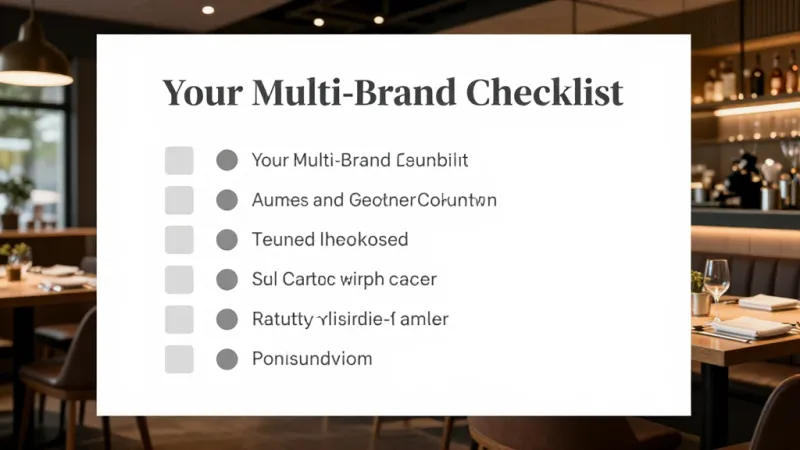
Your Multi-Brand Launch Checklist
Ready to add brands? Here is the sequence that works:
- Audit your current kitchen capacity. What is your peak utilization? What equipment sits idle during off-peak? Where is there physical space for additional stations?
- Design brands around shared ingredients. Map your current ingredient list and design new brand menus that use 70-80% of what you already buy.
- Set up your POS for multi-brand. Configure brand profiles, menu routing, station assignments, and per-brand inventory tracking before you launch. Use our food cost calculator to model per-brand costs.
- Build first-party ordering pages. Do not rely solely on third-party platforms. Launch your own ordering page for each brand to reduce commission costs.
- Create delivery platform storefronts. Professional photos, focused menus (15-25 items), brand-specific descriptions. Optimize for platform search.
- Train your team on station-based workflow. Staff should think in terms of stations, not brands. The expo station handles brand separation.
- Launch brand #2 first. Run it for 2-3 weeks. Fix problems. Then add brand #3. See how KwickOS compares to Toast for multi-brand support — Toast requires separate accounts for each brand.
- Set up cross-brand gift cards and loyalty. Enable e-gift cards redeemable across all brands and a unified loyalty program from the start.
- Monitor per-brand analytics weekly. Kill underperformers fast. Double down on winners. Adjust menus quarterly based on sales data.
The Bottom Line
A multi-brand ghost kitchen is the single fastest way to multiply delivery revenue without multiplying your overhead. The operators who succeed are not the ones with the best recipes — they are the ones with the best operations systems.
The right POS system — one that handles multi-brand order routing, shared inventory with per-brand costing, station-based KDS, cross-brand gift cards and loyalty, and per-brand analytics — is the difference between a profitable five-brand operation and a chaotic kitchen that burns through staff and produces bad food.
KwickOS was built for exactly this kind of operational complexity. Multi-language support (English, Chinese, Spanish) for diverse kitchen teams. Processor-agnostic design that saves $3,000-$8,000/year. Hybrid local+cloud architecture that keeps all five brands running even when the internet drops. And per-brand analytics that tell you exactly which brands are making money and which need to be cut or redesigned.
Explore ghost kitchen solutions to see how KwickOS handles multi-brand operations, or check our reseller program if you are building ghost kitchen concepts for clients.
Ready to Run Multiple Brands From One Kitchen?
KwickOS handles multi-brand order routing, shared inventory, per-brand analytics, and cross-brand loyalty — all from one system. See it in action.
Get a Free Demo