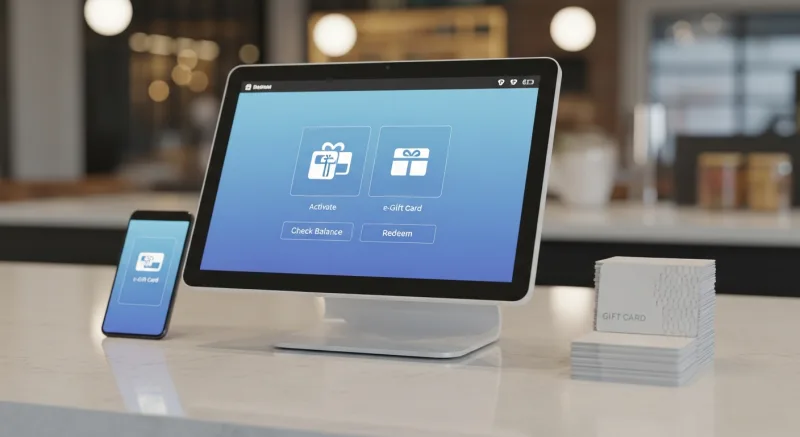
 Kelly Ho
Your competitor down the street just sold a $100 gift card to someone who will never walk through your door.
The buyer was sitting in bed at 11 PM, remembered a birthday tomorrow, pulled out their phone, and bought a digital gift card in 90 seconds. Your restaurant only sells physical cards at the register. You never had a chance.
Here's the thing: that same competitor is also losing sales to you — because they stopped stocking physical cards at their counter, and every impulse buyer who sees your display rack while waiting to pay grabs a $50 card as an afterthought.
Neither format wins alone. But most businesses pick one and ignore the other, bleeding revenue from a channel they never opened. Industry research suggests businesses offering both digital and physical gift cards see 40-60% higher total gift card revenue than those offering only one format.
This guide breaks down exactly where each format wins, where it loses, what it costs, who buys it, and how to build a hybrid strategy that captures every possible sale. We'll use real numbers so you can make the decision in the next 15 minutes.
The Sales Channel Split: Where Each Format Dominates
The digital-vs-physical debate isn't really about which is "better." It's about where the sale happens.
Physical gift cards dominate in-store. A customer finishes their meal, walks past the gift card rack by the register, and thinks: "Aunt Linda's birthday is Saturday." That's a $50 sale that required zero marketing, zero digital infrastructure, and zero effort from your staff. The card was just there, visible and tangible, at the exact moment the customer had their wallet open.
And that's not all: physical cards carry a psychological weight that pixels can't replicate. When someone hands you a beautifully designed card in an envelope, it feels like a gift. When someone forwards you an email with a code, it feels like a transaction. For major gifting occasions — birthdays, holidays, graduations, anniversaries — physical cards still outsell digital by a significant margin in-store.
But it gets worse for physical-only businesses. Here's what you're missing:
Digital gift cards dominate every channel outside your four walls. Mobile purchases. Late-night impulse buys. Last-minute gifts purchased at 6 AM on Mother's Day morning. Corporate bulk orders sent to 200 employees. Long-distance gifting from across the country. Social media promotions. Email marketing campaigns.
Industry data suggests that mobile gift card purchases have grown over 300% in recent years, and that trend is accelerating. If you're only selling physical cards, you're invisible during the fastest-growing buying moments.
| Sales Channel | Physical Cards | Digital Cards |
|---|---|---|
| In-store register impulse | Dominates | Weak |
| Holiday gifting (in-person) | Dominates | Moderate |
| Mobile/online purchase | Not available | Dominates |
| Last-minute gifts | Not available | Dominates |
| Corporate bulk orders | Slow/difficult | Dominates |
| Email/social campaigns | Not available | Dominates |
| Long-distance gifting | Requires shipping | Instant delivery |
The pattern is clear: physical cards win the in-store moment. Digital cards win everywhere else. And "everywhere else" is getting bigger every year.
The Real Cost Comparison (Not What You Think)
Most business owners assume physical cards cost more. They do — but only if you're counting production cost. When you factor in total cost per sale, the picture shifts.
Physical Card Costs
- Card production: $0.50-$2.00 per card (depending on design complexity, magnetic stripe vs barcode, and order quantity)
- Display rack: $50-$150 (one-time investment, counter or wall-mounted)
- Custom design: $200-$500 (one-time, unless you create seasonal designs)
- Envelopes/packaging: $0.10-$0.30 per card
- Reorders: $250-$600 per batch of 500 cards
First-year cost for 1,000 physical cards: approximately $1,200-$2,800.
Digital E-Gift Card Costs
- Per-unit production cost: $0.00
- Platform/POS integration: Often included in your POS subscription (KwickOS includes it natively)
- Custom email template design: $0-$200 (many POS platforms include templates)
- Delivery cost: $0.00 (email and SMS)
First-year cost for 1,000 digital cards: approximately $0-$200.
Here's the thing: that cost difference is compelling, but it doesn't mean digital is "cheaper" for your business. Physical cards generate sales that digital cards cannot — the impulse purchase at the register, the holiday endcap display, the card someone grabs when they see a beautiful design while paying their tab. Those sales have a cost of goods (the card itself), but they wouldn't exist without the physical product.
The right way to think about it: physical cards are a marketing expense with nearly 100% ROI. Digital cards are pure margin.
Customer Demographics: Who Buys What
Your customer base determines which format drives more revenue for your specific business. And the split is dramatic.
Under 35: Digital gift cards win by a wide margin. This demographic lives on their phones. They buy gifts at midnight, expect instant delivery, and would rather Apple Wallet than a plastic card. If your customer base skews young — bubble tea shops, coffee shops, trendy restaurants — digital should be your primary format.
35-50: Roughly even split. This group appreciates the convenience of digital for everyday occasions but still prefers physical cards for significant gifts. They'll buy a digital card for a coworker's farewell but a physical card for Mom's birthday.
Over 50: Physical cards dominate. This demographic associates gift-giving with tangible objects. An email with a code doesn't feel like a real gift. If your customer base skews older — fine dining, steakhouses, traditional restaurants — physical cards should remain your primary display.
Corporate buyers: Digital dominates overwhelmingly. When an HR department needs to send gift cards to 200 employees for the holiday party, they're not ordering physical cards and stuffing envelopes. They want to upload a CSV, customize a message, and click send. See our corporate gift card bulk sales guide for how to land these orders.
But it gets worse for businesses that ignore this data: if you only offer the format your current customers use, you're not attracting the customers who want the other format. A restaurant with only physical cards is invisible to every under-35 customer who would have bought a digital card. That's not a lost sale — it's a lost customer segment.
Redemption Rates and the Breakage Factor
Here's where the economics get interesting — and where most business owners miss a major revenue stream.
Industry research suggests digital gift cards have a slightly higher redemption rate (approximately 85-90%) compared to physical cards (approximately 80-85%). The reason is simple: digital cards live on your phone. You can't lose them in a drawer, wash them in your jeans, or forget them at home. A push notification reminds you the balance exists.
Physical cards, on the other hand, are easy to misplace. They end up in junk drawers, wallets that get replaced, and pockets that go through the laundry. That lost card? The money was already paid. The product never gets delivered. That gap — called breakage — is pure revenue.
For a business selling $50,000 in gift cards annually:
| Metric | Physical Cards | Digital Cards |
|---|---|---|
| Estimated redemption rate | ~82% | ~88% |
| Breakage rate | ~18% | ~12% |
| Breakage revenue (on $50K) | $9,000 | $6,000 |
| Avg. spend above face value | ~28% | ~22% |
| Bonus spending (on $50K redeemed) | $11,480 | $9,680 |
Physical cards generate more breakage revenue and more bonus spending per redemption. Digital cards generate more total redemptions and reach more buyers. The winning strategy isn't choosing one — it's running both and letting each format do what it does best.
Important note: breakage revenue is subject to state escheatment laws. Some states require you to turn over unredeemed balances after a dormancy period. Check your state's requirements or read our gift card breakage revenue guide for the full legal breakdown.
The Checkout Connection: How Your POS Makes or Breaks Both Formats
None of this works if your POS system can't handle both formats seamlessly. And "handle" doesn't just mean "activate a card." It means the entire lifecycle: activation, balance tracking, redemption, partial redemption, cross-location sync, reporting, and integration with your loyalty program.
Here's what happens at the checkout counter in a well-integrated system:
- Customer presents a gift card (physical or pulls up digital on their phone)
- Cashier scans the barcode or enters the code
- POS instantly shows the available balance
- Customer applies it to their order — partial or full
- If the order exceeds the balance, the remaining amount is charged to another payment method (split tender)
- New balance is updated in real-time across all locations
- Loyalty points accrue on the transaction amount
- Receipt shows remaining gift card balance
That eight-step flow needs to happen in under 10 seconds. Any friction — a system that can't read the barcode, a manual balance lookup, a location that doesn't recognize the card — and you've created a terrible experience for a customer who was literally given a reason to visit your business.
Crafty Crab Seafood, operating 19 locations with 152 terminals, ran into exactly this problem before switching to a unified POS platform. A gift card purchased in Baltimore wasn't recognized in Virginia because their legacy system didn't sync across locations fast enough. The fix? KwickOS's hybrid local+cloud architecture processes the transaction locally at 1ms while syncing the balance across all 19 stores through the cloud layer. Gift cards work everywhere, instantly, even if the internet drops at one location.
Building Your Hybrid Strategy: The 5 Rules
Now that you understand where each format wins, here's how to run both simultaneously without doubling your workload.
Rule 1: Physical Cards at Every Point of Sale
Place a gift card display at every register, checkout counter, and payment station in your business. The data on placement is clear: register-adjacent displays outperform back-wall displays by 3-4x. If your customer is already paying, the gift card is one impulse decision away.
For Rockin' Rolls Sushi Express with 49 iPad self-ordering stations across 3 locations, this meant adding a "Gift Card" button directly in the self-ordering flow. Customers ordering their own food see a gift card prompt during checkout — no staff interaction required.
Rule 2: Digital Cards on Every Digital Surface
Your website, your online ordering page, your email signature, your Google Business profile, your social media bios — every digital touchpoint should have a "Buy a Gift Card" link. The link goes to your e-gift card purchase page where customers can choose an amount, add a personal message, and send it instantly via email or text.
Rule 3: Match Your Loyalty Program to Both Formats
This is the multiplier most businesses miss. When someone redeems a gift card — physical or digital — they should automatically earn loyalty points on the purchase. And when a gift card recipient creates an account to check their balance, they should be auto-enrolled in your membership or loyalty program.
Think about the math: a $50 gift card brings a new customer through your door. They redeem $50, spend an additional $14 above the card value, earn 64 loyalty points, and now have a reason to come back without a gift card next time. One gift card just created a repeat customer.
On KwickOS, the gift card module, loyalty points system, and CRM are all part of the same platform. When a gift card is redeemed, loyalty points accrue automatically. There's no manual integration, no third-party app, no "please enter your rewards number" friction at the register.
Rule 4: Seasonal Physical, Year-Round Digital
Physical cards shine brightest during gifting seasons — November through January for holidays, May for Mother's Day, June for Father's Day and graduations. Stock up before these windows and create seasonal card designs that feel special.
Digital cards are your year-round workhorse. Birthday auto-sends, corporate orders, social media promotions, email campaigns, last-minute saves — these happen 365 days a year and require zero physical inventory. Use our e-gift card marketing strategy guide for campaign ideas that drive consistent digital sales.
Rule 5: One Dashboard, Both Formats
If you're tracking physical cards in one system and digital cards in another, you don't have a gift card program — you have two half-programs that can't talk to each other. Unified reporting means seeing total gift card revenue, outstanding liability, breakage rates, and redemption patterns across both formats in one view.
This is where your POS platform matters more than anything else. A processor-agnostic system like KwickOS means gift card transactions aren't inflated by locked-in processing fees. When you process $50,000 in annual gift card sales, the difference between a locked 2.99% rate and a negotiated interchange-plus rate saves you $400-$600/year on gift card transactions alone — money that goes straight to your bottom line.
The Multi-Location Advantage
Gift cards become exponentially more valuable when you operate multiple locations — but only if the technology keeps up.
T. Jin China Diner, running 15 stores with 75 terminals, uses gift cards as a customer acquisition tool across locations. A customer who usually visits the Chinatown location buys a gift card for a friend who lives near the suburban location. That friend redeems the card, discovers they love the food, and becomes a regular — at a location the original customer never visits. The gift card just crossed geographic boundaries and created a new customer at a different store.
For this to work, every location needs to activate, recognize, and redeem every card — physical or digital — in real time. There's no "sorry, that card was purchased at another location" in a well-integrated system. KwickOS's hybrid architecture handles this natively: local processing for speed, cloud sync for cross-location consistency, and offline fallback so gift cards work even when the internet drops at one store.
What About Self-Service and Kiosk Environments?
Gift cards in self-service environments require a different approach. Baked Cravings, operating a self-serve kiosk at Lego Land, uses digital gift cards exclusively for their kiosk operation. There's no cashier to suggest a gift card purchase and no counter display to catch someone's eye. Instead, the kiosk's checkout screen prompts: "Want to send a gift card to a friend?" with a one-tap purchase flow.
For Tiger Sugar with 2 self-ordering kiosks, the approach is different. Physical gift card displays sit next to the kiosks, and the kiosk interface accepts gift card codes as a payment method during checkout. The minimal-step flow means a customer can redeem a gift card in one additional tap — scan code, apply balance, pay the difference, done.
In both cases, the POS handles gift card and loyalty enrollment in the same transaction. The kiosk isn't just a point of sale — it's a point of relationship.
The Numbers That Matter: Your Gift Card Program Scorecard
Track these metrics monthly to know if your hybrid strategy is working:
- Total gift card revenue (physical + digital combined)
- Channel split (what percentage of sales come from each format)
- Average load value (are digital buyers loading more or less than physical?)
- Redemption rate by format (which cards are actually being used?)
- New customer rate (how many gift card redeemers are first-time visitors?)
- Loyalty conversion rate (what percentage of gift card redeemers join your loyalty/membership program?)
- Above-face-value spending (how much do redeemers spend beyond the card balance?)
- Outstanding liability (total unredeemed gift card balances — this is money you owe)
Use the gift card revenue calculator to model your projected revenue from both formats based on your current sales volume.
Stop Choosing. Start Combining.
The digital-vs-physical debate is a false choice. It's like asking whether your restaurant should accept cash or credit cards. The answer is both — because different customers want to pay differently, and every sale you refuse is a sale your competitor accepts.
Physical gift cards capture the in-store impulse moment. Digital gift cards capture every moment outside your store. Together, they create a gift card program that's always available, always convenient, and always converting.
The businesses that win at gift cards aren't the ones with the best card design or the slickest e-gift card email template. They're the ones with a POS system that treats both formats as first-class citizens — unified tracking, cross-location sync, automatic loyalty integration, and zero friction at checkout.
Your gift card program should be as easy to manage as your regular menu. And the customers who receive those gift cards should have the same seamless experience whether they're holding a plastic card or showing a code on their phone.
Run Both Gift Card Formats From One Platform
KwickOS includes native physical and digital gift card management, automatic loyalty integration, multi-location sync, and processor-agnostic checkout — all in one system. See how it works for your business.
Get a Free Demo