 Tom Jin
Look at your menu right now. Find your best-selling latte. Now find your cold brew.
That latte uses $1.10 in milk, $0.35 in espresso, and requires 90 seconds of skilled barista labor. You sell it for $5.50. That is a 74% margin on a good day.
Your cold brew uses $0.45 in coffee, no milk, and zero active labor at the point of service. You sell it for $5.00. That is a 91% margin. Every single cup.
Here's the thing: most coffee shop owners treat cold brew as a seasonal afterthought — something to offer when the weather gets warm. They are leaving tens of thousands of dollars on the table.
A coffee shop selling 40 cold brews per day at $5.00 generates $73,000 in annual revenue with less than $7,000 in ingredient costs. That is $66,000 in gross profit from a product that requires no barista skill, no expensive equipment, and almost no labor to serve.
And that's not all: add a nitro tap, and you can charge $6.00-$6.50 per cup while actually reducing your labor further — because nitro pours from a tap in 8 seconds flat.
This guide breaks down every number: batch costs, keg systems, pricing psychology, seasonal promotion strategy, and shelf life management. Whether you are adding cold brew for the first time or optimizing an existing program, the math will change how you think about your menu.
The Cold Brew Cost Breakdown: Why 91% Margins Are Real
Let us get specific. The reason cold brew margins are so extraordinary is that you eliminate the two biggest cost drivers in specialty coffee: milk and labor.
Here is the per-cup cost for a 16oz cold brew versus comparable drinks:
| Item (16oz) | Ingredient Cost | Retail Price | Margin |
|---|---|---|---|
| Cold Brew (black) | $0.45 | $5.00 | 91% |
| Nitro Cold Brew | $0.52 | $6.00 | 91% |
| Iced Latte | $1.35 | $5.75 | 77% |
| Hot Latte | $1.45 | $5.50 | 74% |
| Drip Coffee | $0.25 | $3.00 | 92% |
Drip coffee has a comparable margin percentage, but look at the dollar amount: $2.75 profit per cup for drip versus $4.55 profit per cup for cold brew. Cold brew commands premium pricing because customers perceive it as a premium product — smoother, less acidic, more refined. That perception is money.
But it gets worse for shops that ignore this opportunity. Every iced latte you sell instead of a cold brew costs you $1.80 in margin. If 30 of your daily iced drink customers switched to cold brew, you would earn an extra $19,710 per year in gross profit — with less labor and less equipment wear.
Batch Brewing: The Setup That Runs Itself
Cold brew is the only coffee product that gets better the less you touch it. Here is how batch brewing works at scale:
Equipment You Need
- Brewing vessels: Toddy commercial systems ($150-$400) or food-grade 5-gallon buckets with fine mesh filters ($30-$50 each). Start with two vessels so one is always steeping while you serve from the other.
- Coarse grinder: Your existing shop grinder works, but a dedicated burr grinder for cold brew ($200-$500) prevents cross-contamination of grind settings and saves time during morning prep.
- Storage containers: Food-grade Cambro containers or stainless steel kegs for the finished concentrate. Label everything with brew date and expiration.
- Scale: A digital kitchen scale ($30) for precise coffee-to-water ratios.
Total startup cost: $200-$900. Compare that to a $15,000 espresso machine. The ROI timeline on cold brew equipment is measured in days, not years.
The Batch Process
Here's the thing: cold brew requires roughly 10 minutes of active labor per batch, and each batch yields 40-60 servings.
- Grind: 5 pounds of coffee at the coarsest setting (2-3 minutes).
- Combine: Add grounds to 2.5 gallons of filtered cold water in your brewing vessel (2 minutes).
- Steep: Cover and refrigerate for 18-24 hours (0 minutes of labor).
- Filter: Strain through the mesh filter into storage containers (3-4 minutes).
- Label: Date, batch number, expiration (1 minute).
That is 10 minutes of work for approximately $200-$300 in retail product. Your espresso machine requires a trained barista for every single cup. Cold brew requires a trained barista for zero cups.
And that's not all: because cold brew concentrate keeps for 10-14 days, you only need to brew 2-3 times per week to maintain supply. Track your batch volumes and sell-through rates in your POS system to dial in production — KwickOS inventory tracking lets you set par levels that alert your team when it is time to start a new batch.
Nitro: The $1.50 Premium That Pays for Itself in Weeks
Nitro cold brew is regular cold brew infused with nitrogen gas through a pressurized keg system. The nitrogen creates a cascading, creamy texture with a thick head — similar to a Guinness pour. Customers pay $1.00-$1.50 more for it, and the additional cost per cup is roughly $0.07 in nitrogen.
Let that sink in: $0.07 extra cost, $1.50 extra revenue.
Keg System Investment
| Component | Cost | Lifespan |
|---|---|---|
| 5-gallon Cornelius keg (x2) | $150-$300 | 10+ years |
| Nitrogen tank (20 lb) | $200-$300 | Refill $30-$50 |
| Regulator | $60-$100 | 5+ years |
| Stout faucet + shank | $80-$150 | 5+ years |
| Lines, connectors, cleaning kit | $50-$80 | Replace annually |
| Total | $540-$930 |
At 20 nitro cups per day with a $1.50 premium, you are generating $30/day in pure additional margin. That is $900/month. The entire keg system pays for itself in less than one month.
But the financial benefit goes beyond the premium price. Nitro eliminates several hidden costs:
- No cream or sugar needed: Nitrogen naturally sweetens the flavor and creates a creamy mouthfeel. According to industry data, roughly 40% of nitro customers drink it black who would normally add cream to regular coffee. That saves $0.08-$0.15 per cup in dairy costs.
- Faster service: A nitro pour takes 8 seconds. An iced latte takes 60-90 seconds. During peak hours, that speed difference translates directly to throughput and revenue.
- Less waste: Keg systems are sealed, preventing oxidation and extending freshness compared to open containers of cold brew.
Pricing Strategy: Anchor High, Sell Volume
Most coffee shop owners underprice cold brew. They treat it like iced coffee — a cheaper, simpler product. That is a mistake worth thousands per year.
Cold brew is a premium product. Price it like one.
The Psychology That Works
Anchor with nitro. List your nitro cold brew at $6.50. Directly below it, list regular cold brew at $5.00. The nitro price makes $5.00 feel reasonable, even though your cold brew costs less to make than a $3.00 drip coffee. This is classic price anchoring, and it works because customers evaluate price relative to nearby options, not absolute cost.
Size pricing matters. Offer three sizes:
| Size | Price | Cost | Margin |
|---|---|---|---|
| Small (12oz) | $4.00 | $0.34 | 92% |
| Medium (16oz) | $5.00 | $0.45 | 91% |
| Large (20oz) | $5.75 | $0.56 | 90% |
The large is only $0.75 more than the medium, but the extra 4oz costs you just $0.11. According to restaurant industry data, 45-55% of customers choose the middle option, but the ones who upsize to large generate outsized margin. Configure your POS to prompt for size selection — KwickOS modifier prompts increase average transaction size by guiding customers through these decisions automatically.
Here's the thing: the checkout flow matters as much as the menu. When a customer orders cold brew, your POS should prompt the barista or self-service screen to suggest nitro as an upgrade. A simple "Would you like to try nitro for $1.50 more?" converts at roughly 15-25% based on industry benchmarks. That is free money on every transaction.
Seasonal Promotion: Cold Brew Is Not Just for Summer
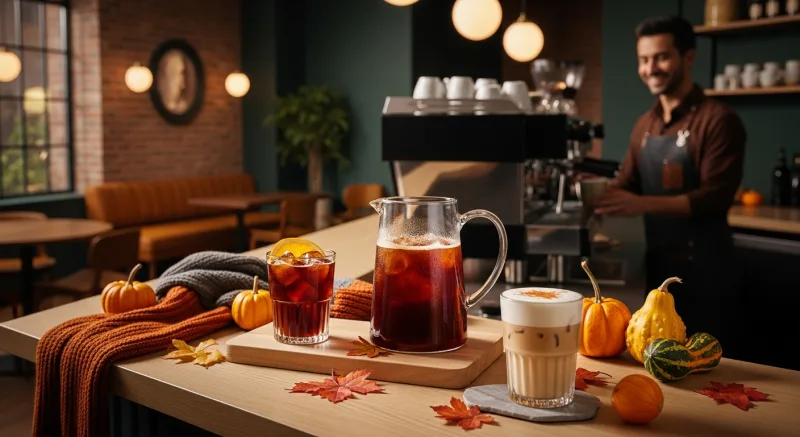
The biggest mistake coffee shops make with cold brew is treating it as a seasonal item. Cold brew consumption has grown year-round, with winter cold brew sales now representing a significant share of the market according to specialty coffee industry data.
Here is a quarter-by-quarter promotion strategy:
Q1 (January-March): New Year, New Brew
Launch a "New Year Cold Brew Challenge" — buy 10 cold brews in January, get the 11th free. Track this through your loyalty program. KwickOS loyalty points auto-accrue on qualifying purchases, so you can create a cold-brew-specific promotion without manual tracking. This is also the perfect time to introduce e-gift cards tied to cold brew bundles — a "Cold Brew Lover's Gift Card" loaded with $30 for $25 drives trial from new customers who received them as holiday gifts.
Q2 (April-June): Spring Launch
This is your ramp-up season. Introduce seasonal flavors — lavender cold brew, vanilla bean nitro, honey cinnamon. Charge a $0.50-$1.00 flavor premium. Run a social media campaign: "Tag us with your cold brew and get 50 bonus loyalty points." These seasonal specials create urgency and social sharing.
Q3 (July-September): Peak Volume
Maximize throughput. Offer a cold brew subscription: $79/month for one cold brew per day. At $5.00/cup, a daily customer would normally pay $150/month. They feel like they are saving $71. You are locking in $79 in guaranteed monthly revenue with a product that costs you $13.50/month to produce. The math works overwhelmingly in your favor. Use your POS membership module to auto-bill and track redemptions.
Q4 (October-December): Holiday Nitro
Launch limited-edition holiday nitro flavors — pumpkin spice nitro, peppermint nitro, gingerbread nitro. Price these at $7.00-$7.50. During the holiday gift card season, create a "Nitro Gift Pack" — a branded tumbler plus a $25 gift card for $30. Gift card breakage (unredeemed value) averages 15% according to industry data, which means roughly $3.75 of every $25 gift card is pure profit. Promote these at the POS checkout counter with eye-catching displays.
Shelf Life Management: The Science of Not Wasting Product
Cold brew's shelf life is its superpower and its risk. Unlike espresso, which goes stale in minutes, cold brew concentrate stays fresh for up to two weeks. But without proper tracking, shops either waste product or serve stale coffee — both cost money.
The Freshness Framework
- Concentrate (undiluted): 10-14 days at 38°F or below
- Ready-to-serve (diluted): 5-7 days at 38°F or below
- Kegged nitro: 7-10 days under nitrogen pressure
- Bottled retail: 7-14 days refrigerated (check local regulations)
But it gets worse if you are not tracking this systematically. A single batch of wasted cold brew concentrate costs $12-$18 in coffee alone. Waste two batches per month and that is $288-$432 per year walking straight into the drain.
The solution is production tracking through your POS inventory system. Enter each batch with its brew date, expected yield, and expiration. KwickOS inventory management tracks batch quantities in real time — when a keg or container drops below par level, it triggers a prep alert. When a batch approaches expiration, it flags the product for discount or promotional use rather than waste.
Crafty Crab Seafood uses exactly this approach across their 19 locations — not for cold brew, but for perishable ingredients with the same shelf-life challenges. Their one-click inventory sync across 152 terminals means every location follows the same freshness protocols. The same system works for any coffee shop managing cold brew production.
Retail and Bottled Cold Brew: Your Second Revenue Stream
Every coffee shop with a cold brew program is sitting on a retail product line and most do not realize it.
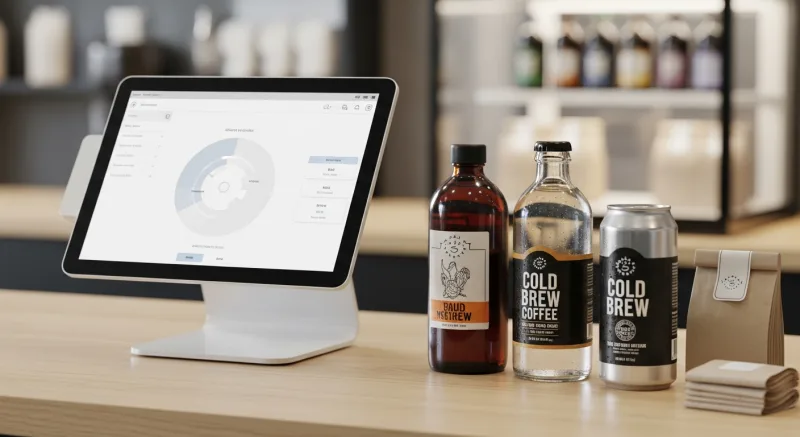
Bottled cold brew in a grab-and-go cooler near the register converts customers who are in a hurry, want to stock up at home, or are buying gifts. The numbers are compelling:
| Product | Production Cost | Retail Price | Margin |
|---|---|---|---|
| 12oz bottle | $0.85 (incl. bottle + label) | $5.50 | 85% |
| 16oz bottle | $0.95 | $7.00 | 86% |
| 32oz growler | $1.40 | $12.00 | 88% |
A shop selling just 10 bottles per day adds $16,425 in annual revenue with under $3,100 in costs. And unlike fresh-brewed coffee, bottles sit in a cooler and sell themselves — no barista time required.
Here's the thing: retail cold brew also drives gift card sales. When customers buy bottles to share, they often ask about gift options. Position gift cards next to your bottled cold brew display with messaging like "Give the Gift of Cold Brew — E-Gift Cards Available." KwickOS supports both physical and e-gift cards that customers can purchase and send instantly from their phone.
POS Integration: Track Every Pour, Price Every Drop
Cold brew's simplicity is deceptive. Without proper POS tracking, you are flying blind on your most profitable product.
Here is what your POS needs to handle for a cold brew program:
- Batch tracking: Log each batch with brew date, volume, and cost. This feeds your food cost reports accurately.
- Modifier management: Size, flavor add-ons, nitro upgrade, milk alternatives. Each modifier needs its own cost and price so your margin reports reflect reality.
- Subscription billing: If you offer a cold brew subscription, your POS needs auto-recurring billing and per-visit redemption tracking. KwickOS membership management handles this natively — set the monthly price, define the daily redemption limit, and the system handles billing, tracking, and reporting.
- Inventory deduction: Each cold brew sold should deduct from your concentrate inventory automatically, triggering prep alerts when you hit reorder points.
- Loyalty integration: Cold brew purchases should earn loyalty points like any other item, and you should be able to create cold-brew-specific rewards (free upgrade to nitro at 50 points, free cold brew at 100 points). This encourages repeat cold brew purchases and builds habit.
T. Jin China Diner uses KwickOS across 15 locations with 75 terminals to track inventory and sales in real time. The same POS infrastructure that gives Tom remote visibility into 15 restaurants gives a coffee shop owner real-time visibility into cold brew production, sales, and profitability — from any device, anywhere.
And because KwickOS is processor-agnostic, you are not paying inflated processing fees on every cold brew sale. A locked processor like Toast charges 2.99% + $0.15 on every transaction. On a $5.00 cold brew, that is $0.30 per cup going to Toast. Switch to an interchange-plus processor through KwickOS and that drops to roughly $0.18 per cup. Over 40 cold brews per day, that is $1,752 per year in processing savings on cold brew alone. Use our processing fee calculator to see your specific savings.
The Cold Brew Upsell Machine
Cold brew is not just a high-margin product — it is a high-margin platform for upsells. Every add-on carries massive margins:
- Flavor shot (vanilla, caramel, lavender): Cost $0.08, charge $0.75 — 89% margin
- Oat milk or alternative milk: Cost $0.20, charge $0.80 — 75% margin
- Nitro upgrade: Cost $0.07, charge $1.50 — 95% margin
- Extra shot of espresso: Cost $0.25, charge $1.00 — 75% margin
- Whipped cream or sweet foam: Cost $0.10, charge $0.75 — 87% margin
A plain cold brew at $5.00 generates $4.55 in margin. Add a vanilla shot, oat milk, and nitro upgrade, and you have a $8.05 ticket generating $7.00 in margin. That is a 87% margin on a $8.05 drink.
Configure your self-order kiosk or POS screen to present these modifiers in a logical sequence. Tiger Sugar's 2 self-ordering kiosks use this exact approach — minimal-step personalization that guides customers through customizations without overwhelming them. The result: higher average tickets with customers feeling in control of their order rather than being "upsold."
Fingerprint Clock-In and Cold Brew Production
Here is a pattern interrupt most coffee shop articles will never mention: who is brewing your cold brew matters for accountability.
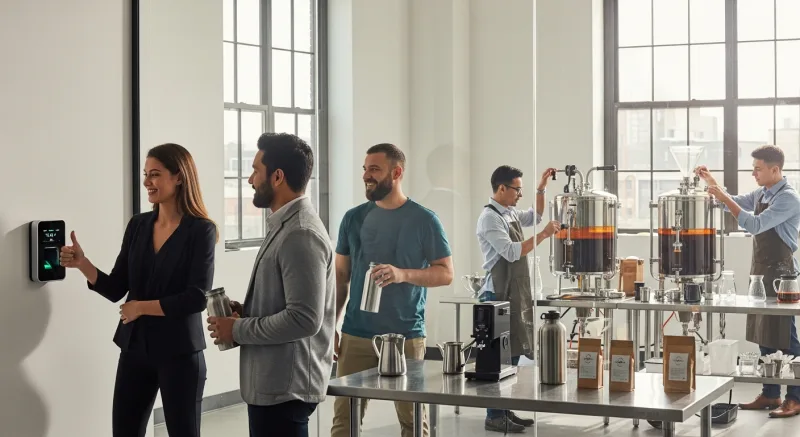
When you track batches, you need to know which team member brewed them. If a batch comes out weak or goes bad early, you need to trace it back to the prep process. KwickOS fingerprint 1:N authentication means the team member who clocks in for prep and logs the batch is verified biometrically — no buddy punching, no "I don't remember who brewed that batch" when quality issues arise.
This level of accountability sounds small until the day a batch of cold brew tastes off and 30 customers get subpar drinks. Knowing who brewed it, when, and what process they followed turns a mystery into a coaching moment.
Cold Brew + Loyalty: The Habit Loop That Prints Money
Cold brew customers are creatures of habit. According to industry data, cold brew drinkers have higher visit frequency than customers who order hot coffee. They are your best candidates for loyalty and membership programs.
Here is the loyalty structure that maximizes cold brew lifetime value:
- 1 point per dollar spent on all purchases (standard earning)
- 2x points on cold brew and nitro (drives product-specific frequency)
- 50 points = free size upgrade (encourages progression from small to large)
- 100 points = free cold brew (rewards loyalty with the highest-margin product)
- 200 points = free nitro + flavor (premium reward for top customers)
The genius of rewarding cold brew with more cold brew is that your cost of redemption is $0.45-$0.52 per reward — far less than giving away a $5.50 latte that costs $1.45 to produce. You are being generous with your cheapest-to-produce premium product.
KwickOS CRM and loyalty handles multi-tier point structures natively, including product-specific multipliers. Your staff does not need to calculate anything — the system applies the right earning rate at checkout automatically, and customers see their points balance on the receipt or in their digital wallet.
The Bottom Line: Cold Brew Is Your Most Undervalued Asset
Let us add it all up for a coffee shop selling 40 cold brews and 20 nitros per day:
| Revenue Stream | Daily | Annual |
|---|---|---|
| Regular cold brew (40 x $5.00) | $200 | $73,000 |
| Nitro premium (20 x $1.50) | $30 | $10,950 |
| Flavor/modifier upsells | $45 | $16,425 |
| Bottled retail (10/day) | $55 | $20,075 |
| Total cold brew revenue | $330 | $120,450 |
| Total ingredient cost | $38 | $13,870 |
| Gross profit | $292 | $106,580 |
$106,580 in gross profit from one product category. That is not a side menu item. That is a business within your business.
The equipment investment? Under $2,000 for everything including the nitro keg system. The labor? Less than 30 minutes per day of batch prep. The skill required? Any team member can learn the process in a single shift.
Your espresso program will always be the heart of your coffee shop. But cold brew and nitro are the margin engine that funds everything else — better beans, higher wages, that second location you have been planning.
Stop treating cold brew as a seasonal afterthought. Start treating it as the most profitable product in your entire operation. Because the math says it already is.
Build Your Cold Brew Profit Machine
KwickOS gives coffee shops the inventory tracking, loyalty programs, and processor-agnostic checkout to maximize every cold brew sale. See how it works for your shop.
Get a Free Demo