
The Missed Call Problem
Every restaurant owner knows the scenario: Friday night rush, phones ringing off the hook, staff juggling dine-in customers and takeout orders. A call goes unanswered. That's $35 gone. Maybe $50 if it was a family order.

Industry data shows the average restaurant misses 20-30% of incoming calls during peak hours. For a restaurant doing $15,000/week in phone orders, that's $3,000-$4,500 in lost revenue every week.
The traditional solutions — hiring a dedicated phone person ($3,000-$4,500/month), using an overflow call center ($2-5 per call), or just accepting the loss — all have significant downsides.
In 2026, AI voice ordering has matured to the point where it's a realistic, cost-effective alternative.
Looking for a complete restaurant POS solution? See our restaurant POS system page for a full feature overview.
How AI Voice Ordering Actually Works
Modern restaurant AI voice systems do three things:
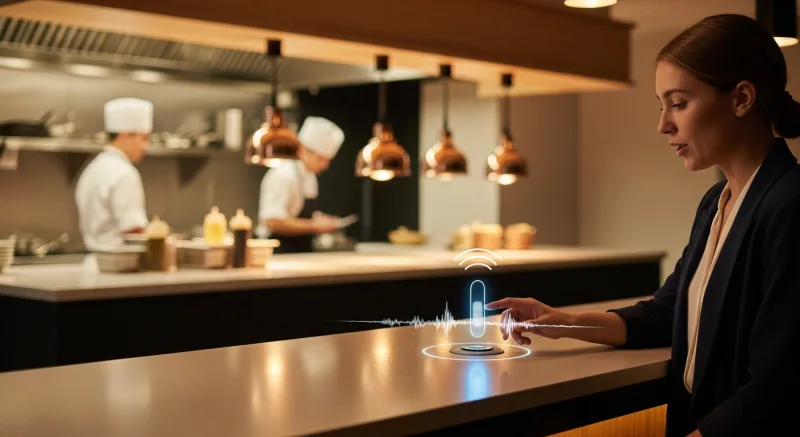
- Understand speech — including accents, background noise, and restaurant-specific terminology
- Process orders — navigating menus, handling modifiers ("no onions", "extra sauce"), confirming totals
- Push to POS — sending the completed order directly into the kitchen workflow
The customer experience is simple: they call the restaurant's regular number, an AI voice answers, takes their order conversationally, confirms it, and provides a pickup time. Most customers can't tell the difference from a well-trained human — and the AI never puts them on hold.
What to Look For in an AI Voice Ordering System
1. POS Integration Depth
This is the single most important factor. A voice AI that can't send orders directly to your POS is just an expensive answering machine.
There are two approaches in the market:
- Third-party integration — the AI vendor connects to your POS via API. Works, but adds latency, sync issues, and another vendor to manage.
- Native integration — the AI is built by your POS company, sharing the same menu database and order pipeline. Zero lag, zero sync issues.
KwickPhone, for example, is built directly into the KwickOS platform — orders appear on the kitchen display within seconds, using the exact same menu and modifier structure the restaurant already has configured.
2. Language Support
If your customer base includes non-English speakers, you need an AI that handles multiple languages natively — not through translation, but through actual multilingual models. This is especially critical for restaurants in diverse communities.
3. Menu Complexity Handling
Simple menu? Any AI can handle "I want a large pepperoni pizza." But what about "I want the #7 combo, substitute the drink for a large Thai tea, add an extra egg roll, and split the pad thai into two containers"? Test edge cases before committing.
4. Fallback to Human
The AI should gracefully hand off to a staff member when it encounters something it can't handle — catering requests, complaints, or simply a customer who says "let me talk to someone."
5. No New Phone Number Required
Avoid solutions that require you to advertise a new number. The best implementations use call forwarding from your existing number — either all calls, overflow only, or after-hours only.
The Cost Math
Here's the simple calculation every restaurant owner should run:
| Item | Monthly Cost/Value |
|---|---|
| Missed calls (20 calls/day × $35 avg × 30 days × 30% miss rate) | $6,300 lost revenue |
| Dedicated phone employee | $3,000 - $4,500 |
| AI voice ordering solution | $300 - $900 |
Even if the AI only captures half the missed orders, it pays for itself 10x over.
The Market in 2026
The restaurant AI voice ordering market has exploded. Enterprise chains use systems from companies like SoundHound (processing 100M+ interactions). But for independent restaurants and small chains, the options that matter are:
- Standalone AI phone services (third-party, connect to various POS systems)
- POS-native AI solutions (built into your existing POS platform)
The trend is clear: POS-native solutions win on reliability, speed, and total cost of ownership. Having one vendor for your entire restaurant technology stack eliminates the integration fragility that plagues multi-vendor setups.
Getting Started
If you're considering AI voice ordering for your restaurant:
- Audit your missed calls — check your phone system's abandoned call rate during peak hours
- Calculate the revenue gap — missed calls × average order value = money left on the table
- Ask your POS vendor ��� do they offer native voice AI? If not, you'll need a third-party solution
- Start with overflow — forward calls to AI only when staff can't pick up. Low risk, immediate value.
KwickPOS customers can activate KwickPhone same-day with zero hardware changes. For everyone else, the key is finding a solution with solid POS integration and multilingual support for your customer base.
Ready to stop losing phone orders?
See KwickPhone AI in action — handles English, Spanish, and Chinese.
Get a Free Demo →