
 Tom Jin
Every restaurant owner has lived this nightmare. You look at your walk-in cooler on a slow Wednesday morning and see $800 worth of protein that will not survive another day. Meanwhile, last Friday you ran out of your best-selling entrée by 7:30 PM because the weather turned nice and half the city decided to eat out.
Here's the thing: you are making one of the most expensive decisions in your business — how much to prep and who to schedule — based on a gut feeling and a glance at last week's numbers.
That guessing game is costing you between $18,000 and $35,000 per year in wasted food, missed sales, and misallocated labor. According to restaurant industry data, the average full-service restaurant throws away 4-10% of food purchased before it ever reaches a customer's plate. For a restaurant buying $15,000/month in ingredients, that is $7,200 to $18,000 annually — straight into the dumpster.
But it gets worse: the waste you can see is only half the problem. The other half is the revenue you never capture because you under-prepped for a busy night or under-staffed during an unexpected rush.
AI demand forecasting eliminates both problems. Not with crystal ball predictions, but with pattern recognition across thousands of data points your POS system already collects — and never uses.
What AI Demand Forecasting Actually Does (No Buzzwords)
Strip away the hype and AI demand forecasting does one thing: it tells you what tomorrow looks like before it happens.
The system analyzes your historical POS data — every transaction, every item sold, every hour of every day — and cross-references it with external factors like weather forecasts, local events, holidays, and seasonal trends. From those patterns, it generates a prediction: "Tuesday will do approximately $4,800 in sales, 23% above your normal Tuesday average, driven by a concert at the arena three blocks away."
That single prediction changes three critical decisions:
- Prep volume: You prep for 240 covers instead of your usual 195 Tuesday prep.
- Labor schedule: You add one extra server and one prep cook for the dinner shift.
- Purchasing: You order 15% more protein and produce for Monday delivery.
And that's not all: the system gets smarter every day. Every actual sales result feeds back into the model, correcting its assumptions and tightening its accuracy. Within 60-90 days, most restaurants see forecast accuracy between 85% and 95% for next-day predictions.
5 Data Signals That Power Restaurant Demand Forecasting
AI forecasting is only as good as its inputs. Here are the five data signals that drive the most accurate predictions — and your POS system is already collecting most of them.
1. Historical Sales Patterns
This is the foundation. Your POS records every transaction with a timestamp, which reveals patterns invisible to the human eye: that your check average drops 8% on the first Tuesday after a long weekend, that appetizer sales spike 15% when the temperature drops below 50°F, that your bar revenue doubles during playoff season.
You need at least 12 months of clean POS data for reliable forecasting. 24 months is better because it captures year-over-year seasonality.
2. Weather Correlation
Weather is the single biggest external factor in restaurant demand. Industry research suggests that a sunny Saturday can drive 15-25% more walk-in traffic than a rainy one. Delivery orders, conversely, increase 20-30% when it rains.
AI models incorporate 7-day weather forecasts and correlate them with your specific sales history. If your historical data shows that rainy Fridays produce 18% more delivery orders but 12% fewer dine-in covers, the model factors that into every rainy Friday forecast.
3. Local Events and Calendar Awareness
A concert at the venue down the street. A home game for the local football team. A convention at the hotel next door. School holidays. Payday cycles. These events create demand spikes that a simple "same day last year" comparison would miss entirely.
Here's the thing: most of these events are publicly available data. AI forecasting systems scrape local event calendars, sports schedules, and school calendars to factor them into predictions automatically.
4. Seasonal and Holiday Trends
Mother's Day is your biggest Sunday of the year. The week between Christmas and New Year's is always slow. Valentine's Day triples your reservation count. These are obvious. What is less obvious is that the second week of January consistently produces 22% lower sales as customers abandon holiday spending, or that your seafood items see a 30% bump during Lent.
AI models capture these micro-seasons across your full transaction history.
5. Internal Promotional Activity
Running a gift card promotion this week? Launching a new loyalty program tier? Sent an email blast to your membership list yesterday? These internal marketing activities create demand that historical patterns alone would not predict.
When your POS, CRM, and marketing tools are unified on one platform, the forecasting model can factor in promotional activity automatically. An e-gift card campaign that generated $3,200 in gift card sales means approximately $3,200 in future redemptions — and the model knows that 60% of gift cards get redeemed within 30 days.
The $35,000 Problem: Where Restaurants Lose Money Without Forecasting
Let us put real numbers to the guessing game. Consider a mid-volume restaurant doing $80,000/month in sales with a 32% food cost.
| Loss Category | Without Forecasting | With AI Forecasting | Annual Savings |
|---|---|---|---|
| Food waste (over-prep) | 6% of food cost | 2.5% of food cost | $10,752 |
| Missed sales (under-prep/86'd items) | 3% of revenue | 0.8% of revenue | $21,120 |
| Labor overscheduling | 5 extra hours/week at $18/hr | 1.5 extra hours/week | $3,276 |
| Total annual impact | $35,148 |
That $35,148 is not theoretical. It is money that leaves your business every year because prep decisions are based on intuition instead of data. For a restaurant operating on 5-8% net margins, recovering $35,000 in waste and missed revenue has the same bottom-line impact as adding $440,000 to $700,000 in new sales — without hiring a single new employee.
How KwickOS Makes Forecasting Automatic
Most standalone forecasting tools require you to export data, upload CSVs, and manually cross-reference results with your prep sheets. That is why most restaurants that buy forecasting software stop using it within 90 days.
KwickOS takes a different approach. Because your POS, inventory, scheduling, loyalty program, and online ordering all run on the same platform, forecasting becomes automatic:
- POS data flows in real time. Every dine-in transaction, every kiosk order, every delivery through KwickDriver feeds the model continuously. No exports. No syncing.
- Inventory updates instantly. When the model predicts a 23% busier Tuesday, your inventory system flags items that need reordering before Monday's delivery cutoff.
- Schedules adapt automatically. The labor scheduling module suggests shift adjustments based on forecast demand, so you are not scrambling to find coverage at 3 PM.
- Gift card redemption patterns factor in. If you sold $5,000 in e-gift cards during a holiday promotion, the model anticipates the redemption curve and adjusts prep accordingly.
- Loyalty member behavior is tracked. Members with points nearing a reward threshold are more likely to visit this week. The model sees that pattern and adjusts.
This unified approach is why KwickOS merchants across 5,000+ businesses and 50 states process over $2M in daily sales with less waste and better margins than operators on fragmented systems.
Real Forecasting in Action: Multi-Location Management
Forecasting becomes exponentially more valuable when you operate multiple locations. Consider Crafty Crab Seafood, which runs 19 stores with 152 terminals on KwickOS. Each location has its own demand patterns — the downtown store is event-driven while the suburban location is family-weekend-driven — but the centralized dashboard gives operators a single view of tomorrow's demand across every location.
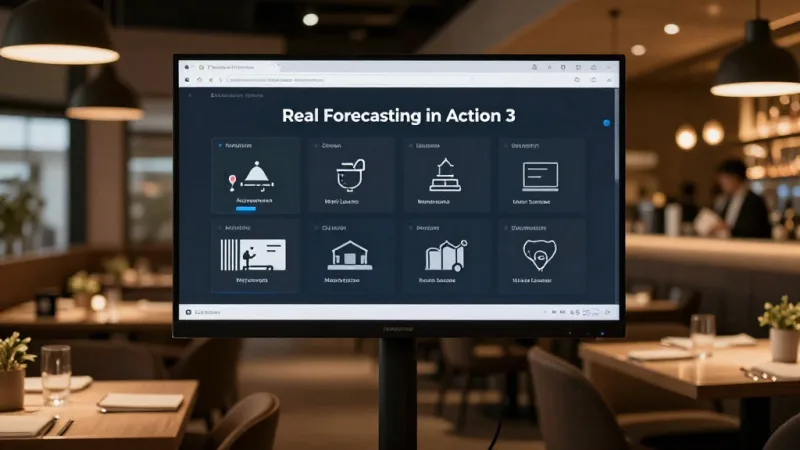
When the forecast predicts a slow Wednesday at three locations but a busy one at two others, the operator can redistribute prep ingredients through inter-store transfers instead of watching food expire at the slow stores while the busy ones run out.
T. Jin China Diner uses the same principle across 15 stores and 75 terminals, monitoring prep levels and sales velocity remotely from a single dashboard. When one location's actual sales start outpacing the forecast by noon, the system alerts the manager to adjust dinner prep upward before it is too late.
But it gets worse for operators without this capability: without centralized forecasting, each location manager makes independent prep decisions. That means 19 separate gut feelings, 19 separate over-orders, and 19 separate waste buckets. Multiply the single-location waste problem by your store count and you understand why multi-location groups see the biggest ROI from AI forecasting.
Implementation: Getting Started in 3 Phases
You do not need a data science team to implement demand forecasting. Here is the practical roadmap:
Phase 1: Data Foundation (Weeks 1-4)
Ensure your POS is capturing clean, item-level data for every transaction. If you have been on KwickOS, this data already exists. If you are migrating from another system, historical data import is part of the onboarding process.
Start tracking waste intentionally. Every discarded prep item gets logged with a reason code: over-prep, spoilage, customer return, or staff meal. This baseline tells you exactly where the money is going.
Phase 2: Forecast Generation (Weeks 5-12)
With 30+ days of clean data (or imported historical data), the forecasting model starts generating daily predictions. During this phase, run the forecast alongside your current prep process — do not replace your existing system yet. Compare the AI's prediction to your manager's estimate and to actual results each day.
Most restaurants discover that the AI outperforms gut-feeling estimates within the first two weeks, and significantly outperforms them by week six.
Phase 3: Operational Integration (Week 13+)
Once you trust the forecast accuracy, integrate it into your daily workflow:
- Prep sheets are generated from the forecast, not from the manager's memory.
- Purchase orders are triggered by predicted demand plus safety stock, not by a weekly routine.
- Labor schedules are built around predicted covers, not last week's schedule copied forward.
- Gift card and loyalty redemption spikes are factored into prep — especially around holidays when e-gift card sales peak and redeem in clusters.
The Checkout Connection: How POS Data Fuels Better Forecasts
Every forecast starts at the checkout counter. The richness of your POS transaction data directly determines the quality of your predictions.
A basic POS that records "Table 12: $87.50" gives the model almost nothing to work with. A comprehensive POS that records item-level detail — two salmon entrées, one appetizer, one dessert, a bottle of wine, payment split between credit and gift card, loyalty points earned, server ID, timestamp to the minute — gives the model dozens of signals per transaction.
This is why POS systems that unify checkout, gift cards, loyalty, and ordering on one platform produce dramatically better forecasting data than fragmented systems where you need to reconcile data from three different vendors.
When a customer pays with a gift card at checkout, that redemption data feeds the model. When a loyalty member earns their 10th visit reward, the system knows their next visit is likely within 5 days. When a kiosk order at a location like Rockin' Rolls (3 stores, 49 iPad self-ordering stations) shows a spike in a particular combo meal, the model adjusts tomorrow's prep for that item.
Weather, Events, and the Signals You Cannot See
Here is something most restaurant operators do not realize: the relationship between weather and your specific sales is not generic. "Rain reduces traffic" is a starting point, but your data tells a more nuanced story.
A BBQ restaurant might see rain reduce Saturday traffic by 25% because customers associate BBQ with outdoor dining. A ramen shop might see rain increase Saturday traffic by 15% because hot soup sounds better when it is cold and wet. A delivery-heavy operation like Tiger Sugar (2 stores, 2 kiosks) might see rain shift revenue from kiosk walk-ins to delivery orders without changing total revenue at all.
And that's not all: the AI model learns these specific correlations from your data. It does not apply generic "rain = slow" logic. It learns that when the forecast shows rain on a Saturday in March, your specific restaurant sees a 12% dine-in drop but an 18% delivery increase, with the net effect being a 3% overall revenue increase because delivery tickets average $8 higher than dine-in.
No human manager, no matter how experienced, can calculate that in their head while building next week's prep list.
The Competitive Advantage Nobody Talks About
There is a second-order benefit to AI forecasting that goes beyond waste reduction and labor optimization. It is about customer experience.
When you never 86 a menu item, customers trust your restaurant. When you always have enough staff for fast service, customers come back. When your gift card holders can always redeem without hearing "sorry, we're out of that," they spend more. When your loyalty members get consistent quality regardless of the day, they stay loyal.
Industry research suggests that 86'ing a menu item during a customer's visit reduces their likelihood of returning by 15-20%. For a restaurant that 86's items twice a week, that is hundreds of lost future visits per year — each worth $45-80 in average spend.
AI forecasting does not just save you money on the back end. It protects your revenue on the front end by ensuring you are always prepared for whoever walks through the door.
Stop Guessing. Start Forecasting.
KwickOS gives you AI demand forecasting, unified inventory, labor scheduling, loyalty, and gift cards — all on one platform that works even when the internet drops. See how 5,000+ businesses across 50 states run smarter operations.
Get a Free Demo
Frequently Asked Questions
How accurate is AI demand forecasting for restaurants?
Modern AI forecasting models that incorporate historical POS data, weather patterns, local events, and seasonal trends typically achieve 85-95% accuracy for next-day sales predictions. Accuracy improves over time as the system learns your specific business patterns, with most restaurants seeing reliable forecasts within 60-90 days of implementation.
What data does AI need to forecast restaurant demand?
At minimum, AI forecasting needs 12-24 months of POS transaction data including timestamps, item-level sales, and daily totals. Better predictions come from adding weather data, local event calendars, holiday schedules, and marketing activity logs. The more data points available, the more patterns the AI can identify — such as the correlation between rainy Fridays and increased delivery orders.
How much food waste can AI forecasting reduce?
According to restaurant industry data, AI-driven demand forecasting typically reduces food waste by 20-40% within the first six months. For a restaurant spending $15,000/month on food, that translates to $3,000-$6,000 in annual savings from waste reduction alone, not counting the labor savings from optimized prep schedules.
Can small restaurants benefit from AI forecasting, or is it only for large chains?
Small restaurants benefit significantly from AI forecasting because they have less margin for error. A single-location restaurant throwing away $200 in over-prepped food on a slow Tuesday feels that loss more acutely than a 50-location chain. Modern POS platforms like KwickOS build forecasting into the system at no extra cost, making it accessible to businesses of any size.
How does AI demand forecasting affect labor scheduling?
AI forecasting allows managers to schedule staff based on predicted demand rather than guesswork. If the system predicts a 23% busier-than-normal Tuesday due to a local concert, you schedule two extra servers and an additional prep cook. If Wednesday looks slow, you run a leaner crew. Industry research suggests this approach reduces labor costs by 3-5% while improving service quality during peak periods.