 Kelly Ho
It is Friday at 7:30 PM. Your dining room is full. A party of four walks in, scans the packed lobby, and asks the host: "How long is the wait?"
Your host glances at the floor, does some mental math, and says: "Probably about 30 minutes."
The family looks at each other. The husband pulls out his phone. Within 90 seconds, they have a reservation at the restaurant three blocks away. They walk out, and you never see them again.
That just cost you $127. The average four-top dinner check, plus the lifetime value of a customer who might have come back once a month for two years. And that is the optimistic scenario — the pessimistic one involves a 1-star Google review about "ridiculous wait times."
Here's the thing: the wait was not the problem. Thirty minutes is perfectly acceptable for a popular restaurant on a Friday night. The problem was everything else — the vague estimate, the crowded lobby, the lack of options, and the feeling that nobody was managing the situation.
Industry research suggests that roughly 7 out of 10 guests who walk away from a wait never return to that restaurant. Not because the food is bad. Not because the prices are wrong. Because the first impression was standing in a lobby watching other people eat.
This guide shows you how to fix that — not by eliminating waits (you cannot control demand), but by transforming the wait into an experience that keeps guests engaged, spending, and surprisingly happy.
The Real Cost of Walked Guests (It Is Worse Than You Think)
Most restaurant owners calculate walkaway losses by multiplying the number of walked parties by the average check. That math is wrong — it is far too conservative.
Here is what a single walked four-top actually costs you:
| Loss Category | Estimated Value |
|---|---|
| Tonight's check | $95 - $140 |
| Bar spend during wait (lost) | $18 - $32 |
| Gift card purchase at host stand (lost) | $25 - $50 |
| Loyalty sign-up value over 12 months | $180 - $360 |
| Word-of-mouth referrals (lost) | $200 - $400 |
| Total true cost per walkaway | $518 - $982 |
Now multiply that by 8 to 15 walked parties per busy night. A restaurant open five busy nights per week could be losing $150,000 to $400,000 per year in combined immediate and lifetime revenue from poor waitlist management.
But it gets worse: those guests are not just disappearing. They are going to your competitors. Every walked guest is a deposit into someone else's register.
Why Traditional Waitlist Methods Fail
The clipboard-and-buzzer system has been the standard for decades. It has three fatal flaws:
1. Host guessing is wildly inaccurate. According to restaurant industry data, host-quoted wait times are off by an average of 12 to 18 minutes. Guests tolerate being seated early. They do not tolerate being seated late. A host who says "20 minutes" when the actual wait is 35 minutes has just created an angry customer before they even sit down.
2. Physical buzzers trap guests in the lobby. Those black pagers have a range of about 200 feet. That means your guests are standing in a crowded entryway, watching tables that seem to take forever, getting hungrier and more frustrated by the minute. They cannot browse the shops next door. They cannot wait in their car. They are prisoners of the buzzer.
3. There is no engagement during the wait. The 25-minute gap between "your name is on the list" and "your table is ready" is dead time. No one is offering them a drink. No one is signing them up for your loyalty program. No one is showing them this week's specials. That is 25 minutes of growing impatience with zero revenue generation.
And that's not all: these systems produce zero data. You have no idea how many people joined the list, how many walked, what the average wait was, or which time slots generate the most demand. You are managing your busiest revenue hours completely blind.
The Modern Waitlist: Virtual Queues and SMS Notifications
A digital waitlist system replaces guesswork with data and replaces frustration with freedom. Here is how it works:
Guests join the queue from anywhere. A QR code at the host stand, a link on your Google Business profile, or a button on your website lets guests add themselves to the waitlist before they even arrive. They enter their name, party size, and phone number. Done.
The system quotes wait times using real data. Instead of a host guessing, the POS system calculates the estimated wait based on current table occupancy, average turn times by party size, and day-of-week patterns. A party of two on a Tuesday gets a very different estimate than a party of six on Saturday — and both are accurate within 3 to 5 minutes.
SMS keeps guests informed and free. Once on the list, guests receive:
- A confirmation text with their position and estimated wait
- An update when they move up in the queue
- A "your table is almost ready" alert at the 5-minute mark
- A "your table is ready" final notification
This changes everything. Guests can wait in their car, browse nearby stores, or — and this is the revenue opportunity — sit at your bar. They are not trapped. They are not anxious. They have information and control.
Restaurants using SMS-based waitlist systems report walkaway reductions of 30% to 50% compared to traditional name-and-buzzer approaches. That translates directly to recovered revenue on your busiest nights.
Turning Wait Time into Revenue: The Bar Upsell Strategy
Here is the part most restaurant owners miss: a well-managed waitlist is not a cost center. It is a revenue engine.
The single highest-margin opportunity in your restaurant is the bar tab of a waiting guest. Think about it: this guest is already committed to dining with you. They have 20 to 40 minutes to kill. And you have a fully stocked bar 15 feet away.
Industry data suggests that guests directed to the bar during their wait spend an average of $12 to $18 on drinks and appetizers — revenue that would not exist if they were standing in the lobby or waiting in their car.
Here is how to maximize this opportunity:
Train your host team to redirect, not just quote. Instead of "It will be about 25 minutes," train hosts to say: "It will be about 25 minutes — would you like to grab a drink at the bar while you wait? I will text you when your table is ready."
Create a wait-specific menu. A small card at the bar featuring 4 to 5 shareable appetizers and signature cocktails — labeled "While You Wait" — gives guests permission to order. Without it, many guests feel awkward ordering food before they have been seated.
Transfer the bar tab to the dinner check. This is critical. Your POS system should allow the bartender to open a tab and transfer it seamlessly to the dining room check when the guest is seated. If the transfer is clunky or requires re-ordering, your staff will not bother. With KwickOS, tab transfers between stations take a single tap — the bartender transfers the open items to the server's table, and the guest's bar spend appears on their dinner check automatically.
Let's run the numbers. If you redirect 30 guests per night to the bar at $15 average spend:
- Daily bar upsell revenue: $450
- Weekly (5 busy nights): $2,250
- Annual: $117,000
At 75% to 80% margins on beverages, that is roughly $88,000 to $94,000 in pure profit from guests who were going to walk out the door.
Accurate Wait Time Quoting: The Trust Factor
Nothing destroys guest trust faster than an inaccurate wait quote. Tell a guest 20 minutes and seat them at 45, and you have lost them forever — even if the meal itself is perfect.
The golden rule: always overestimate by 5 to 10 minutes. Guests who are quoted 30 minutes and seated at 22 feel delighted. Guests quoted 20 minutes and seated at 28 feel lied to. The actual wait is identical. The perception is completely different.
But here's the thing: you cannot overestimate accurately without real data. And real data requires POS-integrated table tracking.
A system that monitors your dining room in real time knows:
- Which tables are occupied and for how long
- Average turn time by party size (a two-top turns in 52 minutes; a six-top turns in 78 minutes)
- Day-of-week and hour-of-day patterns (Friday 7 PM turns are 15% slower than Tuesday 7 PM)
- How many tables are in the "dessert and check" phase right now
With this data, the system can predict table availability with 3 to 5 minute accuracy — something no host, no matter how experienced, can do consistently during a Friday night rush.
T. Jin China Diner uses real-time table tracking across their 15 locations and 75 terminals. Their managers can see turn time patterns from a single dashboard, spotting which locations are running slow and adjusting staffing or seating strategy on the fly. The result: wait time quote accuracy improved significantly, and guest complaints about waits dropped across all locations.
The Waitlist as a Loyalty and Gift Card Machine
Your waitlist captures something incredibly valuable: the guest's phone number. Every person who joins your virtual queue has voluntarily given you their mobile number and permission to text them. That is a marketing goldmine.
Here is how smart restaurants leverage the waitlist for loyalty enrollment and gift card sales:
SMS loyalty sign-up during the wait. After the queue confirmation text, send a follow-up: "While you wait — join our rewards program and earn points on tonight's dinner. Tap here to enroll in 30 seconds." Guests waiting for a table have nothing but time. Enrollment rates from wait-period SMS prompts are 3 to 4 times higher than at-checkout prompts, according to restaurant industry data.
Gift card displays at the host stand. The host stand is the one place in your restaurant where guests stand still and look around. A well-positioned gift card display with messaging like "Give the Gift of [Restaurant Name]" catches guests during their most idle moment. Physical gift cards near the host stand and e-gift card QR codes on the waitlist confirmation screen both convert — especially around holidays.
Birthday and anniversary capture. Your waitlist form can include an optional "celebrating something special?" field. Guests who share a birthday or anniversary get a personalized text before their next visit with a special offer — and a prompt to purchase an e-gift card for the person they are celebrating with. This data feeds directly into your CRM and loyalty system, creating automated marketing triggers that run themselves.
A single waited guest who joins your loyalty program and purchases a $50 gift card for a friend's birthday has just generated 3 future visits — their own return, the gift card redemption visit, and the friend's second visit if you enroll them too. That is $300+ in downstream revenue from one waitlist entry.
Digital Signage and the Wait Experience
What are your waiting guests looking at right now? If the answer is "their phones" or "the wall," you are wasting the most captive audience in your restaurant.
Digital signage in the lobby and bar area transforms dead wait time into an engagement and sales channel:
- Rotating specials and seasonal items — guests who see tonight's featured entree on the screen are 40% more likely to order it, according to restaurant industry research
- Loyalty program promotion — "Join our rewards program and earn points tonight" with a QR code
- Gift card promotion — "E-Gift Cards available — send one from your phone" during holiday seasons
- Social proof — customer reviews, Instagram photos of signature dishes, "serving the community since 2014" messaging
- Upcoming events — wine dinners, live music nights, holiday prix fixe menus
KwickSign integrates directly with your POS menu data, so when you 86 an item or add a special, the lobby screen updates automatically. No separate content management required.
Multi-Location Waitlist Management
For restaurant groups operating multiple locations, waitlist management becomes a strategic tool, not just an operational one.
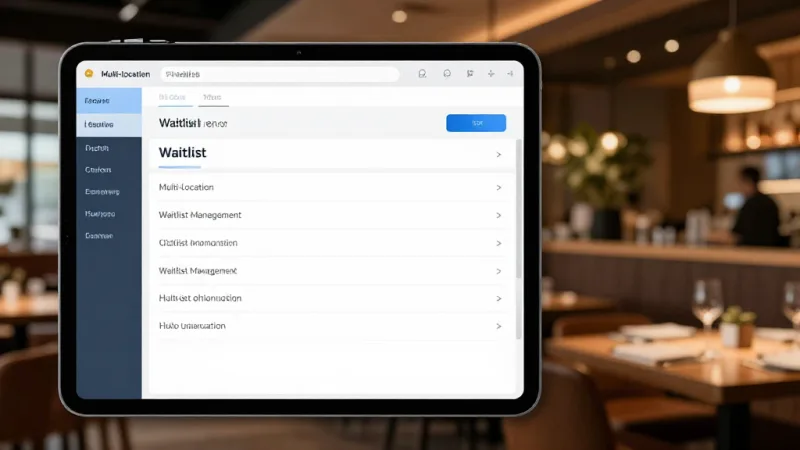
Imagine a guest approaches your downtown location on a Saturday night. The wait is 55 minutes. Your midtown location, 8 minutes away, has a 15-minute wait. A centralized waitlist system can offer the guest the option: "Would you prefer our midtown location? We can seat you in 15 minutes."
Crafty Crab Seafood manages waitlists across their 19 locations with centralized reporting. Their district managers can see which locations are turning tables efficiently and which are falling behind — and redistribute marketing or staffing resources accordingly. With 152 terminals reporting data in real time, wait time patterns across the entire portfolio feed into staffing decisions, reservation policy adjustments, and even lease renewal analysis for underperforming locations.
This cross-location visibility is only possible when your waitlist data lives in the same system as your POS, menu management, and employee management. Standalone waitlist apps create another data silo. An integrated platform makes the data actionable.
The Checkout Connection: Why POS Integration Matters
A waitlist system that does not talk to your POS is a glorified notepad. The real power comes from integration:
Automatic table status tracking. When a server closes a check, the system knows that table is about to open. No host needs to physically walk the floor and check. The waitlist advances automatically.
Guest history at the host stand. When "Sarah M., party of 4" appears on the waitlist, your host sees her profile: 12 previous visits, prefers booth seating, husband has a nut allergy, last visit was 3 weeks ago. The host greets her by name. The server is pre-informed about the allergy. The experience feels personal — because it is.
Fingerprint clock-in for hosts. Your host is the first impression. Knowing who is working the stand, how many guests they have seated, and their average quote accuracy helps you train and schedule your best hosts for peak periods. KwickOS fingerprint authentication ensures the right person is logged in — no buddy punching, no shared logins — and their seating performance data is tracked per shift.
Offline reliability. Your busiest night is exactly when your internet is most likely to hiccup. If your waitlist runs on a cloud-only system and the connection drops, your host is back to the clipboard. KwickOS runs on a hybrid local+cloud architecture with 1ms local response times. The waitlist, table map, and SMS queue all function at full speed even during an internet outage — and sync automatically when the connection restores.
Implementation: Getting Started This Week
You do not need a 6-month technology overhaul to improve your waitlist management. Here is a phased approach:
Week 1 — Fix the quote. Start tracking actual wait times vs. quoted times. Have your host write down every quote and the actual seat time. After one week, you will know your accuracy gap. Use this data to calibrate.
Week 2 — Add the bar redirect. Train every host to offer the bar as a wait option. Create a simple "While You Wait" menu card. Ensure your POS can transfer bar tabs to dining tables smoothly.
Week 3 — Go digital. Deploy a virtual waitlist with SMS notifications. Place a QR code at the host stand and on your Google Business profile. This alone will reduce walkaways by 30% or more.
Week 4 — Add the revenue layer. Set up loyalty enrollment SMS during the wait. Add a gift card display at the host stand. Configure lobby digital signage with specials and promotions. Now your waitlist is not just managing demand — it is generating revenue.
Shogun Japanese Hibachi implemented a similar phased approach and had their team fully trained within 5 minutes on the new system. The interface was intuitive enough that hosts did not need lengthy training — they scanned the QR code, saw the queue, and started seating.
Measuring What Matters: Waitlist KPIs
Once your system is running, track these metrics weekly:
| Metric | Target | Why It Matters |
|---|---|---|
| Walkaway rate | Under 10% | Direct revenue recovery |
| Quote accuracy | Within 5 minutes | Guest trust and satisfaction |
| Bar conversion rate | 40%+ of waited guests | Wait-period revenue |
| Average bar spend per waited guest | $12 - $18 | Upsell effectiveness |
| Loyalty enrollment during wait | 15%+ of new guests | Long-term customer value |
| Table turn time | Benchmark by party size | Capacity optimization |
Review these numbers every Monday morning. If walkaway rate is climbing, check your quote accuracy. If bar conversion is low, retrain your hosts on the redirect script. If loyalty enrollment is flat, test different SMS timing or incentive language. Data turns waitlist management from a guessing game into a science.
Stop Losing Guests to the Wait
KwickOS integrates waitlist management, table tracking, bar tab transfers, loyalty enrollment, and gift card sales into one platform — with offline reliability that works even when your internet does not. See how restaurants across 50 states are turning wait times into revenue.
Get a Free DemoFrequently Asked Questions
How long will customers wait before leaving a restaurant?
Industry research suggests that most casual dining guests will wait 15 to 20 minutes before becoming frustrated. Without updates or engagement, walkaway rates spike sharply after 20 minutes. Accurate time quotes and SMS updates can extend guest patience to 35 to 45 minutes while maintaining satisfaction.
What is a virtual waitlist and how does it work for restaurants?
A virtual waitlist lets guests join the queue remotely via QR code, website, or Google search without standing in a physical line. They receive SMS updates on their position and estimated wait time, then get a text alert when their table is ready. This lets guests wait in their car, browse nearby shops, or sit at the bar instead of crowding the lobby.
How can restaurants make money while guests are waiting for a table?
The most effective strategy is bar and lounge upselling. Guests directed to the bar during their wait spend an average of $12 to $18 on drinks and appetizers that they would not have ordered otherwise. Other strategies include gift card displays near the host stand, loyalty program sign-up prompts via SMS, and digital signage promoting upcoming events or seasonal menu items.
What is the best way to quote accurate wait times?
The most reliable method is POS-integrated table tracking that uses real turn time data rather than host guesses. A system that monitors average dining duration by party size, day of week, and meal period can quote waits within 3 to 5 minutes of accuracy. The key rule is to slightly overestimate: guests are delighted when seated early but resentful when seated late.
How do SMS waitlist notifications reduce walkaway rates?
SMS notifications reduce walkaways by keeping guests informed and giving them freedom to wait comfortably elsewhere. Typical SMS workflows include a confirmation text when joining the queue, periodic position updates, and a final alert when the table is ready. Restaurants using SMS waitlist systems report walkaway reductions of 30% to 50% compared to traditional name-and-buzzer systems.