 Tom Jin
Walk into your restaurant right now. Look around. Every surface, every light fixture, every chair your guests sit in is either making you money or costing you money.
Most restaurant owners treat interior design as an expense — something you do once when you open, then forget about until the paint starts peeling. And that's the problem. Because while you're staring at the same tired booths from 2018, your competitors down the street just dropped $12,000 on new lighting and watched their average check climb 15%.
Here's the thing: restaurant interior design isn't about aesthetics. It's about revenue per square foot. And right now, you're leaving tens of thousands of dollars on the table — literally — because your tables, your chairs, your lights, and your walls aren't working for you.
This guide breaks down exactly which design investments pay for themselves (and which are a waste of money), backed by real numbers from real restaurants. We'll cover the five highest-ROI design elements, show you how to phase renovations so you never close for construction, and give you the math to justify every dollar to your business partner, your banker, or yourself.
The 5 Design Elements With the Highest ROI (Ranked)
Not all design investments are created equal. After 20 years building and renovating restaurants — from T. Jin China Diner's 15-location empire to single-unit startups — I've watched owners spend $200,000 on renovations that added $30,000 in revenue, and $8,000 on changes that added $90,000. The difference comes down to where you put the money.
Here's the ranking, from highest ROI to lowest:
1. Lighting — The Single Most Profitable Change You Can Make
If you only renovate one thing in your restaurant this year, make it the lighting.
According to restaurant industry data, guests in warmly lit environments spend 12-18% more per visit than guests under bright fluorescent or overly dim conditions. The mechanism is straightforward: warm, comfortable lighting slows the pace of dining. Guests order that second cocktail. They linger over the dessert menu instead of asking for the check. They feel like they're in an experience, not a cafeteria.
But it gets worse: bad lighting doesn't just suppress spending — it actively drives people away. Harsh overhead fluorescents signal "fast food" to the brain, regardless of your menu prices. If you're charging $28 for an entrée under $4 hardware store lighting, you're fighting your own environment every single night.
Here's what the investment looks like:
| Lighting Investment | Cost | Impact |
|---|---|---|
| Replace fluorescents with warm dimmable LEDs | $3,000-$5,000 | 10-15% longer dwell time |
| Add pendant/accent lighting over tables | $2,000-$4,000 | Food looks better in photos, Instagram posts increase |
| Install dimmer controls with daypart presets | $800-$1,500 | Bright for lunch turnover, warm for dinner lingering |
| Total | $5,800-$10,500 | 12-18% average check increase |
For a restaurant doing $40,000/month in revenue, a 15% check increase means an extra $72,000/year. On a $10,000 lighting investment, that's a 7:1 return in year one alone.
And that's not all: KwickOS's POS system tracks average check size by daypart, so you can see the exact revenue impact of your lighting changes within the first month. Set your dimmer presets, monitor the data, and adjust. No guessing.
2. Seating Layout — Your Floor Plan Is Your Revenue Ceiling
Your seating layout determines the maximum amount of money your restaurant can make on any given night. It's simple math: more seats (within comfort limits) multiplied by higher turnover equals higher revenue.
But most restaurant floor plans are designed by architects who've never waited tables. They leave 6 feet between tables when 4 feet feels perfectly comfortable. They line every wall with four-tops when 60% of dining parties are two people. They put the host stand where three tables could go.
Here's the thing: optimizing your layout to add just 4 extra two-tops — without making the room feel cramped — can add $400-$600 per night during peak hours. That's $146,000-$219,000 per year.
Key layout strategies that pay off:
- Flexible two-tops that push together. A pair of two-tops becomes a four-top in 10 seconds. This eliminates the problem of two-tops sitting at four-tops (you lose 2 revenue-generating seats every time that happens).
- Banquette seating along walls. Banquettes use 30% less floor space per seat than freestanding chairs. They also feel more private and premium — guests at banquettes report higher satisfaction and spend 8-12% more.
- Bar seating for solo diners. A 10-seat bar counter generates revenue from space that would otherwise be a hallway. Solo diners at bar seating turn faster than table diners (35 minutes vs. 55 minutes) and often order more drinks.
- Remove any table that turns fewer than 2x per dinner service. If a table in the back corner only gets sat once per night, that's dead square footage. Move it to a better position or reconfigure the section.
Crafty Crab Seafood, which runs 19 locations with 152 terminals on KwickOS, optimized their layout across all stores using POS data. They identified which table positions had the highest revenue per square foot and which were underperforming, then reconfigured seating store by store. The result: an average of 6 additional covers per location per night with zero added labor cost.
3. Restrooms — The Underrated Revenue Driver
This one surprises every restaurant owner I tell it to: your restroom is the second most Instagrammed room in your restaurant, after the dining room itself. And it's the room that most directly affects whether a first-time guest becomes a regular.
Think about it from the customer's perspective. The restroom is the only room they visit alone, with no menu or conversation to distract them. Every detail registers: the soap dispenser, the mirror, the door lock, the smell. A dirty or outdated restroom tells the guest, "If this is how they treat the bathroom, imagine the kitchen."
A restroom renovation costs $3,000-$8,000 and addresses the single biggest source of negative Yelp mentions after food quality. Restaurant industry data shows that restroom complaints appear in roughly 1 in 8 negative reviews. Fix the restroom, and you eliminate a significant source of reputation damage.
Quick wins that cost under $1,000: touchless soap and towel dispensers ($200-$400), a fresh coat of paint in a bold accent color ($200-$300), upgraded mirrors and lighting ($300-$500), and a framed piece of art or a funny sign ($50-$100).
4. Entry and First Impression Zone
Guests form their impression of your restaurant within 7 seconds of walking through the door. That impression — anchored by what they see, smell, and hear in the entry zone — colors their entire experience. It affects what they order, how much they tip, and whether they come back.
The entry zone includes everything from the front door to the host stand: the floor, the lighting, the signage, the waiting area, and the first view of the dining room. If this area feels cluttered, dark, or dated, you're starting every guest experience at a disadvantage.
And that's not all: the entry zone is also where your loyalty and membership program lives. This is where guests check in, scan their rewards QR code, or get greeted by name. If your POS supports gamified loyalty, the host stand display can show returning members their points balance and current tier — a powerful psychological trigger that increases visit frequency.
Design investments for the entry zone:
- Feature wall or logo display. A well-lit logo or art piece behind the host stand ($500-$2,000) creates an immediate brand impression and a photo backdrop.
- Dedicated waiting area. Even a small bench with good lighting beats standing in a crowded doorway. Comfortable guests wait longer, which means fewer walkouts during peak hours.
- Digital signage. A KwickSign display at the entrance can show today's specials, upcoming events, gift card promotions, and loyalty program enrollment — turning idle wait time into marketing time.
5. Instagram-Worthy Focal Points
In 2026, every restaurant guest carries a professional camera in their pocket. The question isn't whether they'll photograph your space — it's whether the photos will make their followers want to visit.
Intentional Instagram spots generate free marketing that compounds over time. A neon sign with your restaurant's tagline ($400-$1,500), a living plant wall ($1,500-$5,000), or a dramatic open-kitchen window ($2,000-$8,000) each create guest-driven content that reaches thousands of potential diners at zero ongoing cost.
The math on this is hard to quantify precisely, but consider: one customer Instagram post with 500 views is worth roughly $15-$25 in equivalent advertising value. If 10 guests per week post photos of your focal point, that's $7,800-$13,000 in annual marketing value — from a one-time $3,000 installation.
Tiger Sugar, which operates 2 locations with self-ordering kiosks on KwickOS, built their entire brand aesthetic around Instagram-friendly design — from the dramatic brown sugar drip photography to the minimalist counter layout. Their guest-generated social content drives significant foot traffic, effectively turning every customer into a brand ambassador.
Color Psychology: The Science Behind Paint Choices
Color isn't decoration. It's a revenue tool.
Restaurant industry research has consistently shown that warm colors (reds, oranges, deep yellows) stimulate appetite, while cool colors (blues, greens) suppress it. This is why fast-food chains are red and yellow, and why you almost never see a blue restaurant interior.
But it gets more nuanced than "paint everything red." The color-mood-spending connection works differently depending on your concept:
| Restaurant Type | Best Colors | Why |
|---|---|---|
| Fast casual / QSR | Red, orange, bright yellow | Stimulate appetite and fast turnover |
| Full-service casual | Warm neutrals, terra cotta, olive green | Comfort and dwell time without urgency |
| Fine dining | Deep navy, charcoal, burgundy, gold accents | Luxury signaling and intimacy |
| Cafe / brunch | Soft white, sage green, blush pink | Instagram-friendly, light, clean feeling |
A full interior repaint costs $2,000-$6,000 for a typical restaurant. It's one of the cheapest renovations with one of the most immediate perceptual impacts. Pair it with your lighting upgrade for the biggest bang.
Materials and Durability: Spend More Now or Replace More Later
Restaurant environments are brutal on materials. Grease, steam, foot traffic, chair scraping, and spilled wine destroy consumer-grade finishes in 12-18 months. The owner who saves $3,000 on cheap laminate tables ends up spending $5,000 replacing them two years later.
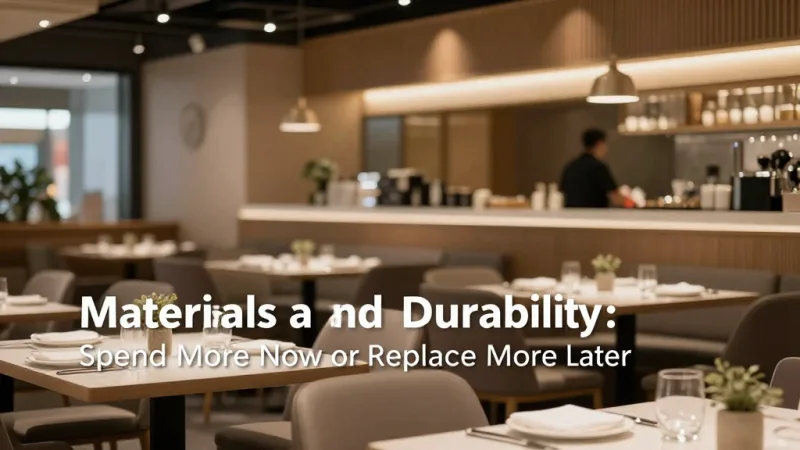
Here's the thing: commercial-grade materials cost 40-60% more upfront but last 3-5x longer. Over a 5-year window, they're dramatically cheaper.
- Tables: Solid wood or commercial laminate with metal bases ($150-$400/table) vs. consumer furniture ($80-$150/table that warps in 18 months).
- Chairs: Commercial-rated chairs with metal frames ($100-$250/chair) vs. residential chairs ($50-$100/chair that wobble within a year).
- Flooring: Luxury vinyl plank or sealed concrete ($4-$8/sqft, lasts 10+ years) vs. hardwood ($8-$15/sqft that stains and warps around the bar).
- Wall finishes: Semi-gloss washable paint or tile wainscoting (cleans easily) vs. flat paint that absorbs grease stains permanently.
Shogun Japanese Hibachi learned this when designing their hibachi station displays. They invested in commercial-grade stainless steel and heat-resistant surfaces around the grill stations, and the stations still look brand new years later — while competitors who cut corners are on their third set of countertops.
The Phased Renovation Strategy: Don't Close Your Restaurant
Every day your restaurant is closed for renovation, you're losing $1,500-$5,000+ in revenue. A two-week full closure for a restaurant doing $50,000/month costs you $25,000 in lost sales — plus the risk of regulars finding a new favorite spot.
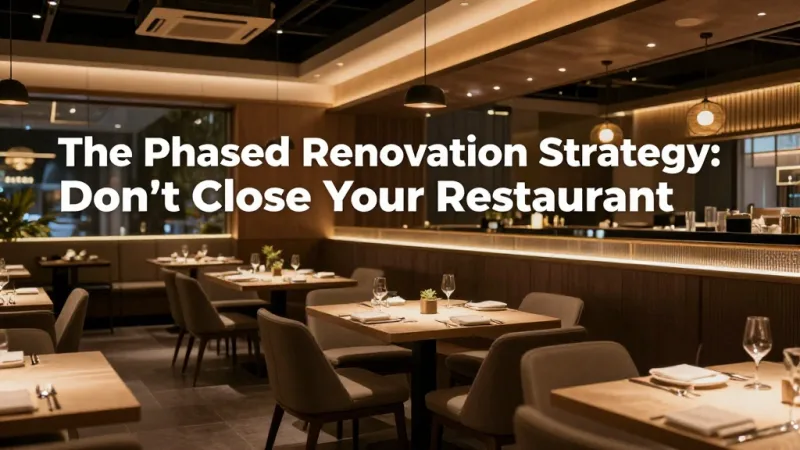
But it gets worse: closed restaurants don't just lose revenue. They lose momentum. Staff applies for other jobs. Google shows "Temporarily Closed." Regulars develop new habits. The reopening has to overcome all of that inertia.
The smarter approach: phase your renovation into three stages that can each be done during off-hours.
Phase 1: Lighting + Restroom + Entry (Weeks 1-2)
Cost: $8,000-$15,000. Can be done entirely between midnight and 10 AM. Lighting installation takes one electrician one night per zone. Restroom refresh takes a weekend. Entry updates are cosmetic — paint, fixtures, signage — all done after close.
Phase 2: Paint + Art + Focal Points (Weeks 4-6)
Cost: $5,000-$12,000. Paint the dining room in sections: one wall per night after close. Hang art and install focal points (neon signs, plant walls) during early morning hours. Guests won't mind seeing one wall look fresher than another for a week — they'll be excited about the improvement.
Phase 3: Furniture + Layout (Weeks 8-10)
Cost: $10,000-$30,000. Order new tables and chairs with a 4-6 week lead time. When they arrive, swap sections overnight: remove old furniture after close, position new pieces before open. Reconfigure your floor plan during the swap.
Total investment: $23,000-$57,000 over 10 weeks, with zero closure days. Revenue continues uninterrupted, and guests experience a steady stream of improvements that generate buzz and social media content.
Your KwickOS POS makes this measurable. Track your average check, table turn time, and revenue per seat before, during, and after each phase. The data will show you exactly which investments are paying off — and help you decide whether Phase 3 needs a bigger or smaller budget based on Phase 1 results.
The Gift Card and Loyalty Connection
Here's something most designers never tell restaurant owners: your interior design directly affects gift card sales and loyalty enrollment.
Think about when people buy gift cards. They buy them when they're impressed — when the experience feels special enough to share. A beautifully designed restaurant generates 2-3x more gift card purchases than an average-looking one, because guests actively want to send friends there.
The same applies to loyalty program sign-ups. Guests who feel emotionally connected to a space are far more likely to join a membership or rewards program. They want to come back, so the loyalty program gives them a structured reason to do it. If your entry zone includes a visible e-gift card display and a loyalty enrollment prompt on your digital signage, you're converting design appreciation into recurring revenue.
At KwickOS, we see this pattern across our 5,000+ merchants: businesses that invest in their physical environment report higher gift card sales, higher loyalty enrollment, and higher repeat visit rates. The design isn't separate from the business — it is the business.
Measuring the ROI: POS Data Tells the Truth
The biggest mistake restaurant owners make with renovations is not measuring the impact. They spend $30,000, the place looks better, business "feels" busier, and they move on. But feeling is not data.

Here's how to measure renovation ROI with your POS system:
- Baseline your metrics before renovation. Record 4 weeks of: average check size, table turn time (minutes from seat to payment), revenue per seat per hour, gift card sales, and loyalty enrollment rate.
- Track the same metrics weekly after each phase. Compare against your baseline, adjusted for seasonality (compare to the same period last year if possible).
- Calculate payback period. Take the total renovation cost and divide by the monthly revenue increase. A $15,000 renovation that adds $3,000/month in revenue pays itself back in 5 months — then it's pure profit for years.
KwickOS's hybrid local+cloud architecture means your POS data is always available for analysis — even if your internet drops during a busy Saturday. The local system captures every transaction at 1ms latency, syncs to the cloud when connected, and gives you dashboard access from your phone anywhere. You can check your post-renovation revenue from the parking lot while the contractor is still painting.
For multi-location operators like T. Jin China Diner (15 locations, 75 terminals), this data becomes even more powerful. Renovate one location first, measure the impact, then roll out the winning design elements across all stores. It's the A/B test approach applied to physical space — and it eliminates the risk of spending $200,000 across 15 stores on changes that don't move the needle.
What Not to Spend Money On
Not every design dollar earns its keep. Here are the lowest-ROI investments I've seen restaurant owners make:
- Expensive artwork with no photo appeal. A $5,000 abstract canvas that doesn't photograph well and doesn't create conversation is dead money. Spend $500 on a neon sign that guests Instagram every night.
- Custom furniture when commercial works fine. Custom-built tables at $800/each look 10% better than commercial-grade at $250/each. Guests don't notice the difference. Your bank account does.
- Sound system overkill. A $15,000 distributed speaker system adds nothing over a well-placed $3,000 setup. Guests want background music, not a concert experience.
- Trendy design that dates quickly. The reclaimed barnwood of 2018 is the avocado shag carpet of 2026. Invest in timeless materials (wood, stone, metal, leather) and use trendy elements only in easily replaceable accents.
Track Every Design Dollar's Impact
KwickOS gives you the POS data to measure exactly how your renovation affects revenue. Average check, table turns, gift card sales, loyalty sign-ups — all on one dashboard.
Get a Free DemoFrequently Asked Questions
How much should a restaurant spend on interior design?
Industry data suggests allocating 15-25% of your total build-out budget to interior design and decor. For a full-service restaurant, that typically ranges from $30,000 to $120,000 depending on size and concept. The key is prioritizing high-ROI elements like lighting (which can increase spending 12-18%) and seating layout (which directly determines revenue capacity) before spending on purely decorative items.
What restaurant design element has the highest ROI?
Lighting consistently delivers the highest ROI of any restaurant design element. Upgrading from standard fluorescent to warm, dimmable lighting can cost as little as $3,000-$8,000 and has been shown to increase average check size by 12-18% by encouraging guests to linger, order desserts, and add drinks. For a restaurant doing $40,000/month, that translates to $57,600-$86,400 in additional annual revenue.
Does Instagram-friendly design actually increase restaurant revenue?
Yes, measurably. Restaurants with clearly designed Instagram-worthy features report that guest-posted photos generate significant free exposure. A single high-performing Instagram post from a customer can reach thousands of potential diners. Creating 2-3 intentional photo spots (a neon sign, a living wall, a dramatic plating station) typically costs $2,000-$8,000 and generates ongoing free marketing that traditional advertising cannot match.
How does seating layout affect restaurant revenue?
Seating layout directly determines your revenue ceiling. Optimizing your floor plan to add even 4-6 additional seats without feeling cramped can add $300-$600 per night in revenue. The key metrics are revenue per square foot and seats per square foot. A well-designed layout achieves 15-18 seats per 1,000 square feet for full-service restaurants while maintaining comfortable spacing. Flexible seating (movable two-tops that combine into four-tops) increases utilization by accommodating varying party sizes.
Should I renovate my restaurant all at once or in phases?
Phased renovation is usually smarter for operating restaurants. Start with the three highest-ROI changes: lighting, restrooms, and entry/first impression area. These can typically be done for $8,000-$15,000 during off-hours without closing. Phase two (seating, paint, art) can follow 3-6 months later once phase one revenue gains help fund it. Full closures for renovation risk losing regulars to competitors, so minimize downtime by phasing unless a complete concept change is planned.