 Kelly Ho
You spent 15 years behind a sushi counter. You source fish from Tsukiji through a broker who knows your standards. Your knife skills are flawless. Your rice is perfect.
And you're charging $85 for omakase.
You're losing $1,800 every single night.
Here's the thing: omakase isn't a meal. It's an experience. And experiences follow different pricing rules than food. A 12-piece nigiri set at a conveyor belt restaurant is food. Twelve courses served directly by the chef who selected, aged, and sliced each piece — that's theater. And theater commands theater pricing.
The restaurants charging $150, $200, even $350 per seat aren't serving dramatically different fish than you are. They've mastered something else entirely: the business model behind the counter.
This guide breaks down the exact math, the sourcing strategy, the seating mechanics, and the experience design that turns an omakase counter into a $3,600-per-night operation — with only 12 seats.
The Omakase Revenue Model: Why 12 Seats Can Outperform 120
Let's start with the math that makes omakase owners smile.
A typical full-service Japanese restaurant with 120 seats, $45 average check, 1.5 turns per night generates roughly $8,100 in nightly revenue. They need 15-20 staff members, a full kitchen brigade, and significant square footage.
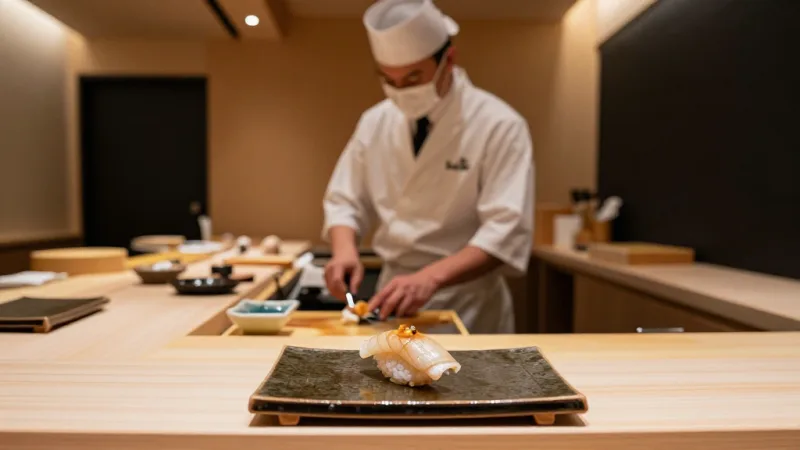
An omakase counter with 12 seats at $150 per person, 2 seatings per night:
| Metric | Full-Service (120 seats) | Omakase (12 seats) |
|---|---|---|
| Nightly covers | 180 | 24 |
| Average check | $45 | $150 (food) + $65 (sake pairing) |
| Nightly food revenue | $8,100 | $3,600 |
| Nightly beverage revenue | $2,430 | $1,560 |
| Total nightly revenue | $10,530 | $5,160 |
| Staff required | 18 | 4 |
| Square footage | 3,200 | 600 |
| Revenue per sq ft | $3.29 | $8.60 |
| Revenue per labor dollar | $585/employee | $1,290/employee |
The omakase generates 2.6x more revenue per square foot with 78% fewer staff. But it gets worse for the full-service model — their food cost is typically 32-35% while a well-managed omakase runs 30-34% because portion sizes are precisely controlled.
And that's not all: omakase has near-zero food waste because you buy exactly what you need for that evening's covers. No overproduction. No menu items expiring. No walk-in full of prep that doesn't sell.
Course Costing: The $51 Ingredient Budget That Feels Like $200
At a $150 price point with 34% food cost target, you have $51 per guest to spend on ingredients across all courses. That sounds restrictive until you understand how omakase portioning works.
Here's a sample 10-course omakase with real ingredient costs:
| Course | Item | Portion | Cost/Guest |
|---|---|---|---|
| 1. Sakizuke (appetizer) | Seasonal vegetable with dashi gelee | 2 oz | $2.10 |
| 2. Otsukuri (sashimi) | 3-piece selection: hirame, shima aji, hon maguro | 2.5 oz | $8.40 |
| 3. Yakimono (grilled) | Grilled kinmedai with shiso | 2 oz | $5.20 |
| 4. Mushimono (steamed) | Chawanmushi with uni | 3 oz | $6.80 |
| 5-8. Nigiri (4 pieces) | Otoro, kampachi, botan ebi, anago | 4 pcs | $18.50 |
| 9. Temaki (hand roll) | Negitoro with house-aged soy | 1 pc | $4.20 |
| 10. Dessert | Matcha panna cotta, seasonal fruit | 3 oz | $2.80 |
| Total ingredient cost per guest | $48.00 | ||
That's 32% food cost with otoro, uni, and premium seasonal fish. The secret is precision: each piece of nigiri uses exactly 18-20 grams of fish and 20 grams of rice. No guessing. No variation. No waste.
But here's the thing: that $48 in ingredients feels like $200 worth of food to the guest because of how it's presented. Ten courses, each one a tiny masterpiece, served one at a time over 90 minutes. The perceived value is 4x the actual cost. No other restaurant format achieves that ratio.
Seasonal Sourcing: Your Menu Changes, Your Margins Stay
The biggest mistake omakase operators make is locking into fixed suppliers and fixed ingredients year-round. Seasonality isn't just a culinary tradition — it's a pricing strategy.
Spring (March-May): Sakura masu (cherry trout), hotaru ika (firefly squid), shiro ebi. These are abundant, priced 30-40% below off-season.
Summer (June-August): Anago peaks, uni from Hokkaido is at its richest, ayu sweetfish. Summer fish tends to be leaner, so you supplement with richer preparations.
Fall (September-November): Sanma (pacific saury), matsutake mushroom, shirako season begins. Fall is the richest ingredient season — build your highest-priced menus here.
Winter (December-February): Fugu season, buri (yellowtail) at peak fat, ankimo (monkfish liver). Premium season commands premium pricing — this is when you can push to $180-$200 per seat.
Here's the pattern interrupt most operators miss: you don't need to change every course every season. Keep 4-5 signature courses year-round (your rice, your egg, your house-cured items) and rotate 5-6 seasonal courses. This gives returning guests novelty while keeping your signature dishes as anchors they come back for.
Track seasonal ingredient costs in your POS inventory system to identify which fish are at peak quality and low cost simultaneously. That intersection is where your best margins live.
Seating Management: The 2-Seating Model That Doubles Revenue
A single seating per night with 12 seats at $150 generates $1,800. That's not enough to justify prime real estate in most cities. The solution: two seatings.
First seating: 5:30 PM - 7:15 PM (90 minutes)
Turnover: 7:15 PM - 7:45 PM (30-minute reset)
Second seating: 7:45 PM - 9:30 PM (90 minutes)
This structure gives you $3,600 in food revenue nightly. But the seating model creates operational requirements that your technology must support:
- Precise timing: Every course must fire on schedule. If course 6 runs 5 minutes late, the entire second seating pushes back. Your POS course fire system must track elapsed time per table and alert when you're falling behind.
- Synchronized service: All 12 guests should receive each course within 2 minutes of each other. The chef's flow depends on serving everyone at once.
- Reservation enforcement: No walk-ins. No "can we stay a bit longer." The second seating guests are arriving at 7:45 regardless.
Some operators run a third seating on Fridays and Saturdays (9:45 PM - 11:15 PM) for a "late-night omakase" at a slightly lower price point ($120-$130). This captures the after-dinner crowd and adds $1,440-$1,560 to your highest-volume nights.
Reservation Deposits: Eliminating No-Shows That Cost $300 Each
With only 12 seats and 2 seatings, every empty seat is catastrophic. A single no-show at $150 per person costs you $150 in lost revenue you cannot recover — that seat cannot be resold at 7:45 PM when your guest simply doesn't show.
For a party of two, that's $300 gone. On a busy Saturday night with a waitlist of 40 people who would have loved that seat.
The solution is non-negotiable: require deposits at booking.
Industry standard for omakase:
- $50-$100 per person deposit at booking (applied to the final bill)
- 48-72 hour cancellation policy for full refund
- No-show or late cancellation: deposit forfeited
- Collect credit card at reservation (charge only for no-show)
According to restaurant industry data, deposits reduce no-show rates from 15-20% down to 2-3%. For a 12-seat omakase running 6 nights per week, that's the difference between 10-14 lost covers per week ($1,500-$2,100 in lost revenue) and 1-2 lost covers ($150-$300).
Your POS and reservation system must handle this seamlessly. Store the deposit, apply it automatically at checkout, and flag no-shows for your records. KwickOS handles reservation deposit management natively — the deposit captures at booking, applies to the final bill at checkout, and processes the no-show charge automatically if the guest doesn't arrive within 15 minutes of their seating time.
The Sake Pairing: Where Your Real Margins Live
Food cost at 32-34% is good. But sake pairing margins are extraordinary.
A 5-pour sake pairing priced at $65 typically costs $12-$15 in product — that's a 77-82% margin. And the best part: approximately 60-70% of omakase guests opt for the pairing when it's suggested by the chef during service.
| Beverage Add-On | Price | Cost | Margin | Take Rate |
|---|---|---|---|---|
| 5-pour sake pairing | $65 | $14 | 78% | 65% |
| Premium sake pairing (+rare bottles) | $120 | $32 | 73% | 15% |
| Single glass premium sake | $22-$45 | $5-$12 | 73-77% | 20% |
| Japanese whisky flight | $55 | $16 | 71% | 10% |
For 24 covers per night with a 65% pairing take rate, that's 15-16 pairings at $65 = $975-$1,040 in additional revenue at 78% margin. The sake pairing alone generates $761-$811 in nightly profit.
This is why your POS must track beverage attachment rates by seating, by night, and by server. When you see pairing rates drop below 60%, it's a service issue — not a product issue. The chef or server isn't offering it with enough confidence.
Gift Cards and E-Gift Cards: The Omakase Secret Weapon
Here's something most omakase operators miss entirely: gift cards are your highest-converting marketing tool.
A $150 omakase is the perfect gift. It's experiential, memorable, and exactly the kind of thing people buy for birthdays, anniversaries, and special occasions. Unlike a $50 gift card to a casual restaurant (which feels transactional), a $150-$300 omakase gift card feels generous.
The numbers are compelling:
- Omakase gift card recipients spend an average of $85 beyond the card value (sake pairing, premium upgrades, additional courses)
- Industry research suggests 12-18% of gift card value is never redeemed (breakage revenue)
- Gift card purchasers become customers themselves 40% of the time
- Digital e-gift cards eliminate the "I forgot to buy a gift" problem — available for instant delivery
Set up both physical and digital gift card options. Physical cards with premium packaging (think washi paper sleeve, minimalist design) work as counter displays. E-gift cards with customizable messages work for last-minute buyers and out-of-town gifters.
Run a "Gift an Experience" campaign before every major holiday. Mother's Day, Valentine's Day, and December holidays drive 60% of annual omakase gift card sales.
Loyalty and VIP Programs: Making $150 Guests Into $5,000 Regulars
The guest who visits your omakase counter once a month spends $2,580 per year (food + pairing x 12 visits). Make them feel recognized, and they become your most powerful marketing asset.
But here's the thing — traditional punch-card loyalty doesn't work for fine dining. "Buy 10 omakase, get 1 free" cheapens the brand. Instead, build a recognition-based VIP program:
- After 3 visits: The chef remembers their name and preferences. Their POS guest profile stores allergies, favorite fish, seating preference (left side vs right side of counter).
- After 6 visits: Access to "off-menu" seasonal courses. The chef prepares one bonus piece not on the standard menu. This costs you $4-$8 per guest but creates stories they tell friends.
- After 12 visits: Priority booking for new seasonal menus. First notification when the winter fugu menu launches. Birthday month: complimentary premium sake pairing upgrade.
Track all of this through your CRM and loyalty system. When a VIP guest books, your staff should see their visit count, preferences, and any notes the chef has added. This is the difference between "fine dining" and "an experience you can't get anywhere else."
The POS Checkout Flow for Omakase
Omakase checkout is unique. You don't hand a guest a check after an intimate 90-minute experience with the chef — that kills the mood.
The seamless flow:
- Pre-authorization: The deposit from booking is already captured. The POS knows the base price ($150) plus whatever pairing was selected.
- During service: Any add-ons (extra course, premium sake by the glass, take-home items) are added to the tab in real-time by the chef's assistant.
- After final course: The guest is invited to a small lounge area or simply remains at the counter. The bill is presented discretely in a wooden box or leather folder — never on a screen.
- Payment: The deposit is automatically deducted. Remaining balance processed. Contactless or card-in-folder — never a terminal shoved in their face.
- Tip: Pre-set tip suggestions at 20%, 25%, 30% (omakase gratuity averages 22-25% because of the personal connection with the chef).
KwickOS supports this exact flow: deposit capture at reservation, automatic application at checkout, discrete payment processing, and customizable tip presets. The customer-facing display can be positioned for privacy or replaced entirely with a handheld terminal the server brings tableside.
Pricing Tiers: Good, Better, Best
It gets even better.
The most profitable omakase counters don't offer a single price. They offer tiers — leveraging the same anchoring psychology that makes every "middle option" the most popular.
| Tier | Price | Courses | Includes | Take Rate |
|---|---|---|---|---|
| Omakase | $150 | 10 courses | Seasonal selection | 35% |
| Premium Omakase | $220 | 13 courses | +A5 wagyu, otoro, uni course | 50% |
| Chef's Reserve | $350 | 15 courses | +Rare fish, aged selections, sake pairing included | 15% |
The $350 tier exists primarily to make $220 feel reasonable. And it works: industry research suggests 74% of diners at tiered omakase choose the middle tier. Your weighted average check becomes approximately $210 per person — 40% higher than a single-tier $150 offering.
With 24 covers at a weighted $210 average: $5,040 in food revenue per night. Add sake pairings and your nightly total approaches $6,200.
Experience Design: What Justifies $150+ Per Seat
Price is what you pay. Value is what you feel. At $150+, guests aren't paying for fish — they're paying for an experience they'll remember and tell friends about. Here's what separates $85 omakase from $200 omakase:
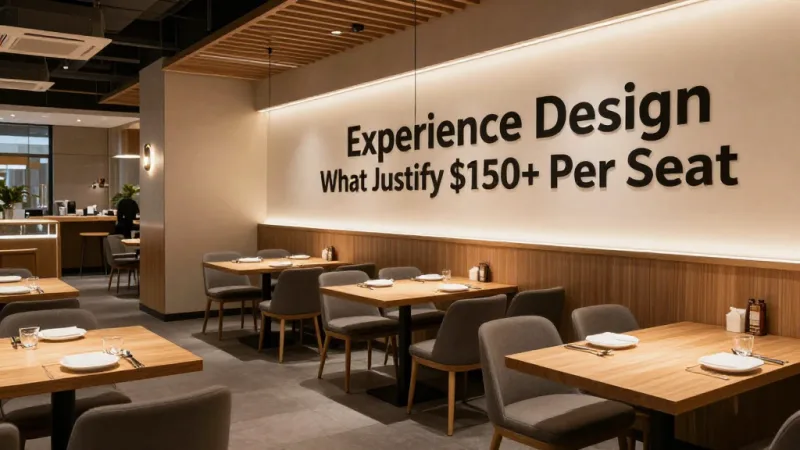
The counter itself: Hinoki cypress wood, meticulously maintained. Guests can see and smell the wood. This single material choice communicates "authenticity" without a word spoken.
Chef interaction: The chef explains each piece — where it came from, how it was aged, why this particular preparation today. This isn't scripted monologue; it's conversational education. It makes a $4 piece of fish feel like a $40 moment.
Pacing: 90 minutes for 10 courses means approximately 9 minutes between courses. Fast enough to maintain flow, slow enough for each course to be savored and discussed. Your POS course timing system tracks this automatically.
Finishing touches: Hot oshibori towels between courses. A small gift at departure (house-pickled ginger jar, seasonal wagashi). These cost $2-$4 per guest and create lasting impressions worth 100x their cost in word-of-mouth.
The Shogun Case Study: Customized POS for Japanese Fine Dining
Shogun Japanese Hibachi implemented KwickOS across 4 terminals with a customized station display system. While their format is different from omakase, the principle translates directly: Japanese dining requires POS technology that understands course timing, chef station communication, and the specific flow of Japanese service.
Their staff achieved proficiency in under 5 minutes — critical when you're hiring skilled sushi chefs who should spend their time on fish, not fighting software. The fingerprint 1:N authentication means only authorized staff can void items or apply comps (essential when you're working with $60/lb fish and individual pieces are worth $8-$18).
For omakase specifically, KwickOS provides:
- Course fire timing: Visual countdown per course, alerts when service falls behind schedule
- Guest preference storage: Allergy, dietary, seating, past orders — all accessible at the counter
- Seating management: 2-3 seatings per night with automatic turnover timing
- Deposit management: Capture at booking, apply at checkout, no-show auto-charge
- Multilingual support: English, Chinese, Spanish — plus Japanese menu item names display correctly
- Processor-agnostic: Keep an average of $3,000-$8,000/year by choosing your own payment processor instead of being locked into Toast's 2.99%
Marketing an Omakase: Scarcity Is Your Brand
You have 24 seats per night, 6 nights per week. That's 144 covers per week. In a city of 500,000+ people, scarcity is real, not manufactured.
Use that scarcity in your marketing:
- "12 seats. 2 seatings. Book 3 weeks in advance." — This isn't a brag, it's information that triggers urgency.
- Instagram the night's fish selection (but never the plated courses — let guests discover those). The prep-to-plate mystery creates anticipation.
- Email your VIP list when rare ingredients arrive: "Hokkaido uni arrived this morning. This week's menu will feature it in course 4. Limited to this week's supply."
- Partner with your local concierge services who recommend dining experiences to hotel guests and corporate visitors.
Track which marketing channels drive reservations through your marketing ROI tools. For most omakase restaurants, Instagram (35%), word-of-mouth (30%), and Google Search (20%) drive 85% of new guests.
Financial Model: Year-One Projections
Now for the numbers that really matter.
Let's build a realistic year-one financial model for a 12-seat omakase operating 6 nights per week with 2 seatings:
| Revenue Line | Monthly | Annual |
|---|---|---|
| Food revenue (24 covers x $195 avg x 26 nights) | $121,680 | $1,460,160 |
| Beverage revenue (65% pairing rate + a la carte) | $38,000 | $456,000 |
| Gift card sales (net new) | $8,400 | $100,800 |
| Total Revenue | $168,080 | $2,016,960 |
| Cost Line | % of Revenue | Annual |
|---|---|---|
| Food cost | 34% | $496,454 |
| Beverage cost | 22% of bev | $100,320 |
| Labor (chef + 3 staff) | 22% | $443,731 |
| Rent (600 sq ft prime location) | 8% | $161,357 |
| Operating expenses | 8% | $161,357 |
| Net Profit | ~32% | $653,741 |
A 32% net profit margin — $653,741 on $2M revenue. The average full-service restaurant nets 3-6% ($60K-$120K on the same revenue). Even successful Japanese restaurants average 8-12%. Omakase at 32% isn't just better — it's a fundamentally different business model.
Compare this to the full comparison between KwickOS and Toast — when you're running a $2M/year omakase, the $3,000-$8,000 you save annually on processor-agnostic payments goes directly to your fish budget.
Common Pricing Mistakes That Kill Omakase Profitability
Mistake 1: Pricing too low to fill seats. If you're charging $85 because you're "not established yet," you're training customers to expect $85 forever. Start at your target price. Scarcity fills seats, not discounts.
Mistake 2: Not charging separately for sake pairing. Bundling sake into the food price reduces perceived value of both. Keep them separate. The pairing should feel like an upgrade, not a default.
Mistake 3: Ignoring seasonal price adjustments. Winter premium ingredients cost more. Charge more. "$180 Winter Omakase featuring fugu and buri" is an event, not a price increase.
Mistake 4: No deposit system. You're leaving $1,500-$2,100 per week on the table in no-show losses. Implement deposits immediately.
Mistake 5: Single tier pricing. You're leaving 40% of potential revenue on the table. Add a premium tier and watch your average check climb.
Technology Stack for Omakase Operations
Here's where it all comes together.
Running a profitable omakase requires technology that handles the unique workflow without getting in the way of the experience. Your stack needs:
- Reservation system with deposit capture — pre-authorize cards, enforce cancellation policies
- Course fire timing and tracking — visual countdown, pace alerts, synchronized service
- Guest CRM with preference storage — dietary restrictions, visit history, VIP status, notes from the chef
- Inventory with freshness dating — track fish aging, daily cost updates, supplier rotation
- Gift card and e-gift card system — seamless purchase, redemption at checkout, holiday campaign integration
- Loyalty tracking without cheapening the brand — visit counts, milestone rewards, personalized recognition
- Hybrid local+cloud architecture — 1ms response time means zero lag during service, and if your internet drops mid-seating, operations continue uninterrupted
KwickOS delivers all of this on a single platform. No stitching together 5 different tools. No syncing issues. No internet dependency during the most critical 90 minutes of your business day.
Build Your Omakase Business Model
KwickOS powers Japanese fine dining with course timing, guest preferences, deposit management, and processor-agnostic payments — all in one platform.
Schedule a Demo