 Ming Ye
Walk into the back of a busy Mexican restaurant at 2:47 PM on a Tuesday. What do you see?
Three line cooks on their phones. A hood that has stopped roaring. $18,000 worth of commercial equipment sitting cold. Rent, insurance, utilities, and manager salary still ticking away at roughly $340 an hour in fixed cost, whether you sell one taco or a thousand.
Now open DoorDash on that same block. You will see fourteen restaurants in a two-mile radius taking orders. Three of them did not exist six months ago. One of them has over 2,400 reviews and is ranked #1 for "burgers near me." Here is the twist: that top-ranked burger brand does not have a physical restaurant at all. It is running out of the back of a Mexican kitchen you have driven past a hundred times.
Welcome to the ghost brand economy. And if your restaurant is not running at least one, you are not just missing a trend. You are paying the full price of a commercial kitchen while only using about 60% of it.
This is a business model where the sunk costs are already paid, the labor is already on the schedule, and the only thing standing between you and an extra $120,000 to $240,000 in annual revenue is a second menu, a second logo, and a POS that can keep the orders straight.
Here is the thing: ghost brands are not a COVID-era experiment that died when dining rooms reopened. Delivery order volume is up roughly 320% from 2019 levels and has stabilized above pre-pandemic trajectory. Restaurant industry data suggests 43% of independent restaurants now operate at least one virtual concept alongside their core brand. The ones that do not are competing for a shrinking share of dine-in traffic while leaving the delivery channel to dedicated ghost kitchens, who are coming for their customers anyway.
This playbook is how we teach KwickOS merchants to launch their first ghost brand, then scale to three, without burning out their kitchen or losing control of the chaos.
What Exactly Is a Ghost Brand?
A ghost brand, sometimes called a virtual brand, delivery-only concept, or cloud kitchen brand, is a restaurant that exists only on delivery apps. It has its own name, its own menu, its own logo and photography, and to the customer it looks like a completely independent business. But physically, it operates out of an existing kitchen that is already paying rent, already paying its lead line cook, and already running its hood.
You might be skeptical. "Is that not just a dishonest gimmick?" Not at all. The FDA and every state health department treats a ghost brand exactly the same as any other restaurant: licensed kitchen, inspected, food handler certifications, labeled packaging. What changes is only how the customer discovers it, algorithmically, through search and category browsing on DoorDash, Uber Eats, and Grubhub, instead of by walking past a storefront.
The operational magic is something called cross-utilization. You design the ghost menu so that 80-90% of its ingredients, equipment, and prep steps overlap with your existing operation. Your Mexican restaurant's flat-top grill that cooks carne asada? It also cooks smashburgers for "Smash Stack Burgers" (ghost brand #1). The same corn tortillas that wrap your al pastor tacos? They are now the "corn-crusted chicken wrap" for your healthy bowl concept (ghost brand #2). Your rice cooker making Mexican rice can just as easily make cilantro-lime rice for a poke bowl brand (ghost brand #3).
The customer never knows. And honestly, they do not care. What they care about is that the food arrives hot, the menu photography looks good, the reviews are 4.6+, and the delivery time is under 35 minutes. Deliver on those four, and the ghost brand grows.
The Economics: Why Ghost Brands Print Money
Let us do the math that most restaurant owners never do.
A typical 2,800 sqft independent restaurant has these rough monthly fixed costs: $9,500 rent, $1,800 utilities, $1,400 insurance, $6,500 manager salary, $2,200 small-wares and repairs, $800 POS and software. That is $22,200/month in fixed cost, about $740/day, that has to be paid before you have sold a single plate.
Your in-house dine-in and pickup operation probably does $75,000 to $110,000/month in sales. That covers the fixed cost, the variable cost of food and labor, and leaves 6-12% as profit. Fine. But every additional dollar of revenue you add on top of that base has dramatically higher margin because the fixed cost is already covered.
Here is what a single ghost brand actually looks like on a P&L:
| Metric | Month 1 | Month 3 | Month 6 | Month 12 |
|---|---|---|---|---|
| Ghost brand orders/day | 8 | 22 | 38 | 54 |
| Average ticket | $24 | $26 | $27 | $28 |
| Monthly gross revenue | $5,760 | $17,160 | $30,780 | $45,360 |
| Platform commission (25%) | -$1,440 | -$4,290 | -$7,695 | -$11,340 |
| Added food cost (31%) | -$1,786 | -$5,320 | -$9,542 | -$14,062 |
| Added packaging | -$345 | -$1,030 | -$1,847 | -$2,722 |
| Added labor (2 hrs/day) | -$1,080 | -$1,080 | -$1,620 | -$1,620 |
| Net monthly profit | $1,109 | $5,440 | $10,076 | $15,616 |
Run that model across three brands and by month 12 you are looking at roughly $46,000/month, $552,000/year, in incremental gross revenue and around $187,000/year in additional profit. From the same four walls you are already paying for.
But it gets worse for the operator who does not act: your competitors are seeing these same numbers. Every month you delay is a month an aggressive ghost-brand operator in your zip code is claiming delivery market share that will be much harder to take back later. Delivery platforms reward entrenchment. The brand that hit 500 reviews first tends to stay #1 for years.
The 5-Step Ghost Brand Launch Playbook
Step 1: Pick a Cuisine That Crosses With Yours, Not Competes
The single biggest mistake is launching a ghost brand in the same category as your main restaurant. A pizza place launching "Tony's Authentic Slice" on DoorDash is not creating new demand. It is cannibalizing the same "pizza near me" search that was already going to their main brand.
Instead, use the adjacent ingredient rule. Look at the proteins, starches, and cooking methods your kitchen already has. Then pick a cuisine that uses 70%+ of the same inputs but targets a different search term:
- Mexican restaurant to smashburger brand (flat-top, buns, lettuce, cheese, fries from same fryer)
- Chinese restaurant to Korean fried chicken brand (wok fryers, rice, scallions, pickled veg)
- Italian restaurant to Mediterranean grain bowl brand (same olive oil, grains, grilled chicken, feta)
- Pizza shop to loaded wings brand (same protein prep, same oven, different flavor profile)
- Sushi bar to poke bowl brand (same rice, same cold protein prep, simpler build)
Rockin' Rolls Sushi Express, which runs 49 iPad self-ordering stations across 3 locations, uses this exact model. Their poke brand operates out of the same cold prep line that handles nigiri, and orders flow into a separate KDS station so the hot kitchen never gets hit twice.
Step 2: Build a Menu Designed for Delivery, Not Dine-In
Delivery food is different from dine-in food in ways that matter. A burger that looks perfect on a plate at 7:32 PM looks sad in a box at 7:57 PM after a 12-minute drive. Fries go soggy. Tempura gets soft. Salads wilt under hot proteins.
Your ghost brand menu must be engineered for travel. That means:
- Items that hold temperature for 20+ minutes without degrading
- Separate containers for components that would steam into mush if combined (sauce on the side, crunchy toppings packaged apart)
- Strategic use of vented containers for anything fried
- A narrow menu, 12 to 18 items maximum, not 47, so your kitchen can execute consistently and photos can be done professionally
- Modifiers that drive ticket size without creating kitchen chaos (upsized protein, premium dips, combo add-ons)
Step 3: Invest in Photography Like Your Business Depends on It (Because It Does)
And that is not all: delivery is a visual medium. Customers scroll through 40 restaurants in under 90 seconds. Your thumbnail hero shot either stops them or it does not. There is no menu narrative, no server describing specials, no smell of the kitchen. There is just a 400-pixel-wide photo.
Hire a professional food photographer, expect to pay $800 to $2,400 for a complete menu shoot, or at minimum invest in a softbox, a 50mm lens, and a full afternoon of practice. The ROI on good food photography for a ghost brand is measurably insane: industry research suggests restaurants that upgrade from phone photos to professional photography see a 30-65% lift in order conversion from the same impressions.
Use KwickPhoto or any comparable tool to keep a clean library of brand-specific images that your POS and online ordering system can pull from without mixing up your main-brand photos and your ghost-brand photos.
Step 4: Set Up Delivery Platforms and Consolidate the Orders
You will need to file separate storefront applications on DoorDash, Uber Eats, and Grubhub. Each requires:
- Brand name, logo, cover photo, and description
- Menu with item photos, descriptions, and prices
- Hours of operation (can be narrower than your main brand)
- Address and kitchen license information
- Banking info for payouts (separate accounting recommended)
Approval typically takes 1-3 weeks per platform. Once live, orders start flowing, and this is where most operators drown.
Imagine peak Saturday night. Your dine-in POS is printing tickets. Three tablets are buzzing with DoorDash orders for three different brand names. Two more tablets are buzzing for Uber Eats. Grubhub is calling the phone. Your line cook does not know whether "Smash Stack Burgers order #447" and "Tony's Taqueria order #882" are going to the same car or different cars, or whether the tickets should be expedited or fired-on-time.
This is why integrated order routing matters more than any other technical piece of ghost brand operations. KwickOS consolidates every order, from every platform, under every virtual brand name, into a single unified KDS display. Each ticket is auto-tagged with brand, platform, and routing instructions. Cross-utilized items fire to the correct kitchen station regardless of which brand the customer ordered from. Checkout is automatic: the delivery driver scans the order number at the counter and the handoff is logged in your POS.
Crafty Crab Seafood, operating across 19 locations and 152 terminals, uses KwickOS's one-click menu sync to push ghost-brand menu updates to every platform, at every store, simultaneously. So when they change the price of their shared shrimp basket, it updates across their main brand and all virtual brands in under 60 seconds. No one is updating PDFs by hand.
Step 5: Launch Slow, Scale by the Numbers
Do not launch 3 brands in week 1. Launch one, operate it for 60-90 days, fix what is broken, then launch the second. Then 60 days later, the third. Operators who try to launch three simultaneously almost always collapse under order volume they cannot yet execute consistently, and their reviews tank within the first two weeks, which is very hard to recover from on delivery platforms.
Do Not Forget the Customer You Already Have: Gift Cards and Loyalty
Here is a twist most operators miss: your ghost brand customers and your main-brand customers are often the same people on different occasions. The smartest operators connect the two through loyalty.
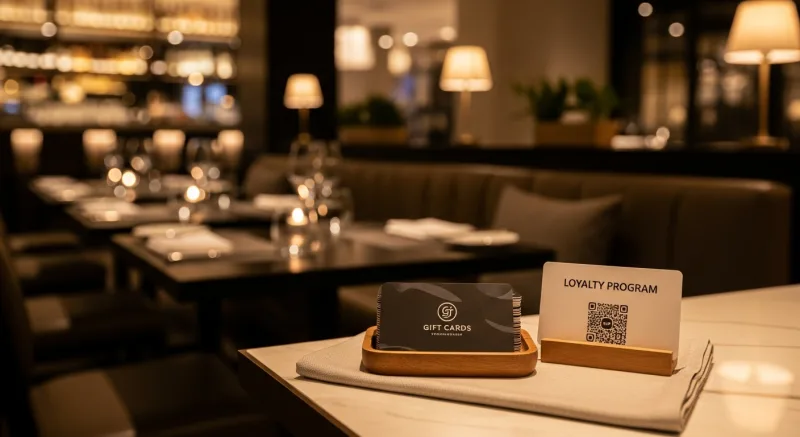
KwickOS's built-in loyalty engine lets you run a single points program across all your brands. A customer orders takeout from your main restaurant, earns points. Same customer orders delivery from your burger ghost brand two weeks later, earns points on the same account. At 500 points they redeem a $10 e-gift card valid at either brand. This does two things at once: it transforms one-time delivery discoveries into multi-brand repeat customers, and it gives you first-party customer data that DoorDash and Uber Eats will never share with you.
Physical gift cards work too, especially during holiday season, when delivery-only brands can sell e-gift cards via their website and via a QR code printed on their packaging. One KwickOS merchant reported that 18% of their holiday e-gift card volume was driven by ghost-brand customers who had never set foot in the physical restaurant. That is a customer the main brand would never have captured.
Membership programs take this even further. A "VIP" tier that costs $7.99/month and delivers 15% off on all brands plus early access to new menu items converts roughly 3-5% of regular delivery customers into paid monthly subscribers, which is nearly pure margin and, critically, locks in order frequency.
The Processing Fee Trap Ghost Brands Fall Into
One more thing. Every ghost brand order runs through payment processing, and the processing cost scales with every additional dollar of delivery revenue you add. If you are on a locked POS system like Toast or Square, your processor markup is fixed at 2.6-2.99% and there is nothing you can do about it. Add $180,000/year in ghost brand revenue and you have just added $5,400 to $8,000/year in processor markup on top of the 25% you are already losing to delivery platforms.
On a processor-agnostic POS like KwickOS, you negotiate your own processing rate, typically 2.1-2.4% effective, which on $180,000 in added volume saves roughly $1,100 to $1,600/year per brand. Across three brands and a five-year horizon, that is $17,000 to $24,000 that stays in your pocket instead of funding Toast's payment processing margin. See the full comparison of KwickOS vs. Toast for the detailed math.
When Ghost Brands Do Not Make Sense
Let us be honest: ghost brands are not right for every restaurant. Skip the strategy if:
- Your kitchen is already at 95%+ capacity during peak hours (you do not have headroom to add orders)
- Your food cost is already above 34% (adding platform commission on top will make the unit economics break)
- Your current reviews are below 4.3 (fix your main brand's operations before layering complexity)
- You do not have a lead line cook or kitchen manager who can own QA on the ghost-brand menu
For everyone else, the math is straightforward. You have already paid for the kitchen. You have already hired the staff. You are already paying the rent. The only question is whether you let that capacity generate a second and third revenue stream, or whether you let a competitor do it from a building two blocks away.
Frequently Asked Questions
What is a ghost brand (virtual brand) in the restaurant industry?
A ghost brand, also called a virtual brand or delivery-only concept, is a restaurant that exists only on delivery platforms like DoorDash, Uber Eats, and Grubhub. It has its own name, menu, logo, and customer experience, but shares a physical kitchen, equipment, and staff with an existing restaurant. A single location can run 3-5 ghost brands simultaneously, each targeting different cuisines or price points.
How much revenue can a ghost brand add to an existing restaurant?
A well-executed ghost brand typically adds $3,000-$8,000 in monthly revenue per brand within the first 90 days. Restaurants running 3 virtual brands frequently see an extra $120,000-$240,000 in annual gross revenue with minimal added fixed cost, because rent, utilities, and core labor are already paid for.
Do I need a new kitchen to launch a virtual brand?
No. The core idea of a ghost brand is cross-utilization: you design each virtual menu around ingredients and equipment your main kitchen already uses. A Mexican restaurant might launch a burger brand using the same flat-top, tortillas repurposed as wraps, and proteins shared with taco prep. You do need delivery-specific packaging, proper labeling, and a POS/KDS setup that can route orders from multiple brand names to the correct kitchen station.
How do you set up a ghost brand on DoorDash, Uber Eats, and Grubhub?
Each platform requires a separate storefront application listing the virtual brand name, menu photos, hours, and address. You must certify that you are operating from a licensed commercial kitchen. After approval (typically 1-3 weeks), orders flow into a tablet or directly into your POS through a delivery integration. Using a POS that consolidates orders from multiple platforms and multiple brand storefronts into a single KDS screen is critical for operational sanity.
What are the biggest mistakes restaurants make when launching ghost brands?
The top mistakes are: launching too many brands before proving one works, making menus too complex for cross-utilization, using the same cuisine as your main brand (which cannibalizes rather than expands), underinvesting in food photography (delivery is a visual medium), and running separate tablets for each platform instead of routing everything through an integrated POS, which creates order chaos during peak hours.
Launch 3 Ghost Brands From the Same POS
KwickOS consolidates every order, every brand, every platform, into one unified kitchen display. Plus processor-agnostic payments that save you thousands per year on your new delivery volume.
Get a Free Demo