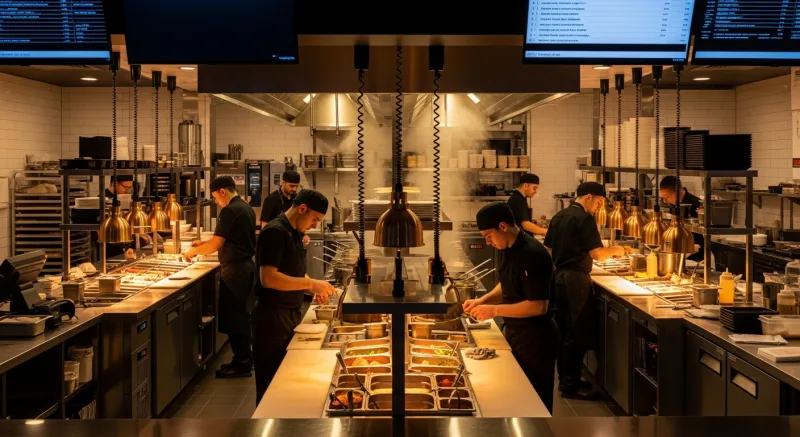
Quick-service restaurants process more transactions per hour than any other business category. A busy QSR handles 50-100 orders per hour during peak, with each order touching 4-6 systems: the ordering interface (counter, kiosk, or drive-through speaker), the payment terminal, the kitchen display, the customer-facing order status screen, the loyalty database, and the delivery dispatch (if applicable). When these systems are separate platforms connected by APIs, the weakest link determines the speed of the entire operation. A 2-second API delay on loyalty lookup multiplied by 80 orders per hour equals nearly 3 minutes of cumulative delay per hour. An operating system eliminates inter-system latency because there is no "inter-system" — it is all one system.
The QSR chains understood this years ago. McDonald's, Chick-fil-A, and Wendy's all run on integrated operating platforms — not bolted-together POS-plus-add-ons systems. Their kiosks, drive-through screens, kitchen displays, and loyalty programs are one platform. Independent QSRs competing against these chains with a Square POS + a separate kiosk app + a separate loyalty platform + DoorDash for delivery are fighting an integrated army with disconnected militias.
The QSR OS Architecture: What Rockin' Rolls Teaches Us
Rockin' Rolls' 49 iPad self-ordering stations across 3 locations represent the most station-dense KwickOS deployment. Each station is both a customer-facing ordering interface and a loyalty enrollment point. The flow:
- Customer approaches station, selects language preference
- Optional: enter phone number for loyalty (one field, 4-second interaction)
- Browse menu with images, select items, customize (add toppings, choose sides)
- Kiosk displays personalized recommendations based on order history (for loyalty members)
- Payment processes at the station
- Order immediately appears on the KDS at the appropriate kitchen station
- Customer receives order number and estimated wait time
- KDS integration with serving counter: when the order is marked complete, the customer display shows their number
This entire flow is one system. There is no handoff between the kiosk software and the POS. There is no API call between the ordering platform and the KDS. There is no sync delay between the loyalty database and the ordering interface. It is all one application running on the same platform.
Why Speed Demands an Operating System
Sub-second order routing. When a customer completes their order at the kiosk, the KDS must display it within 1 second. Cloud-based systems introduce 50-200ms of network latency per API call. With multiple calls (order → POS → KDS → loyalty), the total can reach 500ms-1 second — noticeable during peak. KwickOS processes locally at 1ms, keeping the kiosk-to-KDS path under 10ms total.
Zero-downtime payment. QSRs process payments at extraordinary volume — 300-500 per day. Any payment processing downtime is immediately visible as a growing line of frustrated customers. KwickOS's hybrid architecture processes payments through the local payment terminal, which operates independently of internet connectivity. Cloud-only systems that route payments through their servers introduce an internet dependency on every transaction.
Kiosk uptime. With 49 kiosks, Rockin' Rolls cannot afford individual station failures. KwickOS on Linux is inherently more stable than Windows-based kiosk software — no Windows Update reboots, no driver conflicts, no antivirus scans consuming resources during peak hours. The web-based interface means if a tablet has an issue, it is replaced with any compatible tablet in minutes — no proprietary hardware dependency.
KDS for Multi-Station QSR Kitchens
QSR kitchens typically have 3-5 stations: grill/flat-top, fryer, assembly/make-line, drink station, and expo/packaging. The KDS must route each item to the correct station and coordinate the assembly timing so that all components of an order are ready simultaneously.
KwickOS's KDS handles this with configurable station routing rules: burgers → grill station, fries → fryer station, drinks → drink station, with the expo station showing the complete order and a readiness indicator for each component. When all components show green, the order is assembled and the customer is called. This is the same station routing engine that Shogun Japanese Hibachi uses for their customized hibachi displays and that Crafty Crab uses across 19 locations with 152 terminals.
Loyalty at QSR Speed
Our QSR loyalty guide covers program design. The OS integration point is speed: loyalty lookup at the kiosk or counter must add zero perceived wait time. When the customer enters their phone number at a KwickOS kiosk, the lookup happens locally in under 5ms — their name, points, and favorites appear before they finish tapping the screen. Cloud-based loyalty lookups take 200-500ms, which creates a noticeable lag that slows the ordering flow.
Online Ordering and Delivery Integration
QSR online ordering through KwickMenu provides a web-based ordering page that works on any device without an app download. Orders flow directly to the KDS alongside kiosk and counter orders with identical priority and routing.
KwickDriver handles delivery at $2 flat + $6.99/5mi. For a QSR doing $5,000/month in delivery, DoorDash at 20% costs $1,000/month. KwickDriver costs approximately $400/month (200 deliveries x $2). Annual savings: $7,200 — enough to fund a new kiosk station or a year of loyalty program rewards.
Digital Signage for QSR
QSR menu boards are high-impact: customers decide what to order based on what they see on the screen while waiting in line. KwickSign displays the current menu with dynamic pricing (lunch combos during 11 AM-2 PM, value menu items highlighted during off-peak), item availability (sold-out items disappear automatically), and promotional content (loyalty program enrollment, app download prompts, seasonal items).
Fingerprint Authentication for QSR Security
QSRs handle high cash volume and employ young workforces with high turnover. Fingerprint authentication prevents: buddy punching (employees clocking in for absent coworkers — $4,800/year average cost), unauthorized voids and discounts (each authenticated by the manager's specific fingerprint), and cash drawer access by unauthorized staff. At a QSR running 2 shifts with 8-12 employees, the annual savings from eliminated buddy punching alone typically exceeds $5,000.
Multi-Location Scaling
QSRs are built to scale. A successful single location expands to 3-5 locations within 3-5 years. An OS makes this scalable: centralized menu management (update once, sync everywhere), unified loyalty (customers earn/redeem at any location), consolidated reporting (see all locations in one dashboard), and standardized operations (new locations launch with the same system configuration as existing ones).
Crafty Crab's 19-location deployment with one-click menu sync shows this at scale. The same infrastructure handles a 3-location QSR just as effectively.
Cost Comparison: QSR Patchwork vs. OS
| System | Patchwork | KwickOS |
|---|---|---|
| POS + Kiosk | $79-199/month | All included |
| KDS | $30-50/month | |
| Loyalty | $45-75/month | |
| Online Ordering | $75-200/month | |
| Delivery | 15-25% per order | |
| Total | $229-524/month + delivery % | One platform + $2 flat delivery |
Implementation: QSR OS in 3 Days
QSR implementations are fast because the operations are standardized.
Day 1: Install POS, kiosks, and KDS hardware. Configure menu with combos, modifiers, and pricing. Set up station routing for the kitchen. Enroll employees with fingerprints.
Day 2: Staff training (1 hour for counter, 30 minutes for kitchen, 15 minutes for drivers). Run test orders through every channel: counter, kiosk, online. Verify KDS routing and order completion workflow.
Day 3: Go live. Launch loyalty, activate online ordering via KwickMenu, and set up digital signage. The system is fully operational from the first transaction.
Rockin' Rolls reported reduced serving time from the first day of KDS integration. The operational learning curve was measured in hours, not weeks — consistent with Shogun's report of operator proficiency in under 5 minutes.
Run Your QSR Like Rockin' Rolls Runs 49 Stations
KwickOS gives QSRs POS, kiosk, KDS, loyalty, online ordering, and delivery in one platform. See how one operating system replaces six separate tools.
Book Your Free Demo