Deep-Dish, Polar Vortex, and POS Failures: A Chicago Restaurant Survival Guide
Updated March 2026 · By Tom Jin
The polar vortex that hit Chicago in January 2024 dropped temperatures to minus 30 degrees with wind chill. Power flickered across the South Side. Comcast outages spread from Bridgeport to Back of the Yards. And in kitchens throughout the city, cloud-dependent POS systems stuttered, froze, or stopped working entirely during what should have been the highest-delivery-volume evening of the month. Every restaurant that stayed open and kept processing orders that night made a small fortune. The ones whose technology failed watched delivery requests redirect to competitors.
This is not an edge case in Chicago. This is January. This is February. This is four months of every year when the technology running your restaurant faces conditions that would qualify as a disaster in most American cities but registers as merely “winter” in the Second City. Chicago’s 7,300 restaurants generate $19 billion in annual revenue under operational conditions that stress-test every system, every process, and every piece of hardware from November through March.
The Delivery Economy When Nobody Walks Outside
Chicagoans order delivery differently than any other American city. In New York, delivery is constant year-round. In Los Angeles, delivery competes with a culture of driving to restaurants. In Chicago, delivery volume follows the thermometer: moderate from April through October, then escalating dramatically as temperatures drop, reaching a peak during the weeks when wind chill makes walking to the corner physically dangerous.
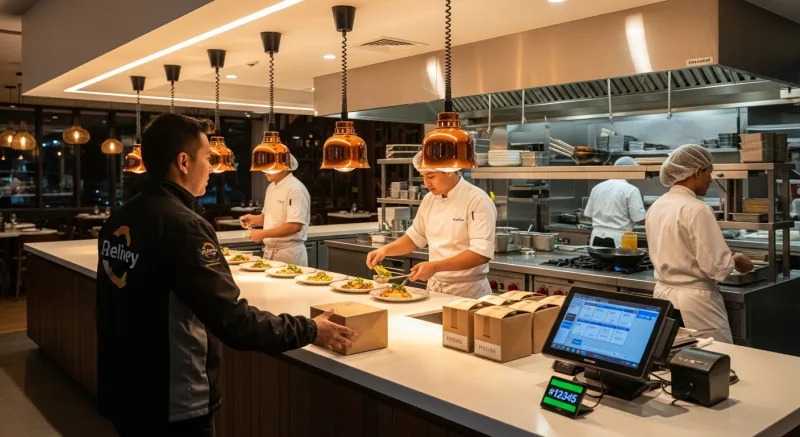
This seasonal delivery surge exposes a devastating cost structure. Third-party platforms charge the same 20-30% commission whether the delivery takes 25 minutes in July or 55 minutes in a January blizzard. But winter deliveries are more expensive for every party involved — drivers earn less per hour because each delivery takes longer, customers wait longer and complain more, and restaurants absorb the refund requests when snow delays push food temperature below acceptable levels.
KwickDriver operates on a flat $2 per delivery plus $6.99 per five miles. No percentage. No weather surcharge. On a $40 winter delivery, DoorDash takes $10-$12. KwickDriver takes $2. Multiply that difference across 50 nightly deliveries for 120 winter days, and the annual savings exceeds $48,000. That is not a rounding error. That is a second cook or a walk-in cooler replacement.
Chinatown to Albany Park: Kitchens That Speak Seven Languages
Walk into a Chinatown dim sum hall, and the language in the kitchen is Cantonese. Cross the city to Albany Park, and you hear Urdu, Korean, and Arabic in adjacent kitchens on the same block. In Pilsen, Spanish dominates every conversation behind the swinging doors. Chicago’s restaurant workforce speaks more languages than any city’s except New York, and the kitchen is where language barriers create the most costly mistakes.
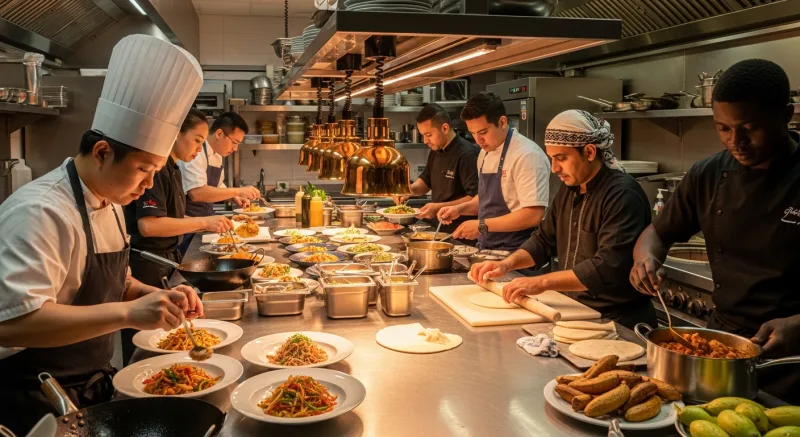
An English-only POS system in a Cantonese-speaking kitchen produces a specific kind of error: transliterated dish names that look similar on screen but refer to entirely different preparations. The difference between two Cantonese dishes might be a single character that English transliteration erases. The wrong dish reaches the table, the customer sends it back, the kitchen remakes it, food cost doubles, and a fifteen-minute delay cascades through every subsequent order.
KwickOS displays Chinese characters natively on kitchen display screens. Not a translation overlay — native rendering that kitchen staff read as naturally as the handwritten tickets they replaced. In Pilsen, the same system runs in Spanish. Each terminal, each KDS station, each self-ordering kiosk operates independently in whatever language serves the person using it. A single restaurant can run English on the front counter, Chinese on the wok station, and Spanish on the prep display simultaneously.
West Loop Rents and the Square-Footage Tax on Technology
Fulton Market rents have crossed $80 per square foot for restaurant space — pricing that means a 15-inch countertop POS terminal occupying 1.5 square feet of counter costs $120 per month in rent just to sit there. A ticket printer accumulating paper on a 2-foot rail costs another $160. In the West Loop, physical space is the most expensive resource a restaurant owns, and every piece of hardware competes with revenue-generating use of that space.
KwickOS runs on 10-inch tablets that mount on walls, attach to kitchen shelves, or sit on narrow ledges that would not accommodate conventional terminals. Kitchen display screens replace the physical ticket rail entirely. A single wall-mounted 15-inch display takes the vertical space that a ticket rail consumed horizontally, freeing 3-4 feet of linear counter space. In a West Loop kitchen where line cooks share 200 square feet, reclaiming four feet of counter changes how the kitchen functions during rush service.
This physical efficiency is not a selling point in suburban restaurants with ample space. In the West Loop, it is the difference between a functional kitchen and one where staff cannot move during the 7 PM crush.
The Health Inspection Documentation Machine
Chicago’s Department of Public Health conducts unannounced inspections with results published online and flagged on Google Maps, Yelp, and every review platform. A “fail” result does not just trigger a reinspection. It triggers a public relations crisis that plays out in real time across the internet. Customers searching your restaurant name on Google see the failed inspection result before they see your menu.
The documentation that protects restaurants during inspections has shifted from paper logs to digital records. Temperature checks on holding equipment, FIFO rotation logging, handwashing reminders, and cleaning schedules all contribute to an inspection outcome. KwickOS integrates food safety prompts into the kitchen display workflow — automated reminders to check steam table temperatures, log walk-in cooler readings, and verify sanitizer concentrations at timed intervals.
When the inspector asks when the last temperature check was performed on the steam table, the manager pulls up a digital log with timestamped entries tied to specific employees through fingerprint verification. Not a paper clipboard where someone wrote “140F” at a time that may or may not be accurate. A digital record, biometrically linked to the person who took the reading, stored permanently and instantly accessible. This documentation is the difference between a smooth inspection and an argument about record-keeping practices.
The Deep-Dish Timing Problem No Other City Has
A deep-dish pizza requires 35-45 minutes in the oven. A salad takes 3 minutes to plate. Garlic bread needs 8 minutes. When a table orders all three, the kitchen faces a coordination problem that has nothing to do with cooking skill and everything to do with timing information. Fire the salad when the pizza goes in, and the customer stares at wilting greens for 40 minutes. Fire it at minute 37, and everything arrives together. The margin for error is narrow, and the consequence of getting it wrong is a table that feels neglected.
Most POS kitchen display systems show orders as a flat list: pizza, salad, bread. The cook sees everything at once and must mentally calculate fire times while managing six other tables. KwickOS KDS supports course-based firing with configurable time offsets per item. The pizza fires immediately with a 42-minute timer. The bread displays as a held item with an automatic fire time at minute 34. The salad fires at minute 39. The kitchen sees what to cook now and what to hold, with automatic prompts when held items should begin.
This is not a generic kitchen management feature. This is a solution to a problem that affects every deep-dish pizzeria in Chicago and that most POS companies do not even recognize as a problem because they have never stood in a Giordano’s kitchen during a Saturday night rush.
Wrigleyville Before and After First Pitch
The neighborhoods surrounding Wrigley Field transform 81 times per year when the Cubs play at home. Restaurants on Clark Street, Sheffield, and Addison experience volume increases of 150-300% in the three hours before a game and the two hours after. A bar that serves 200 drinks on a normal Tuesday serves 600 when the Cubs play at 7 PM.
This volume surge demands two things from a POS system: processing speed that does not degrade under load, and staff management tools that handle the temporary employees hired specifically for game-day service. KwickOS delivers both. Local transaction processing at 1-millisecond speed means the 600th drink rings up as fast as the first. Fingerprint-based employee identification means the temporary bartender hired for game day registers a fingerprint, processes transactions under their own biometric identity, and loses access the moment their employment ends. No shared PINs lingering from a departed game-day hire.
Neighborhood Economics Require Neighborhood-Specific Technology
Chicago’s neighborhoods operate as distinct economic ecosystems. Wicker Park’s young professional brunch crowd, Hyde Park’s University of Chicago community, Andersonville’s walkable restaurant row, and Bronzeville’s revitalizing dining scene all have different customer demographics, spending patterns, and operational rhythms. A POS system configured for a Wicker Park brunch spot would misconfigure a Hyde Park dinner house.
KwickOS is configurable per location because restaurant technology should adapt to how a business operates, not force the business to adapt to how the software works. Menu structures, pricing tiers, loyalty programs, tipping defaults, kitchen display layouts, and employee permission levels all customize per establishment. A restaurant group operating in Wicker Park, Chinatown, and the West Loop simultaneously runs three different configurations on a single platform with unified reporting.
T. Jin China Diner demonstrates this at scale: 15 locations with 75 terminals, each location configured for its specific market while corporate maintains real-time visibility across all of them. When the owner checks the dashboard at 8 PM on a Friday, every location’s performance is visible without a single phone call to a manager.
Processing Fees at Chicago Volume
A moderately successful Chicago restaurant processes $100,000-$150,000 monthly in card transactions. A high-volume River North establishment might exceed $300,000. At these volumes, the difference between locked-in Toast rates and negotiated processor rates through KwickOS is dramatic.
On $200,000 monthly volume: Toast at 2.99% plus $0.15 charges $6,280 per month — $75,360 annually. A competitive processor through KwickOS at 2.15% plus $0.10 charges $4,500 per month — $54,000 annually. The $21,360 annual savings is not abstract. It is the profit margin on $356,000 in additional sales that the restaurant does not need to generate if it simply pays less in processing fees.
Square’s flat 2.6% plus $0.10 on the same $200,000 monthly volume costs $5,400 monthly — $64,800 annually. Better than Toast but still $10,800 more per year than a negotiated rate. And like Toast, Square locks you into their processor with no ability to shop rates as your volume grows and your leverage increases.
What Chicago Restaurants Must Demand
Chicago does not tolerate mediocrity in food. It should not tolerate mediocrity in restaurant technology either. The conditions that make this city’s restaurant scene uniquely challenging also make it uniquely clear which POS capabilities matter and which are marketing fluff.
- True offline processing — Four months of polar vortex weather guarantee internet outages; plan for them
- Native multilingual support — Chinatown, Pilsen, and Albany Park kitchens operate in their own languages
- Course-based KDS timing — Deep-dish coordination is a Chicago-specific operational necessity
- Flat-rate delivery — Winter delivery surges cannot sustain percentage-based commissions
- Compact hardware — West Loop and North End kitchens measure space in inches, not feet
- Fingerprint staff management — Game-day temps and high turnover demand biometric accountability
- Food safety documentation — Chicago health inspections are public and consequential
- Processor independence — Chicago volumes justify rates that locked systems will never offer
The Second City’s restaurant scene is no one’s second choice. Its technology should not be either.
Chicago restaurant owners: Call (888) 355-6996 or visit KwickOS.com to talk with someone who understands that your January is not the same as Miami’s.

Founder & CIO of KwickOS · 30 Years IT · 20 Years Restaurant Industry
Tom built KwickOS after running restaurants and IT companies for decades. He relocated the company to a 10,000 sq ft office in 2023 and now serves 5,000+ businesses across all 50 states, processing over $2M in daily sales.