The Queen City’s Restaurant Renaissance: Charlotte Deserves Better Than a Generic POS
Updated March 2026 · By Tom Jin
Charlotte has spent the last decade quietly building one of the most underrated restaurant scenes in the American South. The city that outsiders associate with banking headquarters and NASCAR has transformed neighborhoods like NoDa, Plaza Midwood, and South End into dining destinations that rival cities twice its size. Over 2,500 restaurants now serve a metro area that grew by 200,000 residents between 2020 and 2025, making it the fastest-growing large city east of the Mississippi.
This growth has created a peculiar technology problem. Charlotte restaurants operate in a market that straddles two identities: the corporate Uptown lunch economy driven by Bank of America, Wells Fargo, and Truist executives who expense everything, and the creative neighborhood dining economy where chef-owned restaurants serve communities that value authenticity over corporate polish. Both segments need technology. Neither is well served by the one-size-fits-all approach of Toast, Square, or Clover.
The Uptown Lunch Window: 90 Minutes to Make or Break a Day
Charlotte’s Uptown financial district concentrates more banking employees per square mile than anywhere outside of Manhattan. Between 11:30 AM and 1:00 PM on weekdays, the lunch rush for restaurants along Tryon Street and Trade Street is among the most compressed and high-value in the Southeast. A fast-casual restaurant in Uptown might process 300 transactions in 90 minutes, with average tickets of $18-25 driven by expense-account spending.
Speed is everything in this window. A banker waiting more than four minutes for a lunch order goes back to the office and orders DoorDash instead. Self-ordering kiosks powered by KwickOS let customers browse, customize, and pay without joining a staffed counter line. A single kiosk processes 40-50 orders per hour — faster than any human cashier and with zero order-entry errors because the customer selects exactly what they want.
The corporate lunch customer also expects polished digital receipts for expense reporting. KwickOS generates itemized digital receipts sent via email or text, formatted with the restaurant name, address, and tax breakout that corporate expense systems require. A minor detail that matters enormously when your best customers are submitting every lunch to a corporate accounting department.
NASCAR Weekends and the Volume Tsunami
Charlotte Motor Speedway hosts multiple major NASCAR events that bring over 100,000 visitors to the metro area. The Coca-Cola 600 and Bank of America ROVAL 400 transform the restaurants along Bruton Smith Boulevard and across Concord into high-volume operations running at capacity from Thursday through Sunday. A restaurant that serves 150 covers on a normal Saturday serves 400 during race weekend.
This 267% volume increase exposes every weakness in a POS system. Cloud-based systems that handle normal volume adequately begin to lag when transaction speed matters most. Kitchen display systems backed by remote servers show noticeable delays when the dinner rush hits during pre-race festivities. Staff who function smoothly under normal conditions make mistakes when the system is a step slower than they need it to be.
KwickOS processes every transaction locally at 1-millisecond speed regardless of volume. The 400th transaction of the day processes exactly as fast as the first. Kitchen display screens update instantly because the data travels across a local network, not to a cloud server and back. For Charlotte restaurants that depend on race weekends for a disproportionate share of annual revenue, this performance consistency is not a technical specification. It is revenue protection.
South End Brewery District: Where Food Meets Draft Lists
South End has evolved into Charlotte’s primary brewery and restaurant corridor, with over 30 breweries and taprooms operating alongside restaurants that range from wood-fired pizza to Vietnamese fusion. The brewery-restaurant hybrid model creates technology requirements that standard restaurant POS systems handle poorly: draft beer menus that change weekly, tasting flight configurations with multiple small pours per order, and food menus that complement but do not dominate the beverage program.
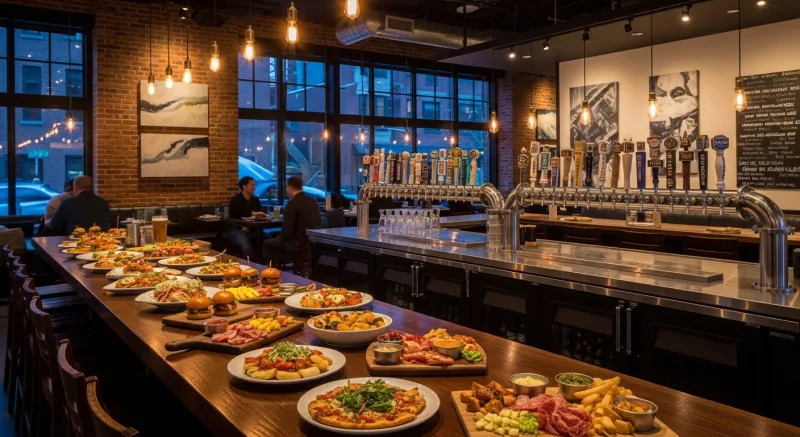
KwickOS handles complex beverage programs with modifier trees that accommodate pour sizes, flight configurations, and rotating draft selections. When a new keg taps on Tuesday, the menu updates instantly across all terminals and digital signage. When a keg blows on Friday night, the item disappears from KwickSign displays and the POS simultaneously — no more customers ordering a beer that ran out twenty minutes ago.
KwickSign digital menu boards are particularly relevant for South End taprooms where the draft list changes three or four times per week. A printed chalkboard requires someone to physically update it, introduces handwriting legibility issues, and cannot display pricing changes in real time. A KwickSign display updates from the POS in seconds, maintains consistent branding, and can show ABV, tasting notes, and pricing that recalculates automatically when happy hour starts at 4 PM.
NoDa’s Creative Economy and the Independent Restaurant
Charlotte’s NoDa arts district attracts the kind of chef-driven, independently owned restaurant that defines a city’s culinary identity. These are not chain operations. They are 40-seat restaurants where the owner works the line, the menu changes with the seasons, and the profit margin lives or dies on the difference between 2.99% and 2.2% processing rates.
For these operators, every dollar of processing cost is personal. Toast’s locked-in 2.99% plus $0.15 per transaction on a restaurant doing $60,000 monthly means $1,944 per month in processing. An independent processor through KwickOS at 2.2% plus $0.10 charges $1,420. That $524 monthly savings — $6,288 annually — is the difference between a chef-owner taking a modest salary and working for free.
KwickOS’s processor-agnostic design was built for operators like these. The software earns revenue from the software subscription, not from capturing a percentage of every card swipe. This alignment of incentives means KwickOS benefits when the restaurant thrives, not when the restaurant processes more transactions at locked-in rates.
Carolina Hospitality and the Full-Service Challenge
Charlotte’s dining culture retains a Southern hospitality expectation that affects technology requirements in ways Northeastern POS designers often overlook. Guests expect tableside interaction, unhurried pacing, and a level of personal attention that fast-turn table management undermines. A POS system that optimizes purely for table turnover speed misses the point of Charlotte dining, where a two-hour dinner is not inefficiency — it is the product.
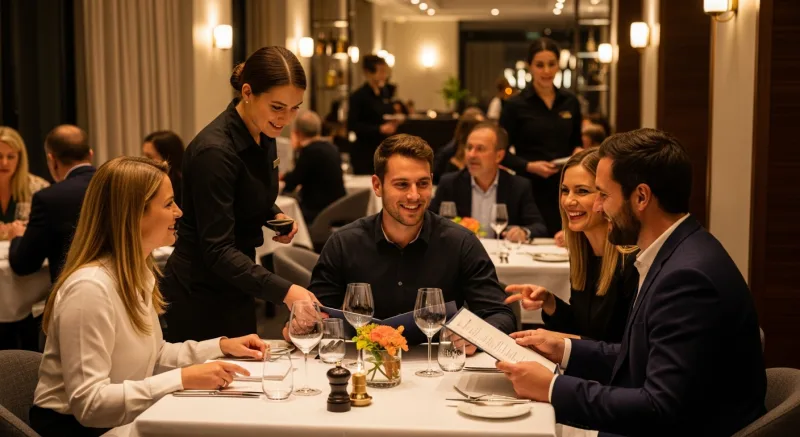
KwickOS supports course-based firing through the kitchen display system, allowing servers to control the pace of a meal. First course fires when the table is seated. Second course holds until the server sends it. Dessert fires on demand, not on a timer. This pacing control respects the Charlotte dining rhythm while ensuring kitchen coordination that prevents food sitting in the window while a table finishes their previous course.
Membership programs through KwickOS let Charlotte’s fine-dining restaurants create wine club tiers, tasting event access, and priority reservation benefits. A Plaza Midwood restaurant offering a $100/month wine membership generates predictable recurring revenue while building the kind of regular clientele that Southern hospitality depends upon. The membership management is integrated into the POS — when a member dines, their status is visible to the server, enabling the personalized experience that justifies the membership fee.
Charlotte’s Growing Asian Food Scene
Charlotte’s Asian restaurant community has expanded dramatically, particularly along South Boulevard and in the University City area near UNC Charlotte. Korean BBQ, Chinese hot pot, Vietnamese pho shops, and Japanese ramen houses have opened at a pace that reflects the metro area’s diversifying population. These restaurants face the same language challenges as Asian restaurants in every major American city: kitchen staff who operate most efficiently in their native language.
KwickOS’s native Chinese language support means Charlotte’s growing Chinese restaurant community can operate kitchen display systems in Chinese characters. Shogun Japanese Hibachi, a KwickOS customer with 4 terminals, demonstrated how the system handles specialized kitchen configurations — customized hibachi station displays that show chefs exactly what each guest at their station ordered, in the format that makes sense for the hibachi cooking workflow. New operators achieved proficiency in under 5 minutes because the interface follows the logic of how they actually cook, not how a software designer imagined a kitchen works.
The Lake Norman Expansion Pattern
Charlotte restaurants that succeed in the city center often expand north toward Lake Norman, where Cornelius, Davidson, and Huntersville provide affluent suburban customer bases. This expansion pattern creates a multi-location management challenge: the original NoDa location operates differently than the Lake Norman location in terms of menu, pricing, and customer expectations, but both need to report to the same owner on the same dashboard.
KwickOS’s centralized management with per-location customization handles this pattern. The NoDa location runs a chef-driven menu with seasonal rotations. The Lake Norman location runs a broader, more family-friendly menu with consistent pricing. Both locations appear on a single management dashboard showing real-time sales, labor costs, and inventory levels. The owner sitting at home can compare Friday night performance across both locations without calling either manager.
This scalability is how Crafty Crab grew to 19 locations with 152 terminals. The Charlotte market’s expansion dynamics — city center success leading to suburban satellite locations — follow the exact pattern that KwickOS was designed to support. A system that works for one location and breaks at three is a system that constrains Charlotte’s natural growth trajectory.
Delivery Economics in a Sprawling Metro
Charlotte’s geographic footprint is enormous — over 300 square miles of metro area where most customers drive to restaurants rather than walk. This car-dependent geography creates massive delivery demand and equally massive delivery costs when third-party platforms extract 20-30% per order.
KwickDriver charges $2 per delivery plus $6.99 per five miles. For a Charlotte restaurant delivering to the Ballantyne suburb from a South End kitchen — roughly 12 miles — the cost is approximately $16 through KwickDriver versus $6-$9 in commission on a $30 order through DoorDash. But DoorDash’s percentage scales: on a $60 family dinner order, they take $15-$18 while KwickDriver still charges the same flat rate. The larger the order, the more dramatic the savings.
Combined with KwickMenu online ordering, Charlotte restaurants control the entire customer experience from browse to delivery. No competing restaurants shown alongside yours. No platform algorithm burying your listing because you did not pay for sponsored placement. The customer orders from your website, and their food arrives via your delivery infrastructure.
Gift Cards and Charlotte’s Corporate Gift Culture
Charlotte’s banking industry creates a corporate gift card economy that restaurants in other cities do not experience at the same scale. During the holiday season, financial institutions purchase restaurant gift cards in bulk for clients and employees. A single corporate order can move $5,000-$25,000 in gift cards for a well-known Charlotte restaurant. This represents prepaid revenue and guaranteed future visits.
KwickOS integrates physical and digital gift cards directly into the POS with no third-party fees. Bulk corporate orders generate and track cards from the same system that processes daily transactions. Balance inquiries, partial redemptions, and reload capabilities all live within the POS interface. When Bank of America sends an assistant to purchase 200 gift cards for client holiday gifts, the restaurant processes the order through KwickOS in minutes rather than coordinating with a separate gift card vendor.
Charlotte’s POS Evaluation Criteria
Charlotte has matured from a banking town with chain restaurants into a genuine food city with a diverse, growing dining scene. The technology supporting this evolution should match its ambition. Charlotte restaurants evaluating POS systems should demand:
- Processor flexibility — Corporate lunch volume and race-weekend surges create leverage for rate negotiation
- Local processing speed — The 90-minute Uptown lunch window tolerates zero system lag
- Course-based kitchen management — Southern hospitality dining pacing requires server-controlled firing
- Digital signage for breweries — South End’s rotating draft lists need real-time digital boards
- Multi-location scalability — City-to-Lake-Norman expansion is Charlotte’s natural growth path
- Gift card integration — Corporate bulk purchases need native POS support, not third-party coordination
- Self-ordering kiosks — Uptown lunch efficiency depends on removing the counter-line bottleneck
- Flat-rate delivery — Charlotte’s sprawl demands delivery; percentage commissions destroy margins at distance
Charlotte is building something special in its restaurant scene. The technology behind it should be equally intentional.
Charlotte restaurant owners: Call (888) 355-6996 or visit KwickOS.com to discuss how KwickOS fits your Uptown lunch rush, your NoDa dinner service, or your Lake Norman expansion plan.

Founder & CIO of KwickOS · 30 Years IT · 20 Years Restaurant Industry
Tom built KwickOS after running restaurants and IT companies for decades. He relocated the company to a 10,000 sq ft office in 2023 and now serves 5,000+ businesses across all 50 states, processing over $2M in daily sales.