Clam Chowder, Cobblestones, and Cloud Outages: Why Boston Restaurants Need a Smarter POS
Updated March 2026 · By Tom Jin
Toast was founded in Boston. This is worth mentioning because Boston restaurants know Toast better than anyone, and many of them are starting to understand what that familiarity actually costs. The city that launched one of America’s largest restaurant technology companies has become a living laboratory for the limitations of cloud-dependent, processor-locked POS systems. Irony is not lost on the North End Italian restaurant paying 2.99% per transaction to a company headquartered ten minutes away.
Boston operates roughly 3,100 restaurants across a geography that punishes technology in ways few other cities match. Nor’easters bury the city under snow and ice from December through March, knocking out power and internet. Historic buildings in Beacon Hill, the North End, and Charlestown have electrical systems from the 1950s and walls thick enough to block Wi-Fi. And the city’s liquor licensing system is among the most restrictive in America, creating compliance requirements that ripple through every aspect of restaurant operations — including point-of-sale.
The Nor’easter Test
Between November and April, Boston averages four to six significant winter storms that disrupt normal business operations. The 2024-2025 season brought three storms that dropped over 12 inches each, along with coastal flooding in Seaport and East Boston that knocked out utility infrastructure for hours at a time. Restaurants in these neighborhoods that depend on cloud-based POS systems faced a choice during each event: close entirely or process transactions with degraded, unreliable service.
KwickOS eliminates this choice. Every transaction processes on the local device at 1-millisecond speed. The internet connection is used for syncing, remote management, and online ordering — never for the transaction standing at your register. When a February nor’easter takes out the Verizon node serving your block of Hanover Street, your POS keeps processing, your kitchen display keeps showing orders, and your revenue keeps flowing. When the storm passes and connectivity returns, everything syncs to the cloud automatically.
This is not a theoretical advantage in Boston. This is the difference between staying open and sending staff home during the four or five highest-revenue winter weekends — periods when customers order delivery at three times the normal rate and the restaurants that stay operational capture a disproportionate share of neighborhood spending.
North End Kitchens: 150 Square Feet of Controlled Chaos
The North End is Boston’s most iconic restaurant district and its most physically constrained. Buildings dating to the late 1800s were never designed for commercial kitchens. A typical North End restaurant kitchen measures 150-250 square feet — less than many suburban bathrooms. Every inch is accounted for. A paper ticket printer and its accumulating tickets consume space that could hold a prep surface. A bulky POS terminal on the pass blocks the expeditor’s sight line to the kitchen.
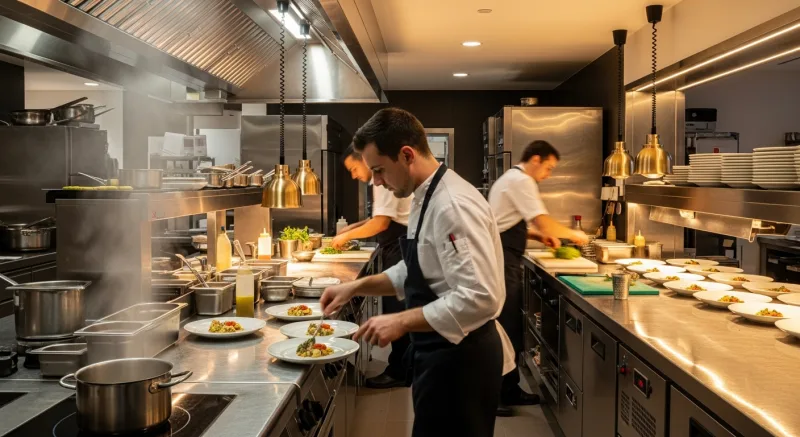
KwickOS kitchen display screens mount flush to the wall, replacing ticket printers and the fire hazard they represent in a cramped kitchen near open flames. A 15-inch KDS screen takes the vertical space of a ticket rail but provides infinitely more information: order timing, modification highlighting, course firing sequences, and allergen flags. In a North End kitchen where the line cook, sauté station, and pizza oven share a space the size of a parking spot, this physical footprint reduction is operationally transformative.
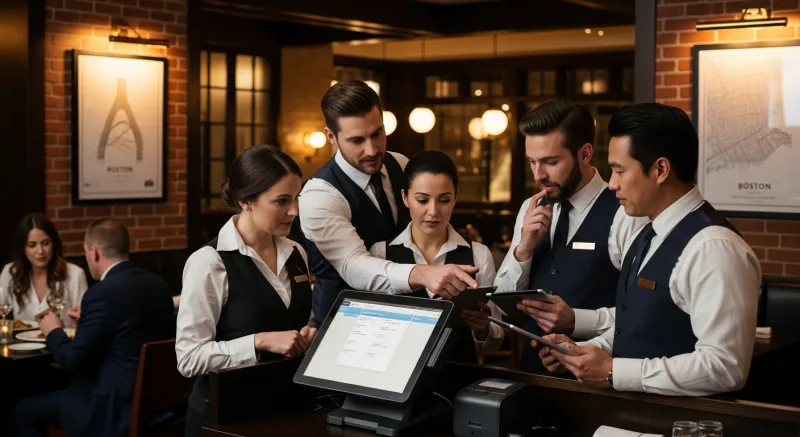
Front-of-house tablets replace countertop terminals. Servers carry them tableside in the narrow dining rooms where a traditional POS station would block the pathway between tables. Payment processes at the table rather than requiring the server to navigate through a packed 30-seat dining room to a stationary terminal and back.
Boston’s Liquor License Labyrinth
Boston caps the total number of liquor licenses available in the city. A full liquor license in Boston can cost $250,000-$400,000 to purchase on the open market — a figure that would be a down payment on a building in most other cities. This scarcity creates an operational imperative: every restaurant with a liquor license must maximize alcohol revenue to justify the investment.
POS systems play a direct role in liquor compliance and optimization. Massachusetts requires itemized alcohol reporting, age verification documentation for inspections, and precise sales tracking that distinguishes food from beverage revenue. KwickOS’s reporting capabilities segment alcohol sales by category, time period, and server — data that satisfies ABCC (Alcoholic Beverages Control Commission) inspection requirements and gives owners the analytics to optimize their most profitable menu category.
Fingerprint verification on KwickOS ensures that only authorized staff access alcohol-related POS functions. When an underage busser cannot ring up a drink because the system requires fingerprint authentication from a bartender or server over 21, the restaurant eliminates a compliance risk that a PIN-code system cannot prevent. Shared PINs do not check IDs. Fingerprints verify the specific individual processing the transaction.
The Seaport Transformation and New-Build Technology
Boston’s Seaport District has undergone the most dramatic restaurant expansion in the city’s modern history. Where parking lots and warehouses stood a decade ago, hundreds of restaurants now serve a mix of tech workers, tourists, and convention attendees. Unlike the North End’s space constraints, Seaport restaurants are built new with modern infrastructure — and their technology decisions reflect the ambition of their buildouts.
A Seaport restaurant investing $2 million in a buildout should not compromise on POS technology to save $100 per month. These are high-volume operations processing $200,000-$500,000 monthly in card transactions. At Toast’s 2.99% rate, a $300,000-per-month Seaport restaurant pays $9,120 monthly in processing — $109,440 annually. The same volume through a competitive processor at 2.2% plus $0.10 on KwickOS costs $6,800 monthly — $81,600 annually. The $27,840 annual savings funds a full-time employee.
Seaport restaurants also serve the Boston Convention and Exhibition Center, where events drive unpredictable volume spikes. When a medical convention brings 40,000 attendees to the district, nearby restaurants need technology that handles three times normal volume without breaking. KwickOS’s local processing eliminates the server-side bottleneck that cloud systems create during these spikes.
College Town Dynamics: Harvard, MIT, and the Student Economy
Greater Boston contains over 50 colleges and universities with a combined student population exceeding 250,000. Cambridge alone — home to Harvard and MIT — supports hundreds of restaurants that depend on student patronage. The student restaurant economy operates by different rules: mobile-first ordering, extreme price sensitivity, late-night hours, and a complete customer base replacement every four years as classes graduate.
KwickOS’s online ordering through KwickMenu captures the mobile-first behavior that drives the student market. A Harvard Square restaurant that does not offer seamless online ordering loses the student who will not call in an order and will not walk in without checking the menu online first. Orders placed through KwickMenu flow directly to the POS and KDS with no third-party commission — essential for restaurants where a $12 average ticket cannot absorb DoorDash’s 25% cut.
KwickDriver’s flat $2-per-delivery pricing makes student delivery economically viable. A $15 delivery to a MIT dormitory costs the restaurant $2 through KwickDriver versus $3.75-$4.50 through third-party platforms. When you are delivering 50 orders per night to campus, that difference is $87.50-$125 in nightly savings — money that keeps the restaurant profitable on transactions that third-party commissions would render unprofitable.
Chinatown: Where Language Support Is Not Optional
Boston’s Chinatown is the third-largest in the country and supports a dense concentration of restaurants where Cantonese and Mandarin are the primary kitchen languages. Dim sum houses, hot pot restaurants, bakeries, and seafood specialists all operate with front-of-house staff who speak English to customers and kitchen staff who work in Chinese.
KwickOS runs natively in Chinese across its entire interface. Kitchen display systems show dish names in characters that kitchen staff actually read. Order modifications display in the language the cook understands. This is not a translation layer on top of an English system — it is native language support that eliminates the daily miscommunication that English-only POS systems create in Chinese-speaking kitchens.
For Boston’s Chinatown restaurants specifically, the dim sum workflow requires a POS system that handles dozens of small-plate items ordered from circulating carts, tracked by table, and settled at the end of the meal. KwickOS’s flexible order management accommodates this workflow natively — items added incrementally to an open check as carts pass tables, with the final total calculated when the customer asks for the bill.
Fenway Park and the Game-Day Revenue Spike
Eighty-one Red Sox home games per season transform the Fenway-Kenmore neighborhood into a high-volume dining district for three hours before each game and two hours after. Restaurants within walking distance of Fenway Park experience volume swings of 200-300% on game days — a surge that demands POS technology capable of handling rapid-fire orders without degradation.
Self-ordering kiosks powered by KwickOS allow Fenway-area restaurants to process the pre-game rush without tripling front-of-house staff for a four-hour window. A kiosk handles 40-50 transactions per hour — the equivalent of two full-time servers — at zero labor cost. For restaurants that cannot hire additional staff for sporadic game-day surges, kiosks provide the throughput that keeps lines moving and customers spending rather than walking to the next option.
Digital signage through KwickSign lets these restaurants promote game-day specials on exterior-facing screens, capturing foot traffic from the 37,000 fans walking to the park. When the pre-game special changes from a $15 burger combo to a $12 hot dog deal as game time approaches, the sign updates instantly across all displays.
The Seasonal Tourism Calculation
Boston’s tourism season peaks from April through October, with the Freedom Trail, whale watching, and fall foliage driving millions of visitors into restaurant districts. The seasonal revenue swing is significant: a Faneuil Hall area restaurant might do double its winter volume during peak summer months. Managing this seasonality requires technology that provides accurate forecasting, flexible staffing tools, and the ability to scale operations up and down efficiently.
KwickOS’s labor management integrates with sales data to project staffing needs based on historical patterns. When the system shows that the third week of October consistently produces 40% higher revenue than the first week of November (foliage season ending), the operator schedules accordingly rather than discovering the shift change after it happens.
Membership programs through KwickOS convert summer tourists into year-round digital customers. A visitor who joins a loyalty program during a July trip to Boston receives targeted offers during the slow winter months — gift card promotions for the holidays, special menu announcements for Restaurant Week, and incentives to order online and ship Boston specialties nationally.
What Boston Restaurants Should Evaluate Before Choosing a POS
Boston’s restaurant operators have watched Toast grow from a local startup to a publicly traded company. They have been its earliest adopters and its most informed critics. The question for Boston restaurants in 2026 is not whether Toast is a good company — it is whether a cloud-dependent, processor-locked system is the right architecture for a city where nor’easters knock out internet, historic buildings block signals, and processing volume justifies aggressive rate negotiation.
- Offline transaction processing — Nor’easters are not hypothetical; they happen four to six times per winter
- Compact hardware — North End kitchens and Back Bay dining rooms have no space for bulky terminals
- Processor independence — Seaport volumes justify negotiated rates that save five figures annually
- Chinese language support — Chinatown kitchens need native-language displays, not translated overlays
- Fingerprint compliance — Liquor license accountability requires biometric verification, not shareable PINs
- Flat-rate delivery — Student delivery economics collapse under percentage-based commissions
- Scalable event handling — Fenway game days and convention surges need local processing speed
- Loyalty and membership — Tourist conversion to repeat customers requires integrated retention tools
Boston deserves POS technology as sophisticated as its restaurant scene. The city that launched Toast should hold all POS systems — including Toast — to the standard its operators actually need.
Boston restaurant owners: Call (888) 355-6996 or visit KwickOS.com to see what POS technology looks like when it is built for your conditions, not just your city’s zip code.

Founder & CIO of KwickOS · 30 Years IT · 20 Years Restaurant Industry
Tom built KwickOS after running restaurants and IT companies for decades. He relocated the company to a 10,000 sq ft office in 2023 and now serves 5,000+ businesses across all 50 states, processing over $2M in daily sales.