The independent pizza shop is fighting a multi-front technology war. On one side are the chains — Domino's, Papa John's, Pizza Hut — whose integrated ordering platforms make it easier to order from them than from you. Domino's can track your pizza from oven to doorstep. Papa John's loyalty program drives 50% of revenue. Pizza Hut's app remembers your last 20 orders. On the other side are the third-party delivery apps — DoorDash, UberEats, GrubHub — that insert themselves between you and your customer, take 15-25% of every order, and own the customer relationship. An operating system fights both wars simultaneously.
The math on DoorDash commission alone justifies the switch. A pizza shop doing $6,000/month in delivery through DoorDash at 20% commission pays $1,200/month — $14,400/year — for a service that also hides the customer's contact information and prevents the shop from building a direct relationship. KwickDriver, integrated into KwickOS, charges $2 flat + $6.99/5mi per delivery. For 200 deliveries/month averaging 3 miles, the cost is $1,798/month under DoorDash versus $400/month under KwickDriver. Annual savings: $16,776.
The 6 Order Channels Pizza Shops Must Unify
1. Phone Orders
Despite the digital revolution, phone orders still account for 25-35% of independent pizza sales. An OS integrates phone ordering into the POS: the staff member enters the order, the caller ID looks up the customer's loyalty account and address, the order fires to the KDS, and delivery dispatching happens from the same screen. No separate phone order terminal, no handwritten tickets.
2. Walk-In and Counter Orders
Standard POS functionality — but in an OS, the counter order earns loyalty points, appears on the KDS alongside delivery and online orders with identical priority, and feeds the same reporting dashboard.
3. Online Ordering
KwickMenu provides the online ordering platform with 500K monthly users already in the ecosystem. Customers customize their pizza (size, crust, toppings, special instructions), select delivery or pickup, choose a time slot, and pay — all flowing directly into the KDS without a separate tablet or manual re-entry.
4. Third-Party App Orders (Transition Period)
During the transition from DoorDash to direct ordering, the OS can receive third-party orders through integration and display them on the same KDS. This ensures no order falls through the cracks while you migrate customers to your direct ordering platform.
5. Self-Service Kiosk
Pizza shops with dine-in or heavy counter traffic benefit from kiosks that reduce order-taking labor. The kiosk handles customization (build-your-own pizza with visual topping selection), earns loyalty points, and routes to the KDS — all part of the OS.
6. Delivery Dispatch
KwickDriver provides driver management integrated into the OS. When a delivery order is ready, the driver is dispatched from the same screen. Routing, estimated delivery time, and driver tracking are native to the platform — not a separate app running alongside the POS.
Kitchen Display: Why Pizza KDS Is Different
Pizza production has a unique workflow: order → prep station (stretch dough, add sauce and cheese) → topping station (add toppings per order) → oven (timed cook) → cut and box → delivery or pickup. The KDS must track orders through this multi-stage process, displaying the right information at each station.
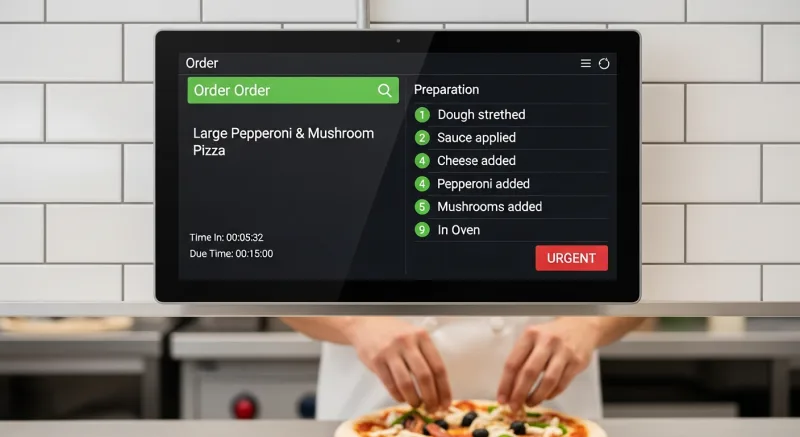
KwickOS's built-in KDS supports multi-stage production workflows. The prep station sees the dough size and base. The topping station sees the individual customizations. The oven display shows cook time remaining. The boxing station sees the delivery/pickup status and any special instructions. All from one system, one database, one order record.
Loyalty: Competing With Domino's Piece of the Pie
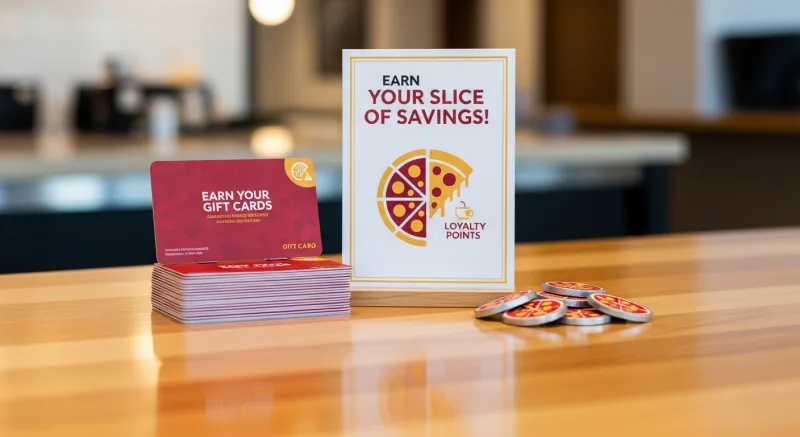
Our pizza loyalty guide covers program design in detail. The OS advantage is that loyalty points are earned regardless of order channel — phone, counter, online, kiosk, or delivery. Domino's does this because their entire platform is one system. With a patchwork of tools, independent pizza shops cannot match this because each channel tracks customers differently. With an OS, it is automatic.
Digital Signage for Pizza Menus
Pizza menus are visually driven — customers decide based on what looks good. KwickSign displays rotating high-quality images of pizzas, current specials, combo deals, and seasonal items on screens throughout the shop. When a topping runs out or a special expires, the signage updates automatically because it is driven by the same menu database that feeds the POS and online ordering.
Security and Accountability
Pizza shops handle significant cash from delivery (many customers still pay cash on delivery). Fingerprint authentication tracks every cash transaction and drawer access by individual employee. Driver cash handling is logged per delivery, reconciled against the orders they carried. Any discrepancy is immediately visible — not discovered during end-of-week reconciliation when the evidence trail is cold.
Hybrid Cloud: Pizza Delivery Cannot Stop
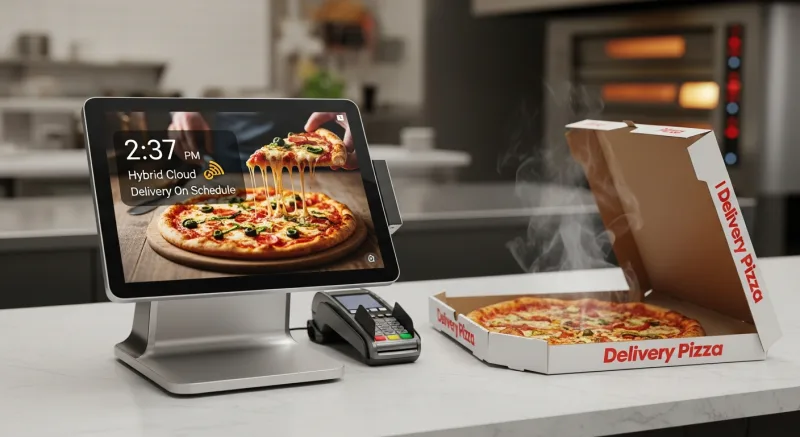
A pizza shop that loses internet during Friday night dinner rush loses its highest-revenue window of the week. Phone orders stop (if using VoIP), online orders stop, delivery dispatch stops, and the KDS goes dark. KwickOS's hybrid architecture keeps the POS, KDS, and local orders running without internet. Phone orders and walk-ins continue normally. Online orders queue and process when connectivity returns. Delivery dispatch works locally.
Cost Comparison
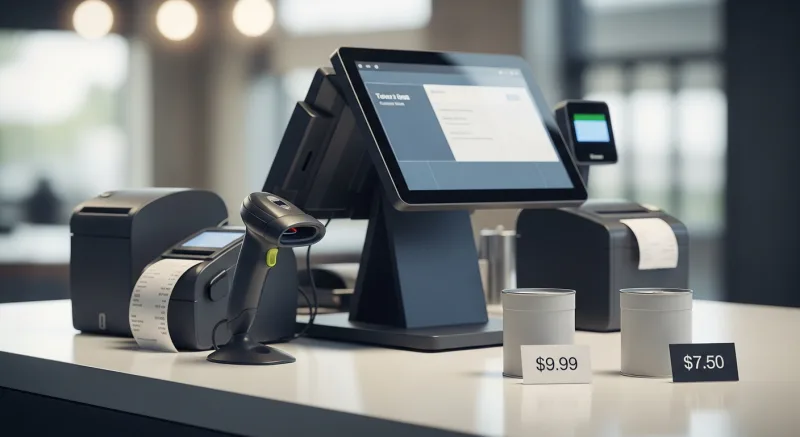
| System | Patchwork | KwickOS |
|---|---|---|
| POS | $69/month | All included |
| Online Ordering | $75-200/month | |
| Loyalty | $75/month | |
| KDS | $30-50/month | |
| Signage | $25/month | |
| Delivery | 15-25% per order ($1,200+/month) | |
| Total | $274+ plus $1,200+ delivery | One platform + $2 flat delivery |
Implementation: Pizza Shop OS in 5 Days
Day 1: Installation and menu setup. Import pizza sizes, crusts, toppings, sides, drinks, and combos. Configure the multi-stage KDS workflow (prep → toppings → oven → boxing).
Day 2: Staff training. Order takers learn the POS (1 hour). Kitchen staff learn the KDS (30 minutes). Delivery drivers learn the dispatch workflow (15 minutes).
Day 3: Activate KwickMenu online ordering. Connect the phone system for caller ID loyalty lookup. Test the full order flow: online order → KDS → kitchen → driver dispatch.
Day 4: Launch loyalty program. Configure gift cards. Set up digital signage with menu boards and daily specials.
Day 5: Go fully live. Begin transitioning delivery customers from DoorDash to direct ordering (insert cards in delivery boxes: "Order direct next time — earn loyalty points and save on delivery fees").
By month 3, target: 50% of delivery orders through direct channels (KwickMenu + phone), $1,000+/month savings on delivery commissions, 500+ loyalty members, and a unified dashboard showing all order channels in one view.
Take Back $14,400/Year From DoorDash
KwickOS gives pizza shops POS, online ordering, KDS, loyalty, signage, and $2 flat delivery — all in one system. See how an operating system beats a POS-and-DoorDash patchwork.
Book Your Free Demo