Keep Austin Weird — But Keep Your POS System Reliable
Updated March 2026 · By Tom Jin
Austin invented the food truck park. Not literally — food trucks existed before — but Austin turned a collection of trailers in a dirt lot into a legitimate dining destination that people drive across town to visit. South Congress, East 6th, Rainey Street, the Domain — every neighborhood has its own constellation of trailers, trucks, and micro-restaurants that collectively define what eating in Austin means. This is a city where a James Beard Award-winning chef operates out of a 200-square-foot trailer, where barbecue is a spiritual practice, and where the phrase “we have an app for ordering” is spoken by a person standing behind a plywood counter in 104-degree heat.
The technology running these restaurants matters more than most Austin operators realize when they open. The wrong POS system does not just cost money. It constrains growth, locks you into unfavorable processing rates, and fails precisely when you need it most — during SXSW, during ACL, during a Friday night when the line stretches around the block and your cloud-based system cannot keep up with your kitchen.
The Food Truck Math That Most POS Systems Get Wrong
Austin has over 1,500 permitted mobile food vendors — more per capita than any other American city. The food truck business model has razor-thin margins that amplify every technology cost. A truck doing $3,000 in daily sales at a busy lot near the Convention Center during SXSW needs to convert every possible dollar into profit, because next Tuesday when it rains and foot traffic vanishes, that reserve is what keeps the truck operational.
Square’s flat 2.6% plus $0.10 per transaction seems designed for food trucks — simple, predictable, easy to understand. But simple is expensive. On $90,000 monthly volume during festival season, Square takes $2,440. A processor-agnostic system like KwickOS, paired with a competitive processor offering 2.1% plus $0.08, brings that down to $1,970. The $470 monthly difference does not sound dramatic until you multiply it by twelve months and realize it is $5,640 per year — the cost of a new generator, a transmission repair, or two months of commissary rent.
Toast is not even a viable option for most food trucks. The hardware is designed for permanent installation, the monthly fees assume a brick-and-mortar operation, and the processing lock-in makes no sense for a high-volume, low-margin business where every fraction of a percentage point matters. KwickOS runs on any touchscreen device, including weatherproof tablets that survive Austin’s brutal summer heat — hardware you already own or can purchase without a proprietary markup.
SXSW, ACL, and the 72-Hour Endurance Test
South by Southwest transforms Austin into a city of 400,000 visitors spending aggressively on food and drink for ten days. Austin City Limits creates a similar surge over two consecutive weekends. These events do not merely increase restaurant volume — they fundamentally alter operating conditions. A restaurant on East 6th Street that normally serves 200 covers on a Saturday might serve 500 during SXSW. A barbecue trailer that typically sells out by 1 PM sells out by 11 AM.
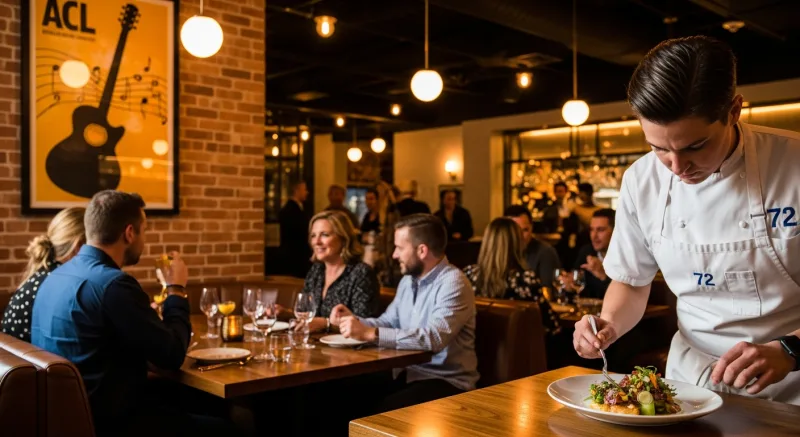
What breaks during these surges is not the food or the staff (though both are stressed). What breaks is the technology. Cloud-based POS systems bog down when transaction volume spikes because every order, every payment, and every modification routes through a remote server. When 50,000 devices in a six-block radius are competing for cellular bandwidth during SXSW, that cloud dependency becomes a bottleneck.
KwickOS processes locally. The transaction happens on the device in front of you at 1-millisecond speed regardless of what the cellular network is doing. For food trucks running off mobile hotspots in festival conditions, this is the difference between processing 60 orders per hour and watching customers walk away because the system is “loading.”
Barbecue Operations and the Pre-Order Kitchen
Austin barbecue is a different operational challenge than any other restaurant format. Brisket requires 12-16 hours of smoking. Pork ribs need 6-8 hours. Sausage links need 3-4 hours. This means the kitchen’s production decisions happen the night before service, based on demand forecasts that can be wildly inaccurate. Underestimate and you sell out at noon, losing afternoon revenue. Overestimate and you waste product that costs $6-8 per pound raw.
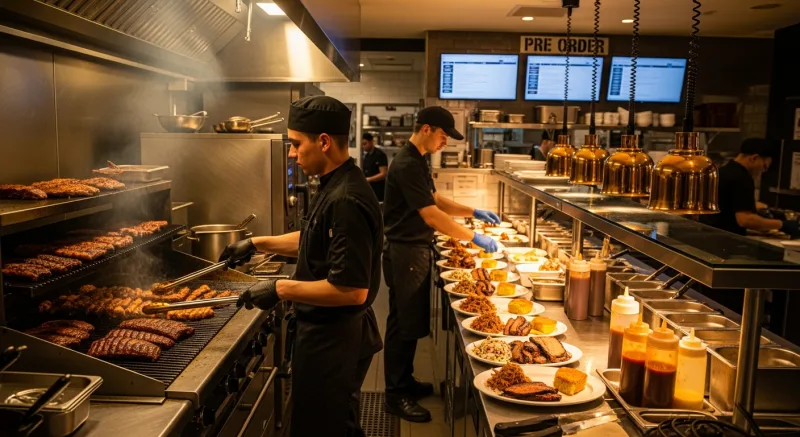
KwickOS’s sales analytics provide the historical data that makes these forecasts accurate. Day-of-week trends, weather correlation, event calendar overlays, and year-over-year comparisons give pit masters the information they need the night before. When KwickOS data shows that the last three Saturdays in March averaged 340 pounds of brisket sold, the pit master loads accordingly rather than guessing.
The kitchen display system also manages the unique flow of barbecue counter service, where customers order at a counter, items are sliced to order by weight, sides are assembled from batch prep, and payment happens at the end of a line — not the beginning. KwickOS KDS stations can be configured for this linear flow rather than the standard ticket-based model that assumes a server submits a complete order to a kitchen.
The East Side Gentrification Technology Gap
East Austin’s transformation from a historically Latino and African American neighborhood into a tech-worker destination has created a restaurant market that straddles two worlds. Legacy taquerias and soul food restaurants that have served the community for decades now operate alongside craft cocktail bars and fusion restaurants charging three times as much for smaller portions. Both types of establishments need technology, but their needs differ dramatically.
A family-owned taqueria on East Cesar Chavez with predominantly Spanish-speaking kitchen staff needs a POS system that operates in Spanish. The same kitchen that has been making handmade tortillas for thirty years should not have to navigate English-only software. KwickOS’s Spanish interface runs natively — not as a translation overlay, but as a fully functional language option where every menu item, every modifier, and every kitchen instruction displays in the language the staff actually uses.
Meanwhile, the new cocktail bar three blocks away needs a system that handles complex modifier trees for craft drinks, integrates with a reservation system, manages a 15-deep cocktail menu with seasonal rotations, and processes payments through a processor that offers better rates than what Toast forces upon them. KwickOS handles both use cases because it is configurable per establishment rather than designed for a single restaurant archetype.
Why T. Jin’s Multi-Location Model Matters for Austin
T. Jin China Diner expanded to 15 stores with 75 terminals by solving a problem that every growing Austin restaurant faces: how to maintain consistency across locations while allowing local flexibility. Each T. Jin location can be monitored in real time from a central dashboard. When the owner wants to know whether the South Lamar location is keeping pace with the Domain location on a Saturday night, that information is one click away — not a phone call to a manager who is too busy to answer.
Austin’s restaurant growth pattern makes this particularly relevant. A successful trailer often becomes a brick-and-mortar. A successful brick-and-mortar often becomes two or three locations. The Domain, Mueller, East Riverside, and South Congress each support their own restaurant ecosystem. Growing from one location to four should not require replacing your entire technology stack. With KwickOS, the same system that ran your food truck scales to a 75-terminal enterprise without migration, without data loss, and without starting over.
Gift Cards and Loyalty in a Transient City
Austin’s population turns over rapidly. The city adds roughly 150 new residents per day, but it also loses residents to housing costs, traffic, and the inevitable cycle of tech-industry relocation. This transience creates a customer acquisition challenge: the brunch regulars you cultivated all spring might move to Denver by fall. Restaurants that do not actively capture customer loyalty lose their base in a rolling cycle of arrivals and departures.
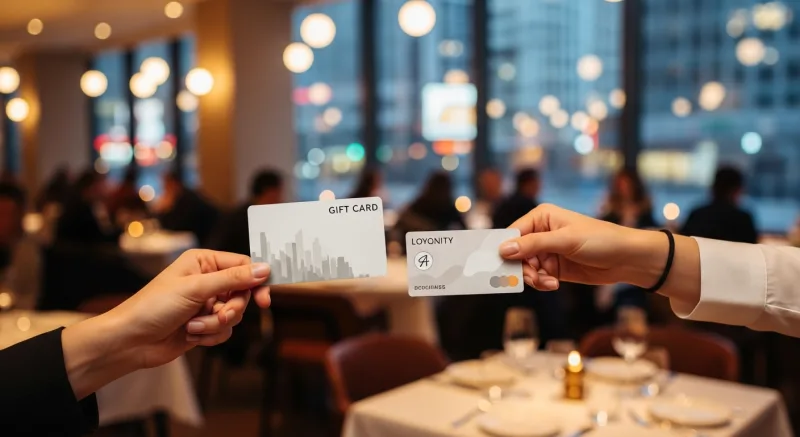
KwickOS integrates gift cards, loyalty points, and membership tiers directly into the POS transaction. A first-time customer who visits during SXSW and buys a $25 gift card becomes a potential repeat visitor. A regular who accumulates loyalty points has an economic reason to keep returning rather than trying the new place that opened last week. These are not separate software products with separate monthly fees. They are built into KwickOS because customer retention is not a premium feature — it is a core business function.
Austin restaurants that rely on Square for loyalty pay $45/month per location for Square Loyalty. Toast’s loyalty add-on starts at $75/month. KwickOS includes loyalty, gift cards, and membership management at no additional cost, because bolting retention tools onto a POS system as an upsell makes as much sense as charging extra for the ability to print receipts.
Fingerprint Security for Austin’s Festival-Season Staffing
During SXSW and ACL, Austin restaurants hire temporary staff at a frantic pace. Servers, bussers, bartenders, and kitchen workers are brought on for one-to-two-week stretches, given minimal training, and expected to perform immediately. This creates an obvious security vulnerability: temporary employees with POS access credentials that they share freely, voids and discounts applied without accountability, and time clock manipulation that is nearly impossible to detect in the chaos of festival operations.
KwickOS fingerprint 1:N identification eliminates this problem. Each temporary employee registers a fingerprint on day one. Every transaction they process, every void they apply, every clock-in and clock-out is biometrically verified. When festival season ends and the temporary staff disperses, there are no lingering PINs or access cards floating around Austin. The fingerprints are deactivated, and the audit trail remains permanently tied to specific individuals.
Toast has no fingerprint capability. It relies on 4-digit PINs that temporary staff share within hours of receiving them. In a festival environment where a restaurant might add 15 temporary workers for a two-week period, PIN-based security is effectively no security at all.
Online Ordering for Austin’s Work-from-Home Economy
Austin’s tech industry created a massive work-from-home population that transformed the city’s lunch economy. When half your potential customer base works from home in neighborhoods like Travis Heights, Crestview, and Windsor Park, they are not walking to your restaurant for lunch. They are ordering online. The question is whether they order through your website or through DoorDash.
KwickMenu, integrated with KwickOS, creates a branded online ordering experience through the restaurant’s own domain. Orders flow directly into the POS and KDS. No third-party commission. No competing restaurants displayed alongside yours. When an Austin tech worker orders lunch from their home office, they order from you — and the order arrives without a 25% commission extracted by a delivery platform.
Combined with KwickDriver’s flat $2-per-delivery fee, an Austin restaurant offering direct online ordering with its own delivery logistics keeps the vast majority of revenue that DoorDash and UberEats would otherwise claim. On a $25 lunch order, the restaurant keeps $23 through KwickOS versus $17.50-$20 through third-party platforms.
The Rainey Street Question
Rainey Street’s converted bungalow bars represent a uniquely Austin challenge: historic structures with limited electrical infrastructure, minimal kitchen space, and outdoor service areas that generate the majority of revenue. Running POS hardware in a converted 1920s house with 60-amp electrical service requires technology that is power-efficient, heat-resistant, and capable of operating on a Wi-Fi network shared with 200 customers streaming Instagram stories.
KwickOS runs on standard tablets consuming minimal power, processes transactions locally without depending on Wi-Fi bandwidth, and displays kitchen orders on screens that draw less power than a single incandescent light bulb. For Rainey Street establishments where adding a dedicated circuit for POS hardware means tearing into a historically designated structure, this efficiency matters practically and financially.
Austin’s POS Decision Framework
Austin’s restaurant landscape rewards operators who think independently about technology, just as they think independently about food. The city’s culture of creative, owner-operated establishments deserves a POS ecosystem that respects that independence rather than extracting value from it. Before signing any POS contract, Austin operators should verify:
- Processor independence — Festival-season volume creates negotiating leverage; use it
- Local transaction processing — Cellular congestion during SXSW and ACL will test cloud systems to failure
- Hardware flexibility — Food trucks, converted houses, and traditional restaurants all need different form factors
- Spanish-language native support — East Austin’s kitchen workforce operates in Spanish
- Scalability from truck to multi-location — Austin growth patterns demand technology that grows with you
- Integrated loyalty without add-on fees — Customer transience makes retention tools essential, not optional
- Fingerprint identification — Temporary festival staff and high turnover demand biometric accountability
- Direct online ordering with flat-rate delivery — Keep the margin that platforms would otherwise take
Austin keeps things weird because weird works. But your POS system should not be weird. It should be reliable, flexible, and designed to protect your margins rather than someone else’s revenue model.
Austin restaurant and food truck operators: Call (888) 355-6996 or visit KwickOS.com to schedule a demo that fits your format — whether it runs on wheels or a foundation.

Founder & CIO of KwickOS · 30 Years IT · 20 Years Restaurant Industry
Tom built KwickOS after running restaurants and IT companies for decades. He relocated the company to a 10,000 sq ft office in 2023 and now serves 5,000+ businesses across all 50 states, processing over $2M in daily sales.