Nail salons have unique operational requirements that neither restaurant POS systems nor beauty booking platforms fully address. The walk-in culture means 40-60% of clients arrive without appointments — requiring real-time queue management, not scheduled booking. The commission structure involves different rates for different services, retail product bonuses, tip handling, and multi-technician split services (one person does the manicure, another does the nail art). The high employee turnover (35-40% annually) means the system must be simple enough for a new technician to learn in minutes. And the multi-location expansion path (successful nail salons typically open a second location within 2 years) requires technology that scales without multiplication of complexity.
A POS handles checkout. A booking app handles appointments. A commission tracker handles pay calculations. A loyalty app handles rewards. A scheduling tool handles shifts. Five separate tools, five monthly bills, five logins — and none of them share data. The client's visit history lives in one system, their loyalty points in another, their service preferences in a third, and their commission attribution in a fourth. The owner who wants a complete picture of their business has to mentally merge five partial pictures. An operating system provides the complete picture in one dashboard.
The Nail Salon Technology Gap
The nail salon industry is underserved by technology vendors. Restaurant POS companies (Toast, Square, Clover) do not understand commission structures, walk-in queues, or beauty-specific service workflows. Beauty booking platforms (Vagaro, Booksy, GlossGenius) have weak POS functionality and no inventory depth. Neither category offers fingerprint authentication, hybrid offline operation, or processor-agnostic payment processing.
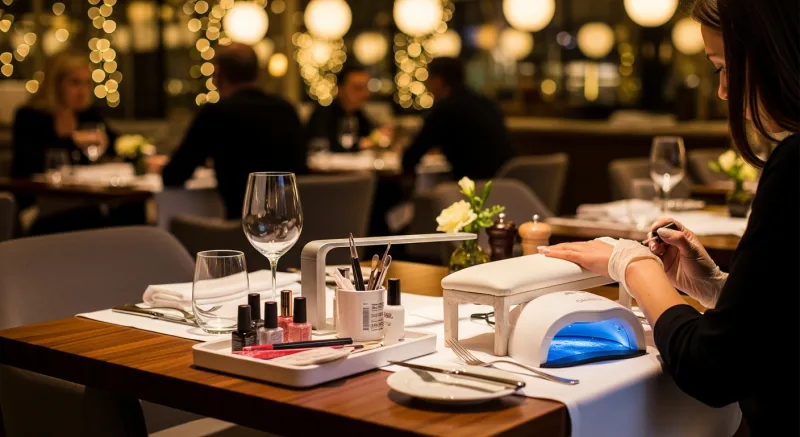
This gap forces nail salon owners into a difficult choice: use a restaurant POS and manually handle commissions and bookings, or use a beauty platform and deal with limited POS features and locked-in payment processing. An operating system eliminates the choice by providing both capabilities natively.
What a Nail Salon OS Includes
1. Walk-In Queue Management
Unlike hair salons (predominantly appointment-based), nail salons handle a mix of walk-ins and appointments. The OS manages both in one view: scheduled appointments appear with client name, requested service, and preferred technician. Walk-ins enter the queue with an estimated wait time that updates in real time based on current service duration and available technicians.
The queue can display on a customer-facing screen in the waiting area, showing position and estimated wait — reducing "how much longer?" questions and improving the client experience during waits.
2. Automated Commission Tracking
This is the core Diva Nail Beauty story. Commission structures in nail salons typically involve:
- 40-60% commission on services (varying by technician seniority)
- 10-20% commission on retail product sales
- 100% of tips to the performing technician
- Split service handling (manicure by one tech, pedicure by another on the same visit)
- Promotional adjustments (loyalty redemptions, discounts, gift card payments)
Calculating this manually for 8-12 technicians across 30-50 clients per day creates a daily reconciliation nightmare. KwickOS automates every calculation: when a client checks out, the system automatically attributes the service revenue to the performing technician, calculates the commission at their rate, allocates the tip, deducts any promotional adjustments from the salon's share (not the technician's), and updates the running payroll total. End-of-pay-period reports generate with one click.
3. Multi-Location Consistency
Diva Nail Beauty's 4-location operation demonstrates the multi-store advantage. Service menus, pricing, loyalty programs, and commission structures are managed centrally. A price change or new service offering propagates to all locations instantly. A client who enrolls in loyalty at Store A can redeem at Store B. A technician who transfers between locations maintains their commission history.
4. Loyalty With Service Memory
As detailed in our nail salon loyalty guide, the OS advantage is that loyalty data is part of the client's unified profile. When a returning client checks in, the front desk sees their preferred services, favorite technician, loyalty point balance, and last visit date — all on one screen. The technician sees the client's service history, preferred nail shapes, and any notes from previous visits.
5. Fingerprint Authentication
Nail salons with cash handling and tip processing need accountability. Fingerprint authentication ensures that each technician can only process their own transactions. Voids and discounts require manager fingerprint authorization. Cash drawer access is logged by biometric identity. This eliminates the $4,800/year average cost of buddy punching and the unquantifiable cost of unauthorized discounts.
6. Gift Card and Retail POS
Nail salons sell gift cards (their highest-margin "product") and retail items (nail care products, cuticle oils, hand creams). The OS handles both alongside services in a single checkout flow. Gift card balances are tracked across all locations. Retail inventory is updated in real time. No separate retail POS or gift card system needed.
Why Hybrid Cloud Matters for Nail Salons
Nail salons in strip malls and shopping centers frequently experience internet outages — shared commercial internet is less reliable than dedicated business lines. Cloud-only systems go down when the internet goes down, leaving the front desk unable to check in clients, view the queue, or process payments.
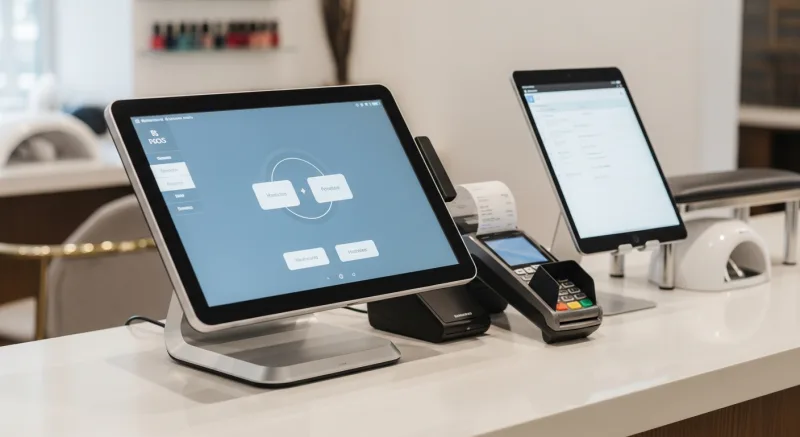
KwickOS's hybrid local+cloud architecture keeps everything running locally. Walk-in queue, appointments, checkout, loyalty lookups, and commission calculations all function without internet. Clients are served without interruption, and data syncs when connectivity returns.
Processor Freedom for Salon Margins
Nail salon transactions cluster around $35-80 per service. At 40-60 transactions per day, processing fees are a significant expense. Square locks nail salons into 2.6% + $0.10 per transaction. On $2,500/day in card sales, that is $75/day = $2,250/month. With KwickOS and a competitive processor at 2.2% + $0.08, the same volume costs $63/day = $1,890/month. The $360/month savings ($4,320/year) funds the entire loyalty program reward budget with money left over.
Cost Comparison
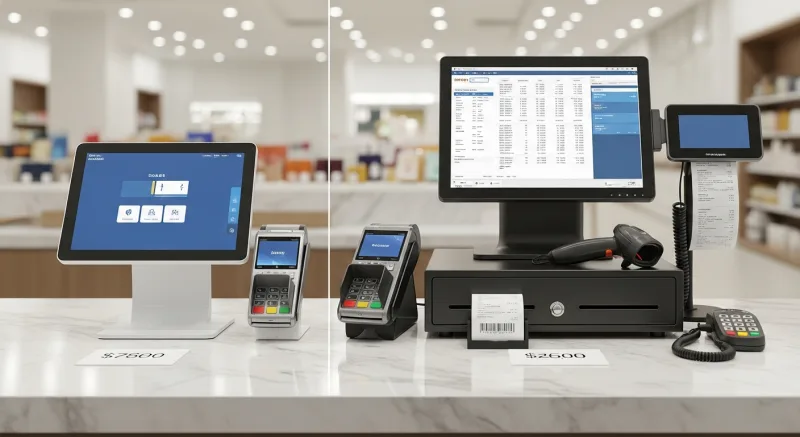
| System | Separate Tools | KwickOS |
|---|---|---|
| POS | $30-79/month | All included |
| Booking/Queue | $30-90/month | |
| Loyalty | $30-75/month | |
| Commission Tracking | $20-50/month (or 15+ hrs manual labor) | |
| Scheduling | $20-40/month | |
| Total | $130-334/month | One unified price |
Implementation: 7-Day Nail Salon OS Launch
Day 1-2: Installation, service menu setup, and technician enrollment. Each technician's commission structure is configured individually. Fingerprint enrollment takes 30 seconds per person.
Day 3-4: Staff training. Front desk learns queue management and checkout. Technicians learn service completion workflow. Owner learns commission reports and dashboard. Total training: 1-2 hours per role.
Day 5: Activate loyalty program and gift cards. Set up walk-in queue display for the waiting area.
Day 6-7: Full operation. Monitor commission calculations for accuracy against the first week of manual checks. Once verified, decommission all legacy systems.
By day 30, commission calculation should be fully automated (zero manual hours), loyalty enrollment should cover 40%+ of clients, and the owner should be reviewing a single dashboard instead of 5 separate reports.
Get the 90% Efficiency Increase Diva Nail Beauty Achieved
KwickOS combines POS, queue management, commission tracking, loyalty, and scheduling for nail salons. One platform, one price, zero manual commission spreadsheets.
Book Your Free Demo