Quick-service restaurants face the most intense loyalty competition in the food industry. The average American lives within 5 minutes of 20+ QSR options. Switching costs are zero — there is no reservation, no relationship with a server, no menu learning curve. The customer pulls into whichever drive-through is most convenient, unless they have a loyalty incentive pulling them to a specific one. That loyalty incentive is now table stakes for the chains. For independent QSRs, it is the most critical technology investment you can make in 2026.
The economics of QSR loyalty are unique because of volume. A QSR doing 400 transactions per day with a $12 average ticket generates $1,752,000 annually. A 25% enrollment rate with a 20% frequency increase generates $87,600 in incremental revenue. The reward cost at 5% of incremental is $4,380. Even at Toast's $75/month loyalty fee ($900/year), the ROI is 96:1. At KwickOS's $0/month, it is infinite.
QSR Loyalty Requirements: Speed, Speed, Speed
3-second enrollment. The QSR drive-through window interaction averages 180-240 seconds. Loyalty enrollment cannot add more than 3 seconds. Phone number entry is the only viable method — no apps, no email addresses, no forms.
Kiosk-integrated enrollment. Self-ordering kiosks are the ideal QSR loyalty enrollment point. The customer is already interacting with a screen, entering their order, and paying. Adding a "Enter your phone number to earn points" step takes 4 seconds and converts at 50-60% — double the rate of staff-driven enrollment.
Order-ahead integration. QSR mobile ordering is growing 25% annually. Loyalty points must be earned identically on in-store, drive-through, kiosk, and mobile orders. Any disparity creates confusion and undermines the program.
Low-ticket calibration. At a $12 average ticket, the points system must deliver meaningful rewards quickly. Customers will not engage with a program that requires 15 visits for a free side. Five to seven visits for a meaningful reward is the QSR sweet spot.
5 QSR Loyalty Models That Compete With the Chains
1. Points-Per-Dollar (Chain-Beating Speed)
Configure 10 points per dollar on every order. At $12 average ticket, each visit earns 120 points. Redemption thresholds designed to beat chain timing:
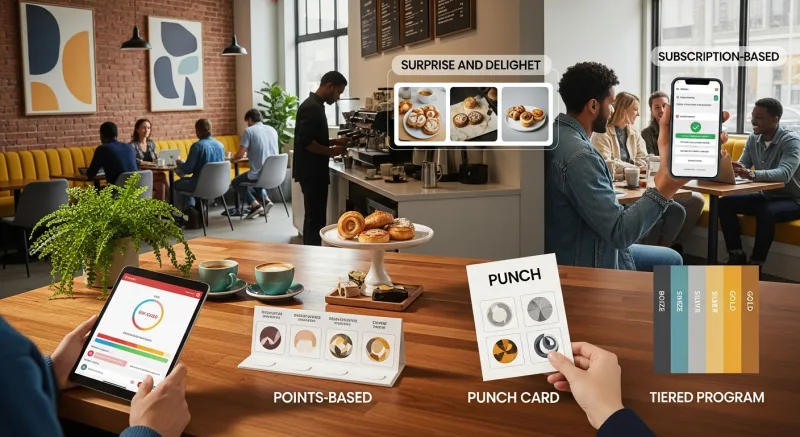
- 250 points = free side or drink (2 visits — faster than any chain)
- 500 points = free combo item upgrade (4 visits)
- 750 points = free entree (6 visits)
- 1,500 points = free meal for two (12 visits)
McDonald's requires roughly 6-7 visits for a free McChicken or fries. Your program rewards a free side after 2 visits and a free entree after 6. Market this aggressively: "Earn rewards twice as fast as the Golden Arches."
2. Kiosk-First Enrollment and Ordering
Rockin' Rolls Sushi Express operates 3 stores with 49 iPad self-ordering stations powered by KwickOS. Their kiosk-based model demonstrates the QSR loyalty-kiosk flywheel: customers order at the kiosk, enter their phone number for loyalty, and the system remembers their favorite orders for one-tap reordering on future visits.
The results: 65% loyalty enrollment rate (versus 25% for counter enrollment), 22% higher average ticket (kiosk upsell prompts + loyalty point motivation), and 30% reduction in serving time through KDS integration. The loyalty data feeds back into the kiosk to power personalized recommendations: "Welcome back! Last time you ordered the Spicy Tuna Roll Combo. Want to add it again? You'll earn 140 points toward a free meal."
3. Combo Bonus Points
QSR margins are highest on combo meals because the perceived value exceeds the actual cost. Incentivize combos through loyalty: 1.5x points on any combo order, 1x on a la carte. A $12 combo earns 180 points instead of 120, reaching the free side reward after just 1.4 visits instead of 2. This drives combo attachment rates — which most QSRs want to increase — using loyalty as the mechanism.
4. Daypart and Channel Multipliers
Most QSRs have dead periods (typically 2-4 PM and after 8 PM). Use loyalty multipliers to fill them:
- 2-4 PM: 3x points ("Afternoon Triple Points")
- After 8 PM: 2x points ("Late Night Double")
- Mobile orders: 1.5x points (drives direct ordering, reduces DoorDash dependency)
- First visit of the week: 50 bonus points ("Start your week at [restaurant name]")
5. Family Meal Subscription
The family market is QSR gold. A weekly family meal subscription — $39/month for a family combo (4 entrees + 4 sides + drinks) every week — locks in $468/year per family and guarantees weekly traffic. The retail value of 4 weekly family combos is $200+/month. The family saves 80%, and the QSR fills tables during a predictable time slot.
Software Comparison for QSR
| Platform | Loyalty Cost | Kiosk Support | KDS Integration |
|---|---|---|---|
| Toast | $75/month | Toast Kiosk (extra) | Toast KDS (extra) |
| Square | $45/month | Square Kiosk | Square KDS |
| KwickOS | $0 (built-in) | Native kiosk mode | Built-in KDS |
KwickOS bundles everything a QSR needs: POS, loyalty, kiosk, KDS, online ordering (KwickMenu), and delivery (KwickDriver). Toast charges separately for each module. A QSR running Toast POS + Toast Loyalty + Toast KDS + Toast TakeOut can easily reach $300+/month in software fees. KwickOS provides the same capabilities as part of the base platform.
Gift Cards in QSR: Small Denominations, Big Volume
QSR gift cards sell in smaller denominations than FSR gift cards, but in much higher volume. The sweet spot: $10, $15, and $25 cards. The $10 card is the bestseller — it is the perfect "thank you" gift, stocking stuffer, or teacher appreciation present. QSR gift card holders overspend by 20-30% beyond the card value because they typically visit multiple times on a single card, adding items on each visit.
Digital e-gift cards are critical for QSR. The target demographic (18-45) expects to send a gift card via text in under 30 seconds. "Send a meal to a friend" should be a prominent option on your online ordering page.
KDS + Loyalty: The QSR Speed Advantage
In a QSR, kitchen speed is everything. KwickOS's built-in KDS displays the customer's name (from loyalty lookup) on the kitchen screen alongside the order. This enables the kitchen to call out the customer's name when the order is ready — a personal touch that chains struggle to execute consistently but that independent QSRs can deliver because their volume is manageable.
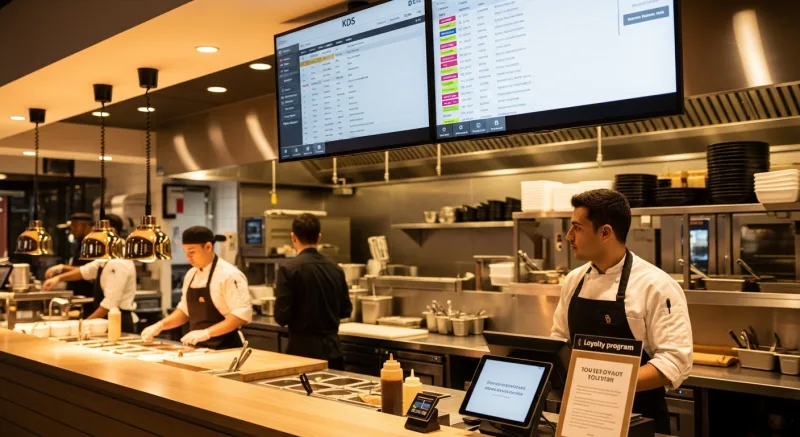
Shogun Japanese Hibachi, running 4 KwickOS terminals, uses customized KDS displays for their hibachi stations. The system was designed to handle complex station routing — and the same KDS flexibility benefits QSRs with multiple prep stations (grill, fryer, assembly, drinks). Loyalty data flows through the entire order lifecycle: from the customer entering their phone number, to the kitchen seeing their name, to the pickup counter calling them personally.
Implementation: 2-Week QSR Loyalty Launch
QSR loyalty launches should be fast. There is no complex configuration — no wine clubs, no stylist assignments, no reservation tiers. It is points, rewards, go.
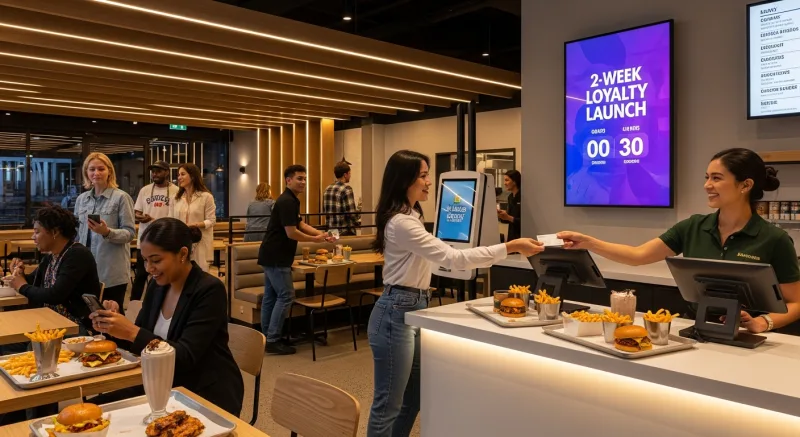
Days 1-3: Configure points, rewards, and multipliers in the POS. If you have kiosks, add the loyalty prompt to the ordering flow. Train staff on the one-line pitch: "Want to earn free food? Phone number?"
Days 4-7: Soft launch. Enroll every customer. Goal: 50+ enrollments per day.
Days 8-14: Full launch. Tray liners and counter cards: "Earn a free [item] in just 2 visits." Drive-through window stickers. Social media announcement. Launch gift cards and birthday rewards.
Month 2: Launch daypart multipliers. Introduce the mobile ordering loyalty integration. Run the first "triple points" event. Begin the family subscription pilot.
Target by day 60: 2,000+ enrolled members, 30% enrollment rate on kiosk orders, 15% enrollment rate on drive-through orders, measurable increase in weekly visit frequency among enrolled customers.
Bring Chain-Level Loyalty to Your Independent QSR
KwickOS includes loyalty, kiosks, KDS, online ordering, and delivery — all built in, all integrated, at a fraction of what chains pay. See how Rockin' Rolls runs 49 self-ordering stations.
Book Your Free Demo